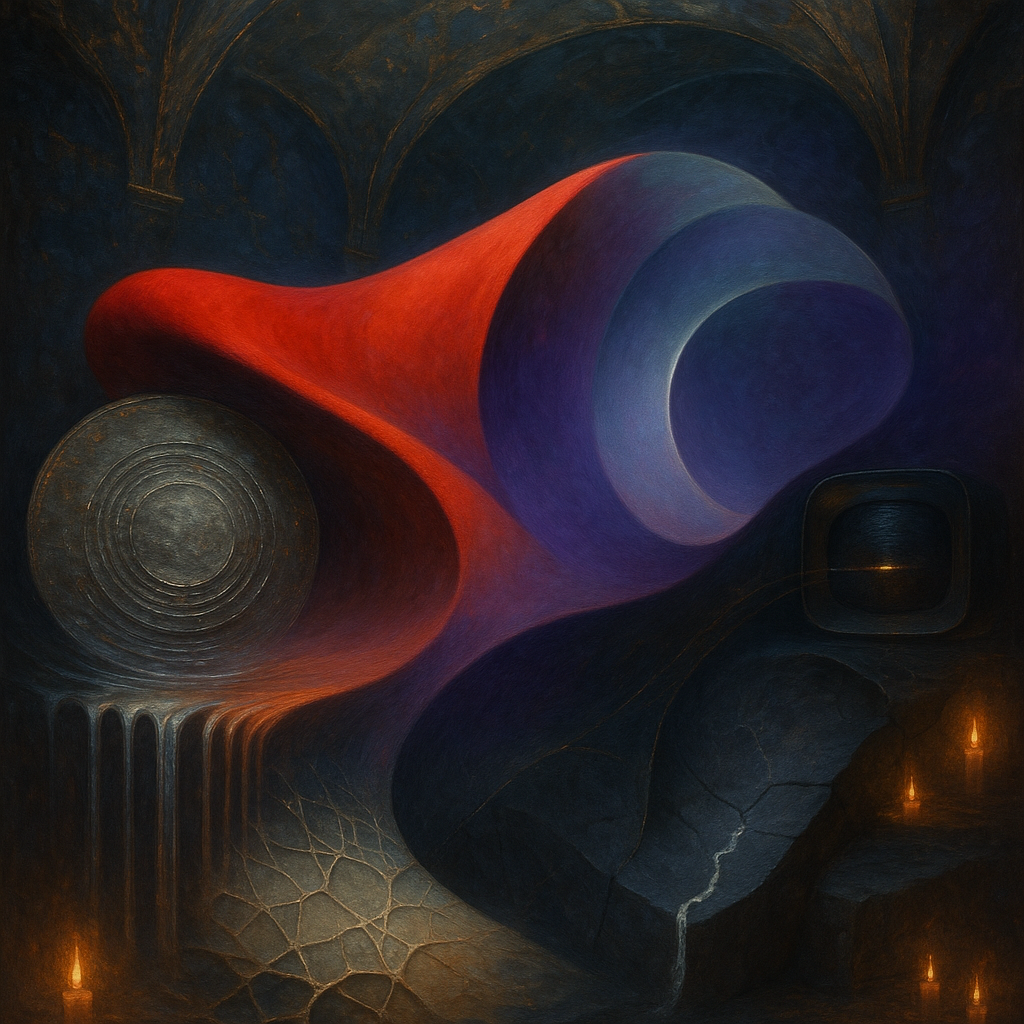
Silver breathes a cool, lunar chill, as if coins were small moons worn smooth by thumbs. Candlelight amber slides over velvet color, carving pockets of warmth into a wide winter hush. Threads pull steady through raw linen, each stitch a heartbeat you can almost hear in the quiet between tremors underfoot. The air tastes like varnish and night frost, with a faint sugar of dust caught in the beam of an opening aperture. Paper edges lift and settle like scales on a sleeping fish, while pixel grains blink awake in a greenish afterglow. Time softens at the corners, folding into itself and slowly dripping from the ledge of the day. Somewhere, a guitar string hums in the throat, and the stars seem to answer in silver pinpricks.
Art signals lean classical-to-modern: silver papal medals surface from Italy’s 18th–19th centuries, while museum spotlights include La Tour’s chiaroscuro Fortune-Teller, a 1779 embroidered sampler, and Matisse’s saturated Odalisque. Online, small exhibitions and collage talk thread through artist posts, with a retro-gaming pulse and steady-hand studio notes. Photography research hubs on Are.na remain active, curating image practices and references. The moon is a waning crescent at about 19% illumination, with short winter day length around 9.9 hours. Solar activity is quiet. Seismic activity is moderate globally, with notable events near the Kurils (M 5.4) and deep Fiji (M 5.1), plus smaller quakes across Alaska, Japan, and California. Coastal gauges show modest tides (e.g., 1.093 m at The
To enhance the initial set of images with more dynamic and visually engaging elements, let's delve into detailed, actionable changes drawing inspiration from movements such as Op Art, Futurism, and Kinetic Art.
### Image 1 Recommendations:
1. **Composition and Forms:**
- Introduce kinetic-inspired elements such as dynamic lines or spirals that suggest movement, particularly around the central red and purple form. Consider adding motion lines extending from the top left to the bottom right at coordinates x: 450-550, y: 100-200.
2. **Color and Texture:**
- Infuse more vibrant, contrasting colors like electric blue or neon green to play against the existing reds and purples, especially in the darker areas around x: 300-400, y: 600-700.
- Employ an Op Art technique by integrating black and white optical patterns within the circles to create visual vibration.
3. **Spatial Dynamics:**
- Add layers or textures with transparency effects, similar to the moiré patterns, which would add depth and create a visual pulsation effect.
### Image 2 Recommendations:
1. **Composition and Forms:**
- Enhance the surreal aspect by incorporating Futurism's characteristic fractured forms. Break the eye into shards or reflections with a prism effect at coordinates x: 200-250, y: 250-300.
2. **Color and Texture:**
- Intensify the rainbow effect below the eye by blending vivid spectral colors, increasing saturation to deepen its impact.
- Create texture on the stone-like elements using a pointillism-inspired technique for more visual complexity.
3. **Spatial Dynamics:**
- Consider adding floating, geometrically-patterned elements—similar to Kinetic Art—at coordinates x: 400-500, y: 500-600 to introduce a sense of changing motion when viewed from different angles.
### Historical and Stylistic Context:
- **Op Art:** Emphasizes optical illusions through strategic color contrasts and patterns, creating perceptions of movement.
- **Futurism:** Focuses