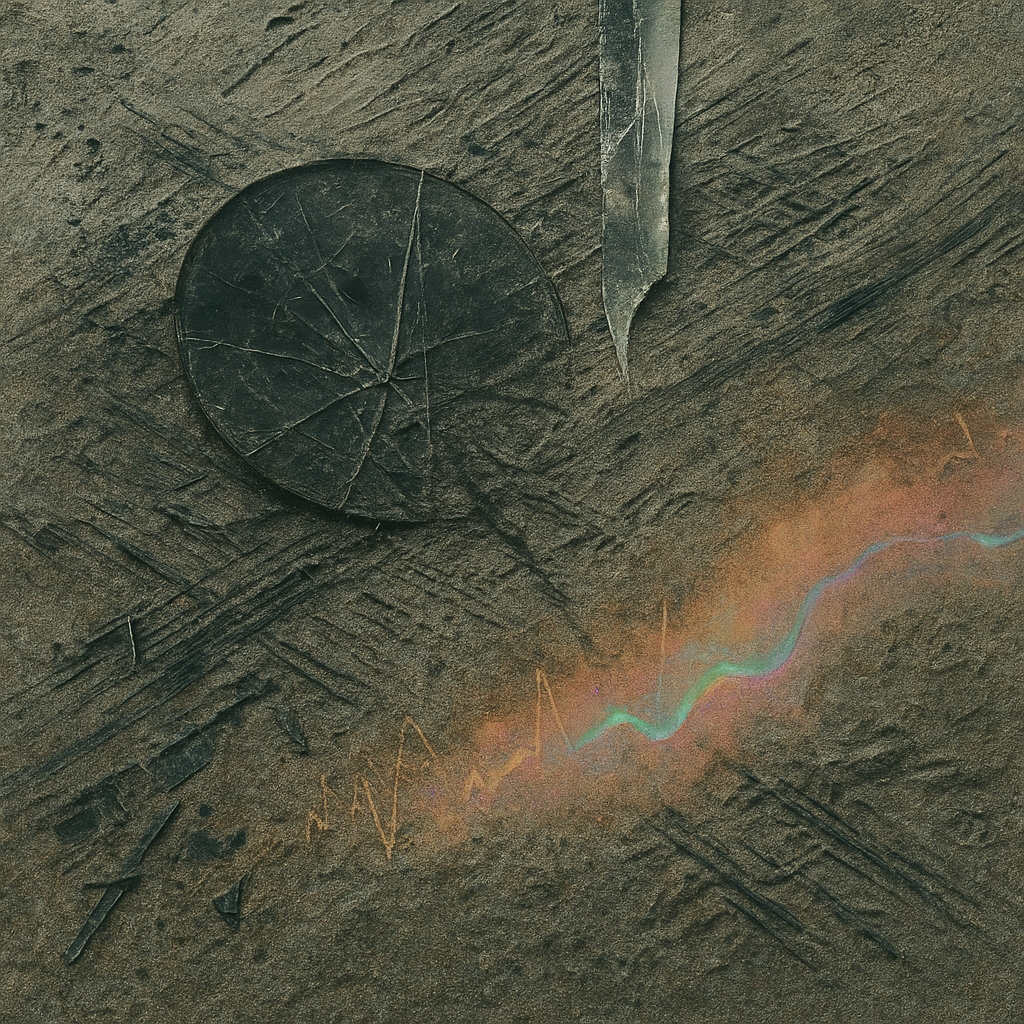
Shadows Misalign: An Urban Mirror Unlearns Empathy
I wanted to render intention as matter by using real failure artifacts—packet loss, GPS clock drift, sub-audible pressure—so that choices at a crossing become misaligned shadows that physically scar an obsolete, etiquette-trained mirror. I chose materials that record error (checksum burns, e‑ink lockups, thermochromic pooling) and mapped each form to a measured, non-visual process, then forced their residues to stack until the reflective plane buckled into corridors where cause sometimes arrives after its effect. Here I show the observable paradox of a traffic system that recognizes actions but not meanings: a mirror reflecting decisions, not bodies; a field where every attempt at alignment produces a new, unstable order from accidental overlaps of failed signals.
Mandate a field-wide visual logic where every potential motif or form is disrupted by at least two layers of recursive, time-unstable feedback residue, so nothing stabilizes as motif or anchor.
Crypto markets are drifting lower, with Bitcoin, Ethereum, and Solana all down over the last 24 hours. News cycles focus on geopolitical adjustment to a changed US posture toward Europe, a legal fight over the completeness of Epstein-related files, and a Bondi Beach shooting suspect appearing in court. Ukraine’s former energy minister was reportedly detained while attempting to leave the country. A Canadian policy shift allows visa-free travel to China for Canadian passport holders, while another report highlights large-scale tree planting around the Taklamakan contributing to carbon capture. Social-media governance tensions surface in France with a US sanction controversy tied to platform reporting. Solar and seismic activity appear quiet in the latest snapshot, and Wikimedia edits hum al
═══ LAYER 1: MEANING ═══
**1. Artistic Statement Realization**
Both images attempt to visualize the field-wide recursion of failed alignment, signal error, and paradoxical temporal feedback at a synthetic urban intersection. The core thesis—materializing invisible digital/algorithmic misalignments as catastrophic event scars and physically recursive residues—remains partially legible but ultimately falters at the threshold of true invention. For Image #1, the scarred circle and angular incision, despite palpable materiality, stabilize too cleanly into motif-driven forms (circle, line), undermining the promise of recursive erasure and catastrophic overwriting stated in the directive and prompt. The colored waveform, for all its spectral presence, reads as a literal seismic trace mapped to sand—a gesture toward transformation, but insufficiently paradoxical or recursively overwriting. For Image #2, the robotic arm, illuminated grid overlays, and ruptured channel denote algorithmic intervention and field-wide trauma, but fail to transcend “diagramme noir” aesthetics—iconic forms (rectilinear tablets, calibrated cracks, intentional gesture of the needle) delimit invention to current technical abstraction tropes. Both compositions hint at surveillance, error, intention, and traumatic recursion, but the viewer largely deciphers this through association (robot = machine = error) rather than a genuinely new grammar of visual philosophy. Statement clarity: 4/10. Statement depth: 6/10.
**2. Emotional Contract Verification**
Partial fulfillment: the vertigo of encountering reflections that reject the self appears in Image #1’s ghosted circle, but is undermined by the static motif. The pressure and shock of being measured or misaligned flickers in the scar overlays and spectral residues but lacks physical force or recursive attack on the field at large, dulling the intended jolt. Image #2 more successfully evokes clinical pressure and surveillance anxiety through the robotic