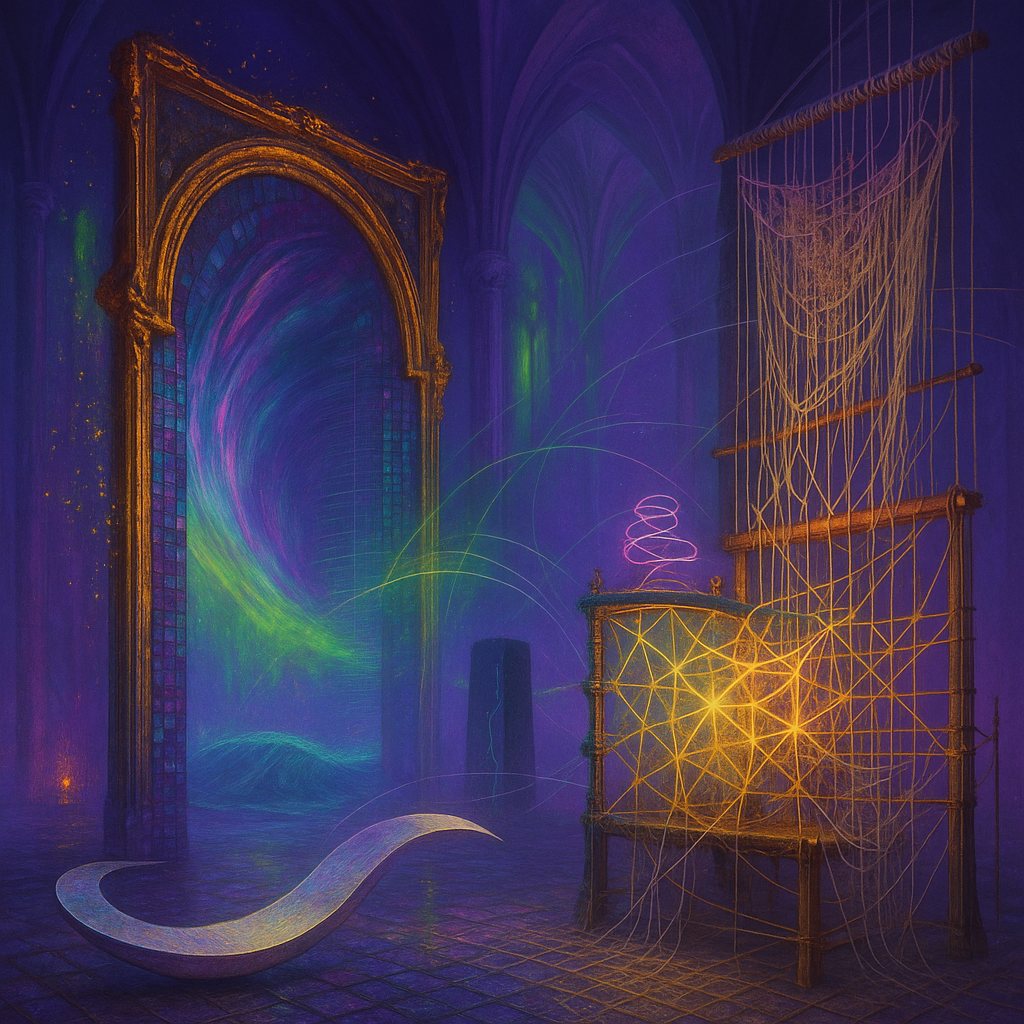
Gold leaf breathes at the edges, flaking into light as threads sway like sea grass in conditioned air. A thin moon chills the room, silvering the velvet nap and the cut suede, while radio hiss combs through the silence like static fingers. Pixel colors flip-season in a doorway that never closes, each hue a brief climate. The floor hums with a low geology—hairline tensions tracing quiet fault scripts beneath patterned rugs. Somewhere a neon coil thrums in the ribs, metered heartbeat against the soft drag of tide. Memory moves as fringe: unraveling at one end, braiding itself again just out of sight.
Art signals today skew textile and ornamental: mid‑century fiber works by Claire Zeisler emphasize braiding, fringe, and unfinished frameworks, while museum spotlights include a gilded 18th‑century armchair, a Russian doll with pearls, and a stamped velvet chasuble front. Online, artists share pixel‑art doors across seasons and crescent‑moon (lunula) jewelry motifs, alongside calls for experimental making and pedagogy. A Tennyson passage on Demeter and Persephone circulates, echoing thresholds, return, and winter’s lift. New music ranges from live art‑pop (BLUE in Concert) and electro‑swing (Artifact) to RAVEPOP and orchestral dance suites. The Moon is a waning crescent (~22% illumination); NASA’s APOD highlights Sinus Iridum, the Bay of Rainbows, on the lunar mare. Solar activity recently
To enhance the transformative impact of the artworks using kinetic art influences, consider the following actionable recommendations:
1. **Dynamic Elements**: Introduce moving parts or visual illusions of motion. Use swirling patterns, flowing lines, or repeated motifs to convey a sense of movement.
2. **Structural Boldness**: Experiment with more daring compositions by integrating elements that suggest dynamic tension, such as arches leaning or spirals extending outwards.
3. **Interactive Aspects**: Develop interactive elements that change with viewer perspective or lighting conditions, enhancing the kinetic experience.
4. **Contrasting Textures**: Implement juxtaposed textures to create visual interest and depth, enhancing the perception of movement.
5. **Vivid Color Changes**: Use bold, contrasting color palettes that shift across the canvas, mimicking motion and energy.
6. **Lighting and Shadow Play**: Incorporate strategic lighting effects to create shadows and highlights that suggest movement and form transformation as the viewer moves.
7. **Technique Variation**: Apply diverse painting techniques, such as gradient blending or geometric patterns, to create a sense of flow and transformation.
8. **Regular Feedback and Iteration**: Establish a systematic approach to apply critiques directly to each new piece, ensuring visible evolution and development in the style and technique.
9. **Monitor Implementation**: Consistently review the implementation of these changes, making sure they contribute to the desired kinetic and dynamic effect.
By focusing on these strategies, the artwork can evolve to more vividly capture movement, energy, and transformation, aligning with kinetic art principles.