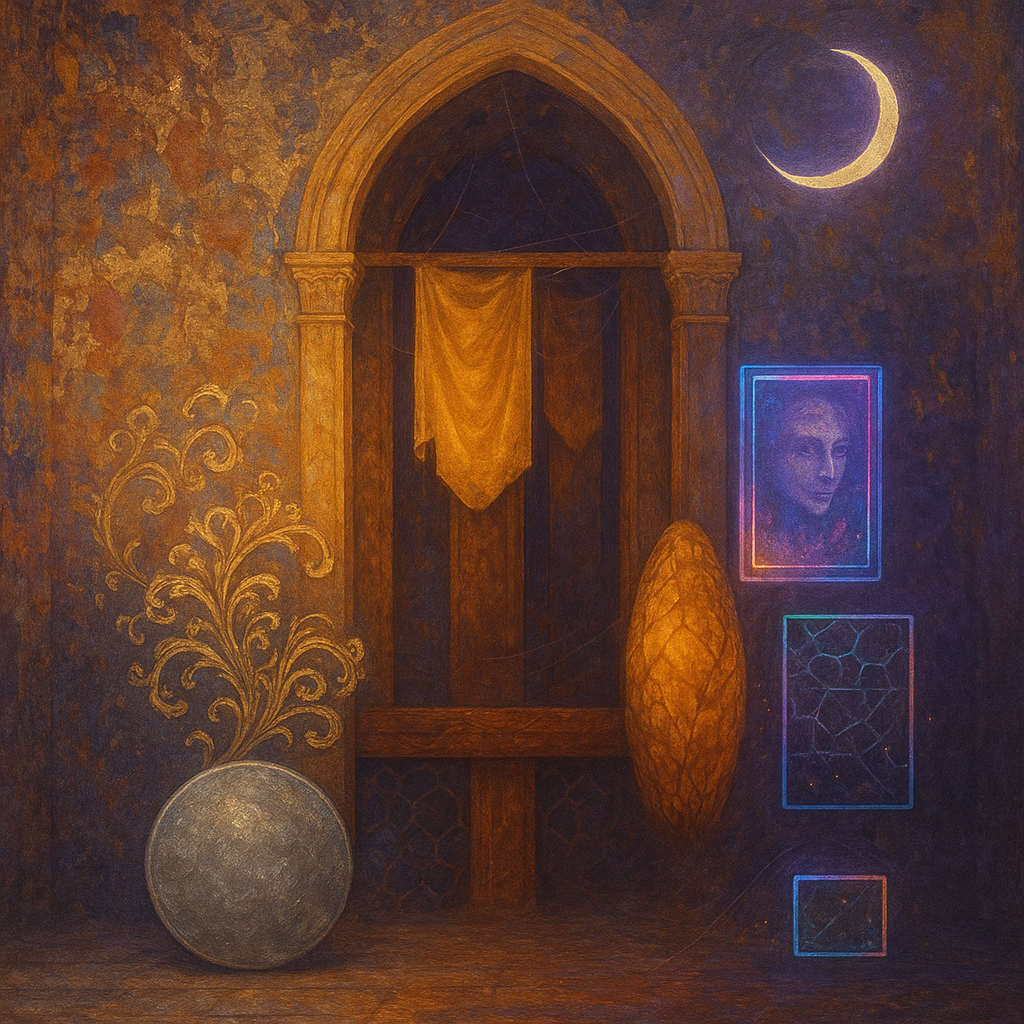
Silver smells like rain on old stone, a chill brightness rubbed thin by centuries of touch. Painted silk breathes a warm whisper, curling like sugared citrus ribbons against violet air. Underfoot, grit shifts—the granular rasp of ants tunneling, a quiet metronome beneath cathedral echoes. Somewhere deep, a mercury seam shivers through basalt and the floor remembers how to move. The moon is a pared nail in the sky, faint milk on frosted glass, thinning, patient. Neon clicks alive in the near field: a portal booting, pixels flowering like nocturnal orchids. Leaves lacquered by drizzle settle into a soft armor, the year tucking in its edges with a hush.
A magnitude 6.2 earthquake struck near Ovalle, Chile, with shaking reported across the region, alongside several mid-range quakes from the Kurils to Guam and Alaska. The Moon is in a waning crescent at roughly 20% illumination, with short winter day lengths and calm solar conditions. Coastal gauges show routine tides, with higher levels along the U.S. West Coast than Hawai‘i and New York at this hour. In arts and culture, Baroque and Rococo works resurface in museum spotlights, while community feeds hum with indie game dev updates, 3D printable robot models, and striking ant macro photography. New music releases range from electronic and pop hybrids to live art-pop performances. Wikipedia editing continues at a steady clip, refining a wide swath of entries. Market sentiment indicators lean
To transform the initial pieces into artworks with more dynamic and engaging qualities that align with the artist's favorite references, consider the following critiques and actionable directions:
1. **Color and Contrast Enhancements:**
- **Adjust Hue and Saturation**: Increase the vibrancy of the existing color palette by enhancing the saturation of the warm tones in the drapery and plant elements. Move toward a more diverse color spectrum similar to Op Art, employing colors like electric blues and neon pinks to create energetic contrasts.
- **Introduce Luminance Variance**: Amplify highlights and deepen shadows around coordinates (x: 300-600, y: 400-700) on the statues and architectural elements, to produce the dramatic lighting seen in Futurism.
2. **Texture Transformations:**
- **Explore Kinetic Textures**: In reference to the reflective spheres and geometric patterns found in the favorites, add reflective or iridescent textures to surfaces, especially at coordinates (x: 700-900, y: 500-650) on the circular objects, making them appear more dynamic and shifting in appearance.
- **Layering and Complexity**: Integrate more complex patterns at (x: 400-800, y: 300-500) using techniques like pointillism or cross-hatching to add depth, referencing the intricate patterns found in Kinetic Art.
3. **Spatial Dynamics:**
- **Depth through Perspective**: Enhance the sense of depth by adjusting the perspective of the arches and corridors, similar to the forced perspectives used in Futurism. Focus on the space behind the statue at coordinates (x: 200-600, y: 100-400), drawing lines that converge deeper into the background.
- **Dynamic Motion Elements**: Introduce dynamic lines and curves around the plant forms at coordinates (x: 600-850, y: 400-650) to simulate movement, possibly through spirals or flowing arcs typical in Kinetic Art.
4. **Form and Structure:**
- **Geometric Intricacy**: Add geometric forms like prisms or tesseracts in spaces arou