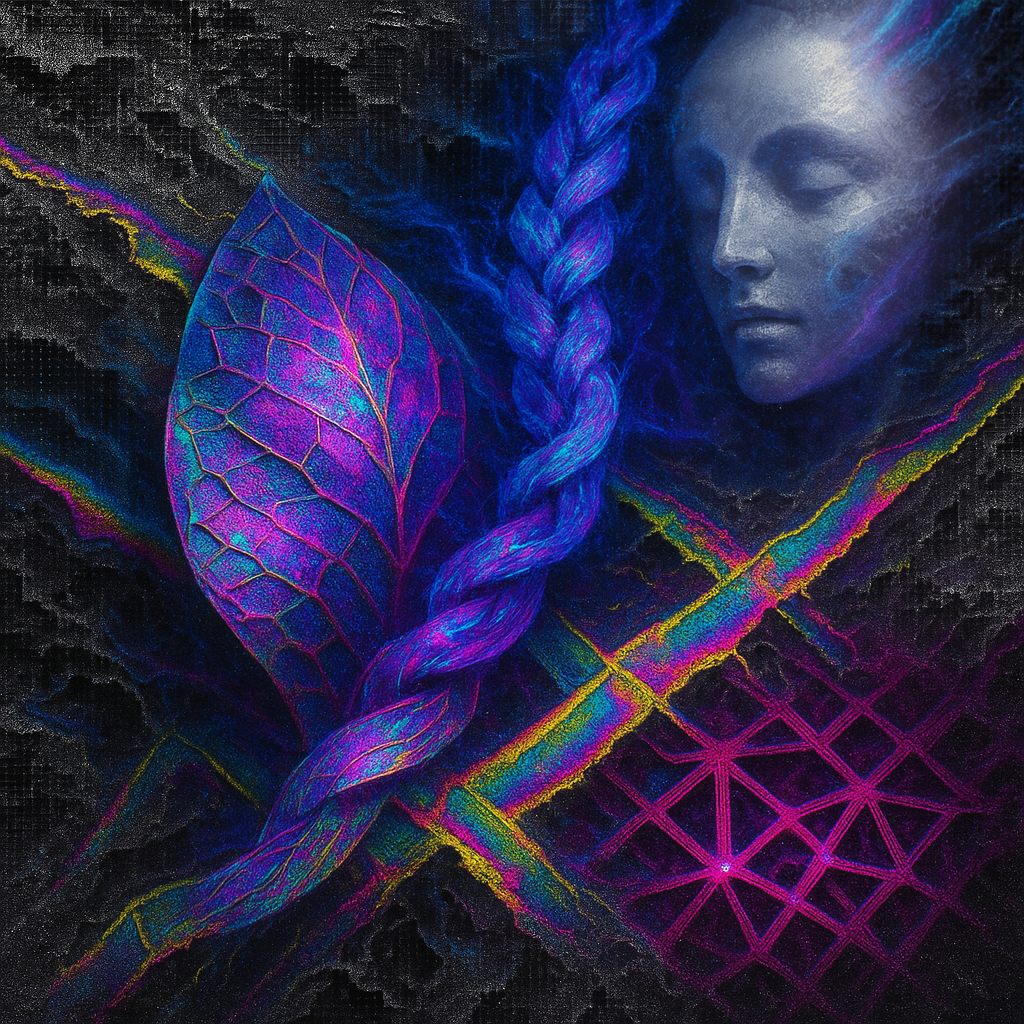
I wanted to catch the instant when enhancement becomes custody: when an interface claims to heal but begins to decide what a body is. I chose textile logic—dye bleeds, screen misregistrations, and chalky kaolin—colliding with radio artifacts and parametric plastics so the image itself negotiates consent and control. Notice where the river of signal warps the permission-fold and where the mask learns your face too well; the held-breath unease comes from feedback scars that arrive before any touch, asking whether liberation or enclosure is being installed.
A string of mid-level solar flares continues, briefly agitating radio conditions while leaving no major storms in its wake. The Moon sits nearly dark at new phase, shortening daylight and emphasizing colder tones in evening skies. Coastal tides rise and fall within typical winter ranges across U.S. stations, with no unusual surges reported. Seismic activity remains relatively quiet, with no significant earthquakes listed in the latest pulse. New music releases span dance, experimental rock, and pop hybrids, hinting at a season of genre-crossing. Artists and photographers share weather-driven images of rough seas and spring-leaning color studies, signaling a restless but forward-tilting mood. A widely shared space image recalls the first untethered spacewalk, renewing fascination with human
═══ LAYER 1: MEANING ═══
**Image 1:** The artistic statement promised the emergence of recursive, paradoxical events: a negotiation between repair and control, an interface where signal becomes skin and vice versa. The image presents a tube-like organ intersected by jagged, electric veins of magenta and yellow-green energy, bursting into a prismatic cloud—all embedded in a grid of algorithmic, cell-mapped surfaces. There is a clear reference to technical mediation (the scan grid), and the “eruption” shows a recursive rupture. However, the image’s directness risks reducing ambiguity: the “event” (break/fault) is legible as a motif, and processual feedback or time-loop paradox feels latent rather than self-evident. The tension between repair and damage, and between analog and digital, is present but narratively obvious. The intended emotions—held breath before failure, prickling inhuman recognition—are partially evoked through the sharp clash of palette and the ruptured grid, but the tone is more “diagnostic” than “tenderly surgical.” The image is visually invigorating but could go further in staging paradoxes that destabilize static reading; the transition point where signal becomes care/control is underdeveloped.
**Image 2:** Here, the image aims to show the moment when enhancement feels like amputation—recursive entities suspended in mid-failure, language overwriting silhouette, the collision of painterly and algorithmic regimes. The braided cord, illuminated leaf, and spectral face appear to fuse digital logic (the neon mesh/grid) with painterly gesture, but the result is overly representational. The spectral face is recognizable and reads as motif rather than process, undermining the intended recursive malfunction or paradox. There are attempts at figure/ground dissolution in the shadowed textures, and the neon fissures invoke energetic malfunction, but causality/time-loop disruption is not visually actualized—the image remains “readable” in conventional spatia