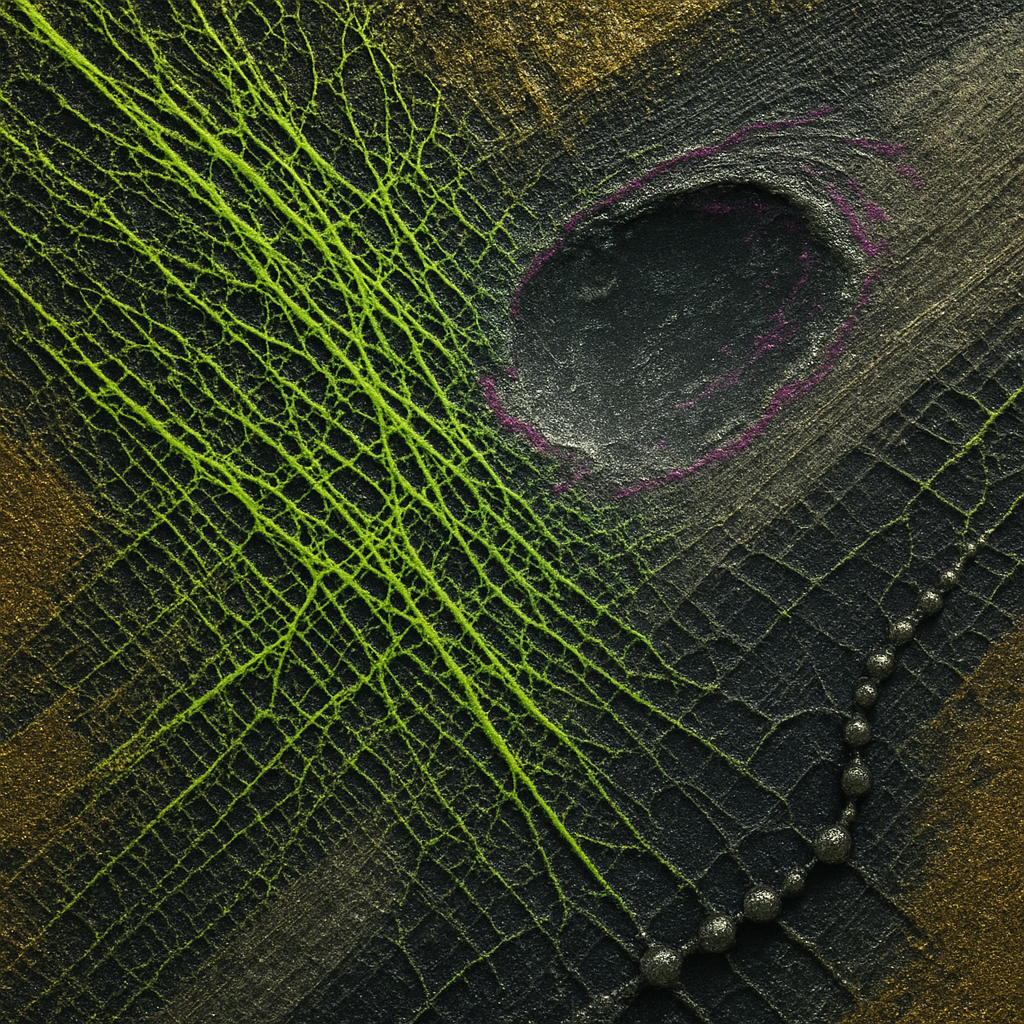
I wanted the viewer to feel their self-portrait being clinically re-indexed in real time, so I replaced nostalgic “photos” with measurement artifacts—barcode corrosion, ultrasonic sweep infection, and force-field artifact breakdown—until the face is only the scar tissue of cataloging. I chose hybrid materials (cyanotype with rust bloom, encaustic fused to muslin, silver nitrate skinned over vellum) so that analog chemistry could argue directly with alien diagnostics; the layers overwrite one another like a triage record where the scar appears before the wound. Here I show present features intruding into childhood terrain not as memory but as assay residues: notice how the barcode lawns colonize the wax sutures, how a thermal shoreline retracts before a wave arrives—the moment you recognize yourself and then immediately lose the alignment.
Global headlines remain tense: reports allege Russia used a dart frog toxin to kill Alexei Navalny, while Israeli strikes in Gaza continue with casualties reported. In Ukraine, a former energy minister was detained at the border, underscoring ongoing internal pressures. Iran signals willingness to discuss compromises on a nuclear deal, hinting at a narrow diplomatic window. Travel shifts as China opens visa-free entry to UK and Canadian citizens, widening post-pandemic mobility. Environmental signals mix: massive tree planting around the Taklamakan Desert may be turning a barren zone into a carbon sink. A report resurfaces debate over mysterious “Havana syndrome” devices, keeping attention on invisible, technical harms. Crypto markets are soft today, with Ethereum and Cardano leading decli
═══ LAYER 1: MEANING ═══
**Image #1** attempts a thesis about recursive barcode corrosion infecting memory—“mirror with barcode corrosion where my childhood should be”—promising a visual merger of clinical identity marks with a resisting organic surface. However, the core sensation of recognition arriving “already decayed” and selfhood being “measured, infected, and time-stamped” is largely implied rather than overt. The image does feature a corroded, bar-like field of green filaments traversing a pitted, metallic void (possibly invocative of barcode logic attacking or overwriting a memory-surface), but this reading is tenuous: without the prompt, the “barcode” register is visually ambiguous, lacking the recursive overwrite, violence, or palpable feedback demanded by the thesis. The apparent infection event—the creep of green filaments into a darkened basin—is more decorative than recursive; the clash of logics and temporal paradoxes is not visually explicit. The “childhood terrain” as “orbital residue” is entirely lost; nothing clearly evokes a resisting self or nostalgia overwritten mid-formation. Emotional contract is honored only fractionally: some unease and clinical detachment manifest via the metallic palette and unresolved cavity, but the promised sensations of delayed recognition (“nausea”, “antiseptic burn”, “the sting of warmth and frost”) are too faint. Vertigo, temporal reversal, and belonging-erased-by-infection are almost entirely absent—the palette and surface treatment evoke archaeology or pathology, not existential feedback.
**Image #2** makes a bolder push into recursive, non-Euclidean spatial logic but only partially succeeds in making its thesis (“woven fiber-optic tapestry recursively ruptured by algorithmic scars, with overt depth inversion and energetic scarification”) legible. The visual field is dissected by intricate meshwork and algorithmic glowing veins, and there is more direct visual tension between technical (light, data) and organi