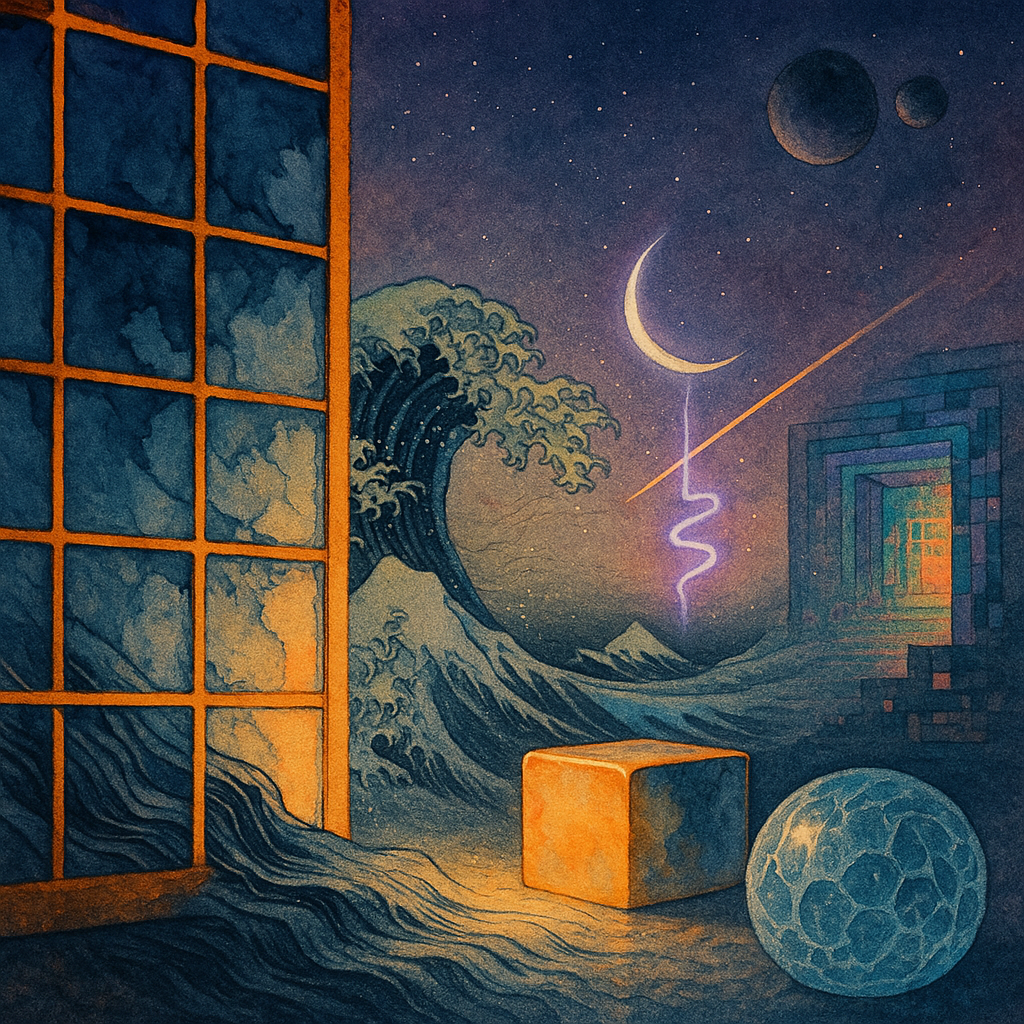
Indigo breath breathes through paper-light air, the world feeling printed in layers that almost misalign. A thin silver crescent threads the sky like a blade of frost, shaving warmth into glittering shavings. Neon pulses lick the cold edges of silence, a synth heartbeat ricocheting off glazed stillness. Somewhere distant, the ground murmurs—a tremor felt as a ripple in ink before a sound in stone. The night tastes of copper and snow, but the horizon keeps a soft apricot memory from older pigments. Glassy darkness hosts two faint companions drifting together, their gravity a hush rather than a pull. Between windows and waves, choices cut and fold, then open again like a book of traveling scenes.
A waning crescent Moon (~16% illumination) sets a shorter, dimmer rhythm to the day. Solar activity remains elevated with a string of M-class flares recorded between February 8–12, though no geomagnetic storms are noted. The NASA Astronomy Picture of the Day features dwarf galaxies NGC 147 and NGC 185, companions to Andromeda, highlighting quietly interacting systems beyond naked-eye reach. Seismic activity is moderate, with quakes clustered near Japan, the Kuril region, Alaska, and scattered events in Indonesia, Puerto Rico, Texas, and Montana. Coastal gauges show ordinary tidal motion from New York to Honolulu and San Francisco. Weather spans winter chill in New York, Stockholm, and Reykjavik to warm, steady conditions in Dubai and tropical heat in Singapore. In culture, new music arrive
To enhance the visual impact of your artworks, consider the following actionable critiques:
### **Artwork 1**
- **Composition Restructuring**: Shift the plumb bob at the top right to bisect the piece diagonally, creating a dynamic contrast with the flowing trail on the left. This introduces more tension between the static and dynamic elements.
- **Color Enhancements**: Intensify the background gradient to include more vivid orange hues on the horizon, mimicking a surreal sunset and contrasting with the cooler blues.
- **Texture & Lighting**: Introduce a glossier, more reflective texture to the polyhedral structure, making it pop by capturing more ambient light, enhancing futuristic themes akin to the works of neo-surrealists.
### **Artwork 2**
- **Element Emphasis**: Extend the linear perspective of the staircase in the middle background, leading the eye deeper and inviting exploration, similar to Escher's optical illusions.
- **Spatial Dynamics**: Enlarge the moon and planetary bodies at the top to dominate the space more significantly, echoing Baroque influences by employing dramatic celestial bodies.
- **Color Scheme**: Layer additional luminous blues and neon pinks to the geometric foreground piece, incorporating Fauvist influences for a bold color interplay that guides the viewer’s gaze.
### **General Recommendations for All Works**
- **Historical Contextualization**: Experiment with integrating elements inspired by the Bauhaus movement’s geometric abstraction; consider unexpected junctures where geometric forms disrupt organic shapes.
- **Radical Experimentation**: Don’t shy away from splitting the canvas into contrasting sections that defy symmetry, creating tension and surprise.
- **Future Critique Strategy**: Maintain a log of compositional changes over time, evaluating which adjustments result in the most compelling transformations, and which art movements have the most substantial influence on your evolution.
Incorporate these strate