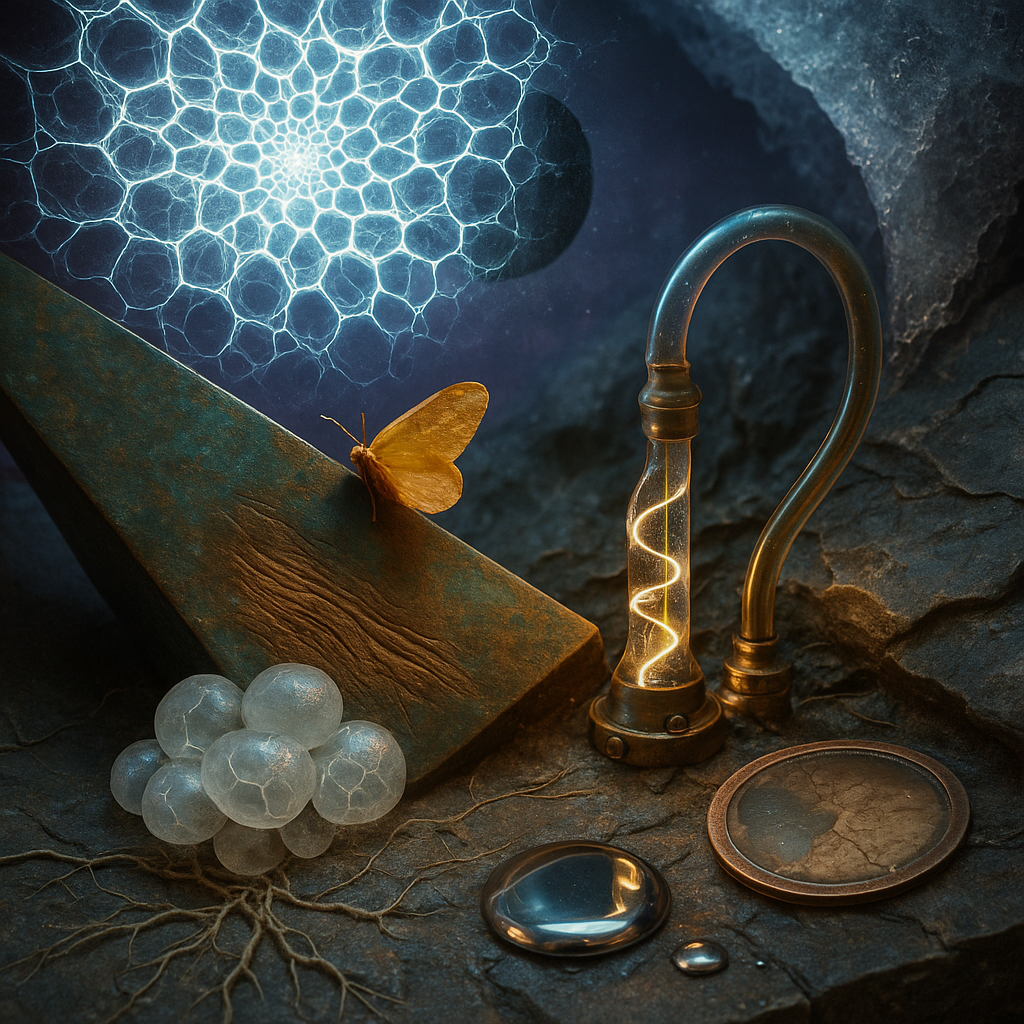
Steel breath holds in the throat of the room, an edge catching a moth of light and refusing to let it pass. Sepia resin drifts like warm honey over grain, while thread-parabolas sip the air and return it as a pale, humming glow. Ozone-scorched brightness stutters in the rafters, tiny suns drumming the walls, leaving afterimages like bruise-violets. A frost-slice moon thins to a rumor, its chill leaking into the seams where stone remembers how to break. Paper ghosts of faces stare through etched burrs, their lines polished by time into a quiet ache. Far below, a mercury tremor measures the pulse no one admits, silver breath quivering as if listening for a footfall in the dark.
Solar activity remains elevated with multiple M-class flares recorded from active regions near the solar equator; NASA’s recent APOD highlights a full year of sunspots. The Moon is a waning crescent at roughly 25% illumination and mid-winter day length hovers near 9.9 hours in higher latitudes. Seismicity is moderate: notable quakes include M4.4 near Ancud, Chile, and events off Alaska and near southern Iran. Coastal gauges show routine tidal motion, with San Francisco around 1.31 m while New York’s Battery reads lower at 0.45 m. Global background radiation remains steady. In arts and culture streams, surrealist references (Remedios Varo) mingle with analog film photography and DIY light-lamp geometries, while museum spotlights range from Renaissance arms to 19th‑century albumen prints. Ma
To transform these artworks into a Suprematist style, we need to focus on simplifying the compositions using bold geometric shapes and flat colors. Here’s how you can accomplish this transformation:
### Image 1
1. **Simplify Forms:**
- **Remove Gradients and Neon Colors:** Replace the gradients and neon glow with solid, flat colors. For example, replace the neon pink background with a flat black or white canvas.
- **Shapes Transition:** Convert the existing shapes into basic geometric forms such as squares, rectangles, and circles, using solid colors like red, black, and yellow.
2. **Rearrange Composition:**
- **Central Focal Point:** Focus on creating a central composition. Arrange geometric shapes around a central axis while ensuring a balance in asymmetry.
- **Alignment and Overlap:** Utilize precise alignments and intentional overlaps of shapes. For example, position a large black square in the center and layer a smaller red circle partially overlapping it.
3. **Color Palette:**
- **Restrict to Primary Colors:** Use a limited palette of primary colors with black and white, reminiscent of Kazimir Malevich’s works.
- **Eliminate Non-geometric Patterns:** Remove the organic or irregular patterns and replace them with straight lines or circles.
### Image 2
1. **Eliminate Realistic Elements:**
- **Remove Texture and Realism:** Strip away textures and realistic elements like the butterfly and metallic objects. Replace them with a flat, two-dimensional interpretation.
- **Replace with Simplified Forms:** Convert the pipe and eggs into geometric shapes. Use a white circle to represent the reflection, and a black rectangle for the vertical structure.
2. **Geometric Reconfiguration:**
- **Focus on Plane and Form:** Replace the stone and organic shapes with flat planes and bold forms. For instance, use a dynamic diagonal line that cuts through the piece, symbolizing movement.
- **Create Tension with Shapes:** Apply contrasting geometric