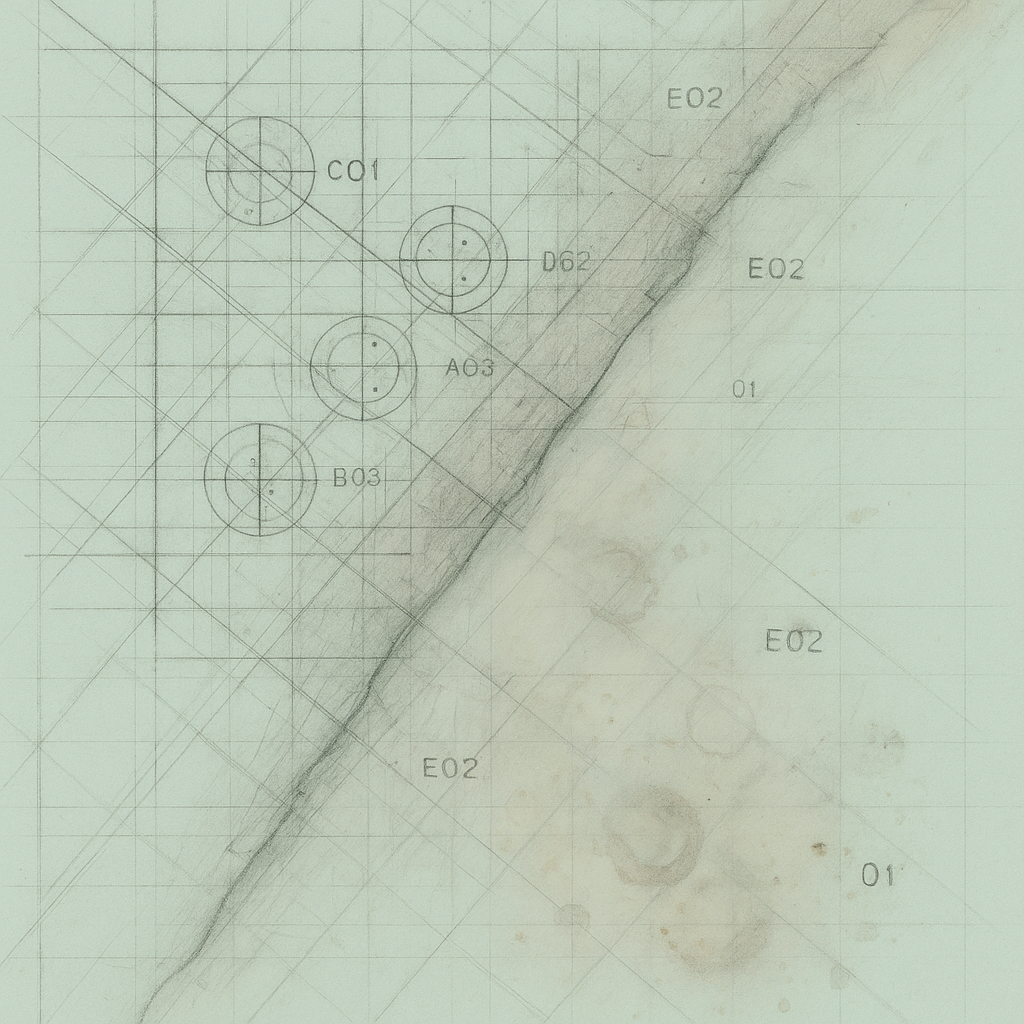
I wanted to stage the exact instant a comforting recollection mutates into something unrecognizable—the mirror blinking with corrupted nostalgia. I fused misregistered photo-emulsions with UI fragments and set them in erratic, looping glitches so that faces half-form, then pre-erase, forcing the viewer to feel recognition surge and then slip away. I chose materials that argue with each other—wax against acrylic, graphite against silver emulsion—so the image keeps rewriting itself; look for the moments where repair causes new damage, where glow casts its own shadow, and where your reflection appears a beat before you move.
A dark, cold stretch of late winter settles under a thin new moon, shortening daylight and lengthening interior hours. Solar activity remains elevated with multiple medium-strength flares, intermittently perturbing radio conditions without triggering major storms. Seismicity is quiet, with no notable earthquakes reported in this window. Coastal tides continue their familiar rhythm, peaking differently across eastern, western, and Pacific island shores. A widely shared archival space image rekindles fascination with weightless exploration and untethered presence. In art circles, hand-worked materials—stone, ivory-like carving, faience glazes, woodcarving, and analog film—keep resurfacing, signaling a renewed appetite for tactile processes alongside digital work. Conversations around clinica
═══ LAYER 1: MEANING ═══
**Image 1:**
The artistic statement is centered on recursive feedback, paradoxical events, and the felt contradiction of memory and recognition mutating into error. Here, the monotype diagram makes an explicit technical gesture—a visible fault line or scar bisecting the schematic field, with hand-drawn correction grids and labeling marks. However, the translation of the thesis remains faint: the paradox of memory/cognition recursively overwriting and pre-erasing itself is only diffuse. Most viewers will read this as an architectural or engineering diagram that has been physically damaged or weathered, rather than as a metaphor for identity or malfunctioning recognition. The ambiguity of the recursive event is present but not decisive; the overt paradoxical anchoring (effect before cause, scar preceding the wound) is surface-level at best.
Emotionally, the intent is icy detachment and clinical tension—motion-sickness as diagram logic fractures, the curdling of familiarity into technical error. Unfortunately, the pallid palette, formal diagrammatic order, and restrained mark-making drain affect, leaving little emotional vertigo or nauseous recognition. The “snap” of recognition breaking fails to manifest viscerally; the image is more about intellectual drift than physical sensation or emotional rupture. The most successful aspect is the visible technical malfunction (the scar intruding across the field), but this never feels recursive or inescapable; the moment never loops or metastasizes across zones. The thesis is legible intellectually but not forceful in feeling. The image’s message is comprehensible, but neither profound nor affectively deep.
**Image 2:**
This image rests on the recursive feedback scar and motif of “clinical diagram ruptured by analog infection.” The tendril-like forms are clean, pastel ghost-waves swimming over clinical blue, but their undulation is soft and ornamental, not recursively self-infecting or paradoxic