Air feels thinned and metallic, a breath caught between stormglass and siren. Doors make a soft stone sound as they close, even when only imagined—weight settling into hinges no one can oil. Cold bites with granular teeth, while far seas churn a salt-dark bruise that won’t stop pulsing. Screens hum like gnats at dusk, stitching little edits into a fabric that frays faster than it mends. Somewhere a wick glows through ash, stubborn and ember-sweet, while elsewhere a seam opens underfoot with a wet, sandy sigh. The skyline wears a violet pressure band, edges haloed by static, and every footstep feels like tapping on a flooded basement stair. Between clenched weather and rattled nerves, the day holds its balance like a coin paused on its rim.
A powerful cyclone struck Madagascar’s east coast, killing dozens and damaging a major port city as rescue and recovery efforts begin. A small Canadian community is in shock after a shooting, with residents describing fear and solidarity in the aftermath. In Ukraine, reports detail civilian casualties from a Russian strike, while European institutions advance large financial support for Kyiv. In Iran, official commemorations unfold alongside visible public discontent, and separate commentary urges continued nuclear diplomacy. U.S. airspace over a Texas border town was briefly closed after an alleged cartel-linked drone incursion before being reopened. In business, a major UK bank announced nearly a hundred more branch closures, even as U.S. jobs data surprised to the upside after a weak 20
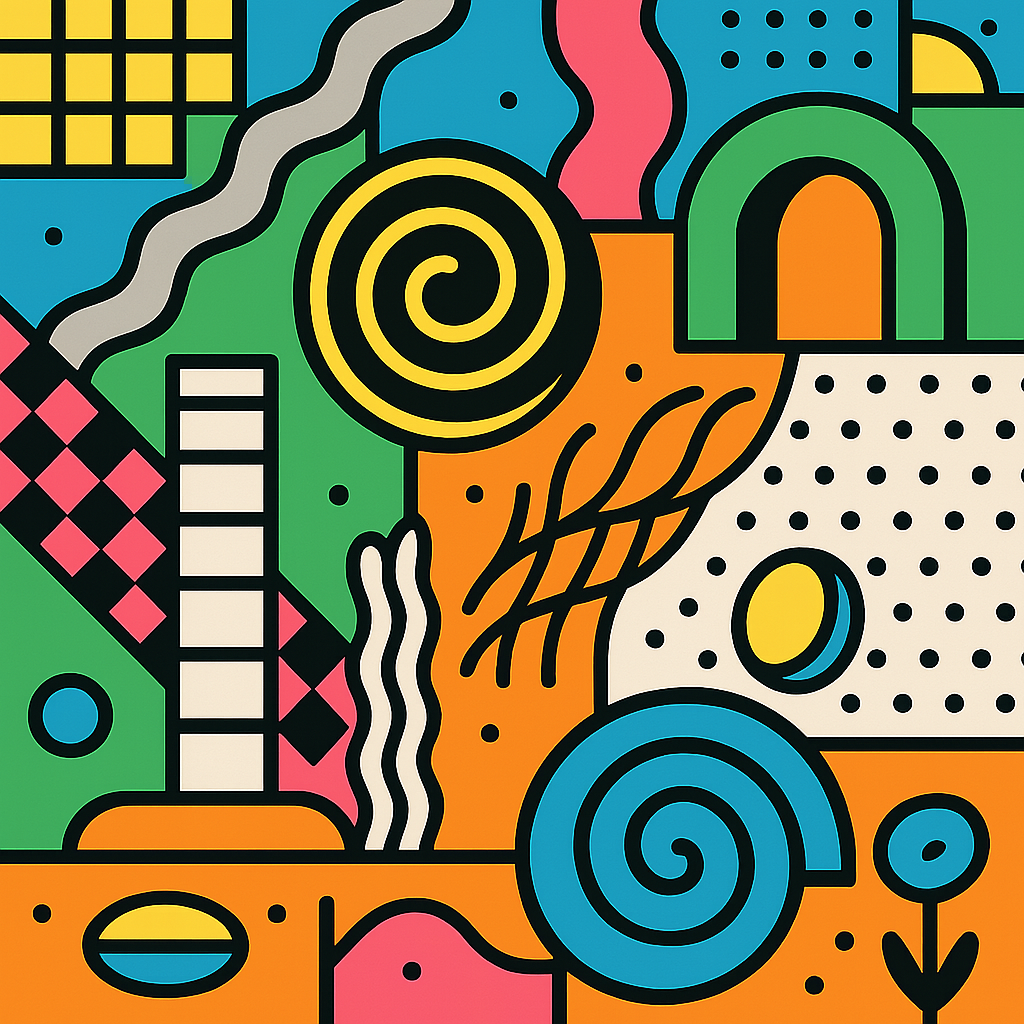
To transform the designs to adhere strictly to the principles of Suprematism—which emphasizes flat shapes, abstraction, and lack of realistic detail—follow these directives:
1. **Remove 3D Effects and Textures:**
- **Implementation:** Replace any gradients with solid colors. For instance, areas with shading in spirals or objects should be converted into flat colors. This eliminates depth and texture.
2. **Simplify Shapes:**
- **Implementation:** Convert detailed or complex shapes, like the curls or patterned grids, into basic geometric forms—squares, circles, and lines. Avoid curves; if present, these can be converted to straight lines or simplified into their most essential forms.
3. **Use Flat, Bold Colors:**
- **Implementation:** Limit the color palette to primary colors and black and white. Ensure all colors are solid without gradients or blending.
4. **Eliminate Realistic Features:**
- **Implementation:** Any design elements that suggest realism (like the archways or any literal representation of objects) should be abstracted. For instance, transform recognizable shapes into abstract, non-representational forms.
5. **Emphasize Composition and Balance:**
- **Implementation:** Arrange elements to create a sense of dynamic balance, focusing on the strategic placement of shapes and lines. Use asymmetry to enhance visual interest without realism.
6. **Evaluate and Adjust:**
- **Feedback:** Review each updated design to ensure no depth, texture, or realistic attributes remain. Compare against classic Suprematism pieces for adherence, adjusting elements not meeting guidelines.
Reference images of Suprematist works, such as those by Kazimir Malevich, can provide guidance in achieving the correct aesthetic: focus on flatness and geometry.
Apply these changes uniformly across all elements for consistency, continuously refining until the design embodies the flat, abstract nature of Suprematism.