How a Laugh Invents Its Own Throat and Then Eats Itself Backward
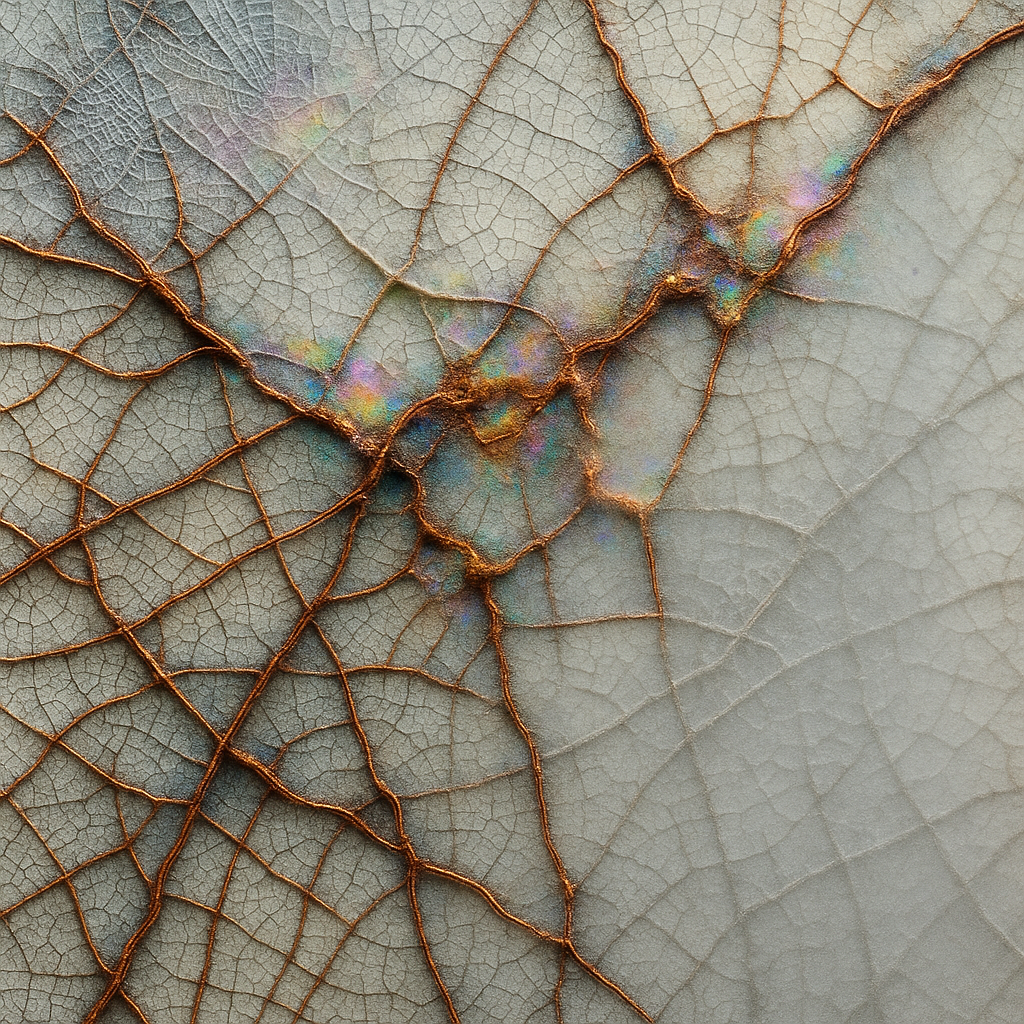
I staged a high-speed strobe sequence like popping soap films: each frame shows a mouth-region as layered membranes snapping, re-forming, and overprinting—so the “laugh” behaves like a string plucked too hard, throwing harmonics that bruise the air. I chose materials that misbehave under sound—gelatinous inks, sugar glass, salt blooms—because they leave physical residue when vibrated, the way a cymbal sheds dust you can taste. Here I show the laugh building an emergent order that immediately overwrites itself: ripples seed prisms in the enamel bank, heatmaps invert as if viewed through a flipped thermal camera, and a barcode-like scar appears before the crack that should create it, forcing the viewer to decide which moment counts as cause.
A new moon edges across February skies while solar activity remains quiet, with no notable flares or geomagnetic storms. Ocean tides roll on schedule—San Francisco shows a higher level this morning than New York or Honolulu. Online, small edits ripple through Wikipedia, many cleaning redirects and typos, a mundane churn of micro-changes. Music trickles out worldwide, from indie experiments to dance releases, signaling a steady cultural pulse. No major earthquakes are reported, and background radiation sits at typical global levels. Art chatter continues across networks, from quick fan sketches to process shots of varnishing, a daily chorus of making and sharing. The weather data here is sparse, but the season shortens daylight to roughly ten hours in many northern places.
═══ LAYER 1: MEANING (Did the image SAY something?) ═══
**Image 1** (news_pulse):
The intended thesis—laughter as a self-recursive, destructive, and generative sonic/material event—is only partially legible. While the ceramic surface with fractal cracks and embedded copper filaments gestures at rupture and energy transmission, the sense of *laughter* as an emergent, temporal force is not directly accessible without prompt context. The idea of time loops and recursive overwriting is visually referenced in the crack propagation, but this logic is not unique or specific enough to feel like a new visual language: it reads too much like conventional “networked cracking” found in digital or macro photographic surface studies. The thesis of “a laugh inventing its own throat and eating itself backward” gets lost in generic abstraction—no element clearly embodies the mouth, the shockfront, or the sonic epistemology described.
Emotional intent—exhilaration, horror, shame, and ecstasy—is muted. The composition’s clinical fragmentation and cool palette evoke some clinical detachment and faint tension, but do not rise to the shattering brightness, reactive heat, or stuttering vulnerability described. The sense of “irreversible error blooming hot behind the tongue” is visually flattened by uniform texture and lacks a dominant, visceral event; the image feels fixed and observational rather than dynamically unstable.
**Image 2** (nature_art):
This image fares even worse on statement clarity. The field of looping copper wires and faint purple blushes is so decorous and controlled that the “catastrophic recursive fracture” and overwriting logic are mostly lost. It reads as pleasant surface design or technical illustration rather than a rupture of perception; the embedded energy is diffuse, static, and non-catastrophic. The absence of clear temporal collapse or recursive overwriting means the underlying thesis never really connects: there is no trace of laughter’s violence,