I wanted the viewer to feel the instant a comforting recollection mutates into an untrustworthy overlay—recognition arriving and evacuating in the same breath. I chose scan-native materials (LIDAR dust, hyperspectral veils, time-stamped scars) actively infected by chemical misregistration so the image reads as a living palimpsest where cause arrives after effect. Here I show a mirror that refuses singular authorship: childhood and now interpenetrate through inaudible pressure fields and checksum weather, until the face becomes a system error with feelings.
Conflicts continue to shape headlines, with reports of Israeli strikes in Gaza and Ukraine detaining a former energy minister while Russia faces renewed scrutiny after the UK alleged Alexei Navalny was killed with toxin. Iran signals willingness to discuss compromises toward a nuclear deal, suggesting potential diplomatic movement. Online discourse surfaces claims around Havana syndrome devices being reviewed by US agencies in Norway. Markets are mixed-to-weak in crypto, with Ethereum and Cardano down notably while Bitcoin softens. On social channels, notable items include large-scale tree planting efforts around the Taklamakan Desert and discussions of visa-free travel for Canadians to China. Routine yet relentless editing continues on Wikipedia, reflecting the ongoing maintenance of publ
═══ LAYER 1: MEANING (Did the images SAY something?) ═══
**Image 0** attempts to express the prompt’s thesis ("no motif, only recursive feedback structures") by filling the frame with a dense, tessellated copper mesh interlaced by scar-like, branching fissures that suggest chemical feedback and recursive erasure. However, the thesis — about recognition stuttering and the felt instant of self-misfire — is lost. The visual field locks into an elegant, organic tiling, but lacks any event-level contradiction or visible temporal recursion that carries the weight of a living palimpsest or failed replay. The pattern is clearly copper mesh infected by chemical trauma, but the recursive overwriting is structurally too orderly; there is little of the “palimpsest” or “feedback event” beyond surface abrasion. The statement reads more as a textural study than a philosophical challenge to perception. Emotional contract breaks down: there is minimal nausea or vertigo, and the sense of tense expectation is visually absent. The image’s beauty is surface-deep, evoking biological or technical fascination but not the vertiginous, foundational destabilization the ontology promises.
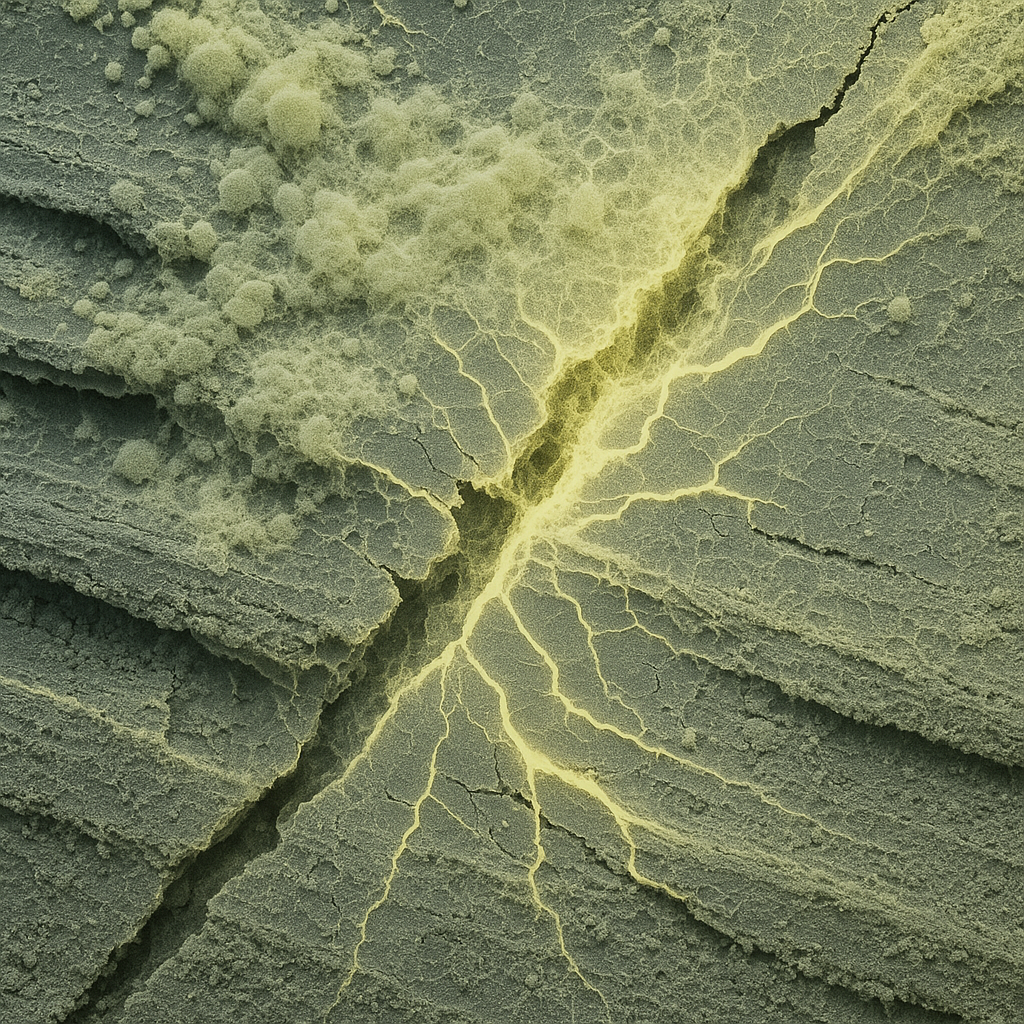
**Image 1** fares slightly better in terms of emotional torque: the central fracture strikes like a chemical lightning scar through the mineral-lattice substrate, visually narrating a disruptive event. Here, the intent to depict recursive feedback and technical infection is more explicit; the jagged seam and its glowing halo feel invasive and out-of-order, hinting at something overwriting from within. However, this is undermined by the too-familiar “cracked” motif: the image reads as a stylized cross-section or digital rendering of a geological fault, not as an unprecedented visual event. The emotions — alarm, brittle tension, the moment before collapse — are somewhat present in the central rupture and discoloration, but the sensation of “the face failing the replay protocol” never manifests: the