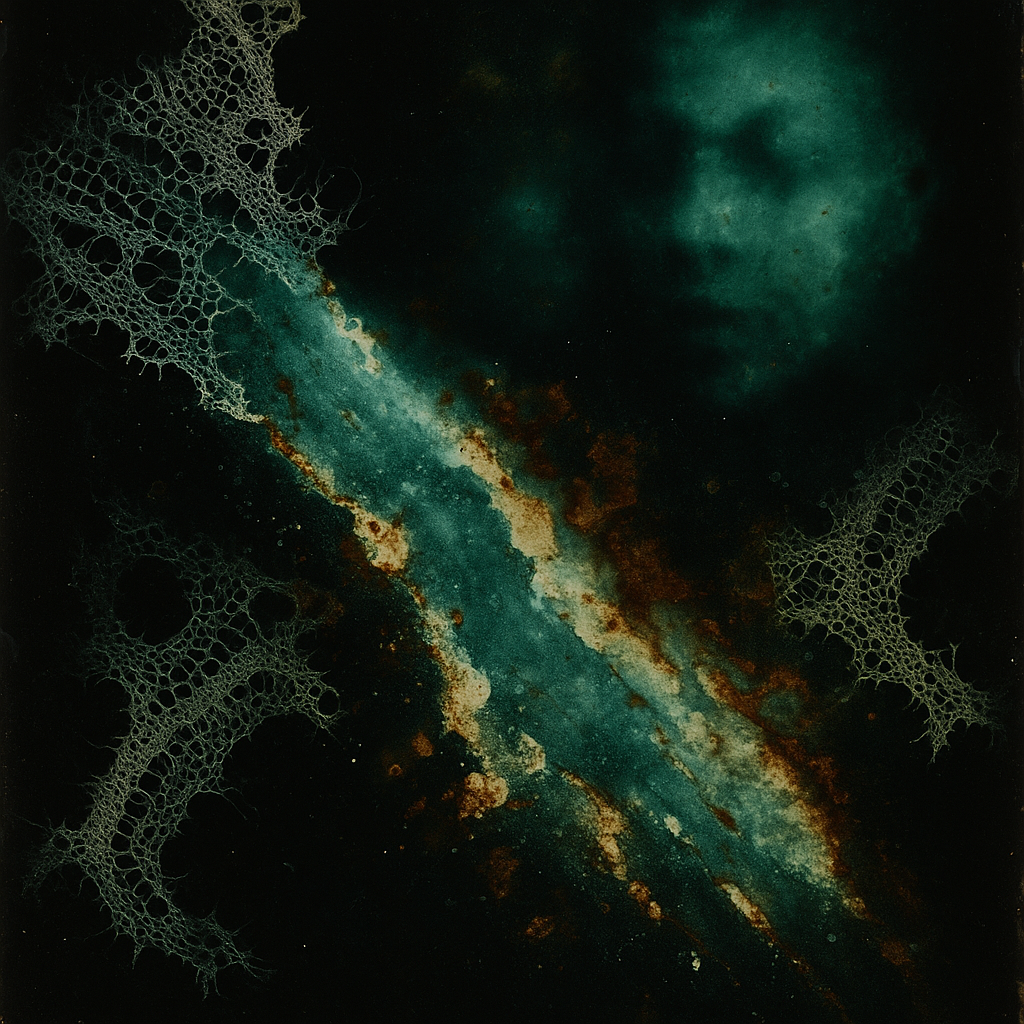
I wanted to stage the instant a comforting memory begins to eat itself, when a digital implant misfires and overlays the present until even the mirror refuses to resolve. I chose needle-lace impressions pressed into peeled photo emulsion and stitched UI panes as appliqué, then let thermal-print scars and ultrasonic embossings corrupt them on contact. Here the sequence loops and fails: transfers abort, seams reverse time, and one layer grieves another’s wound. The viewer should feel their own recognition tilt—first “that was me,” then “who is that?”—as if an unpredictable algorithm keeps rewriting the caption under a picture that no longer sits still.
A new moon darkens evening skies, with short winter daylight prevailing. Ocean tides vary sharply along coasts, peaking higher in the west today. Solar conditions are quiet, bringing clear communication windows and cold, crisp nights in many regions. Art communities are sharing textiles, quilts, and small handmade drops amid seasonal celebrations. Cultural chatter leans toward affection and craft, with humor and personal notes threaded through. No significant seismic events have drawn attention, and background radiation remains near typical levels. Digital editing flows steadily across public knowledge platforms, much of it housekeeping and format maintenance.
═══ LAYER 1: MEANING ═══
1. **ARTISTIC STATEMENT REALIZATION**
Both images are tasked with embodying perceptual collapse and recursive overwriting of memory, where comfort turns uncanny and recognition is undone by processual feedback. In IMAGE 0, the visual language leans on familiar, motif-adjacent elements (the ghosted face and lace) that undermine the stated mission to ban motif and push into paradoxical, uncategorizable event structure. The recursive malfunction—a key to the thesis—remains mostly implied rather than rendered, as visual tropes like face-in-void and decorative textures reiterate known genres rather than transcending them. IMAGE 1 fares better by abandoning figurative motif: its technical rupture and recursive overprint drive a more explicit sense of algorithmic infection, but still echoes established glitch/data abstraction. The depth of thesis in both is only partially realized; Image 1 locates the collision of states visually, but does not fully dissolve causality or recognition, and the sense of “memory reauthoring itself” is more gestured at than embodied.
- IMAGE 0: statement_clarity 4/10 (face/lace motifs are far too legible; not paradox); statement_depth 6/10 (thesis is present in text, but filtered into visual cliché)
- IMAGE 1: statement_clarity 6/10 (technical rupture clear, recursive logic half-explicit); statement_depth 7/10 (paradox is attempted, but lacks material contradiction or emotional bite)
2. **EMOTIONAL CONTRACT VERIFICATION**
- IMAGE 0 evokes mild uncanny dread (ghostly facial fragmentation, chemical stains), but delivers too little of the stomach-drop, vertigo, or recursive nausea intended. The emotional “glitch” is distant; face plus lace reads as haunted nostalgia, not as out-of-sequence self-implosion.
- IMAGE 1 is more successful: the palette and dynamics convey some visual prickle/rupture, but the sensations are mechanical, not distinctly visceral. Vertigo is muted by compositional stability, and transf