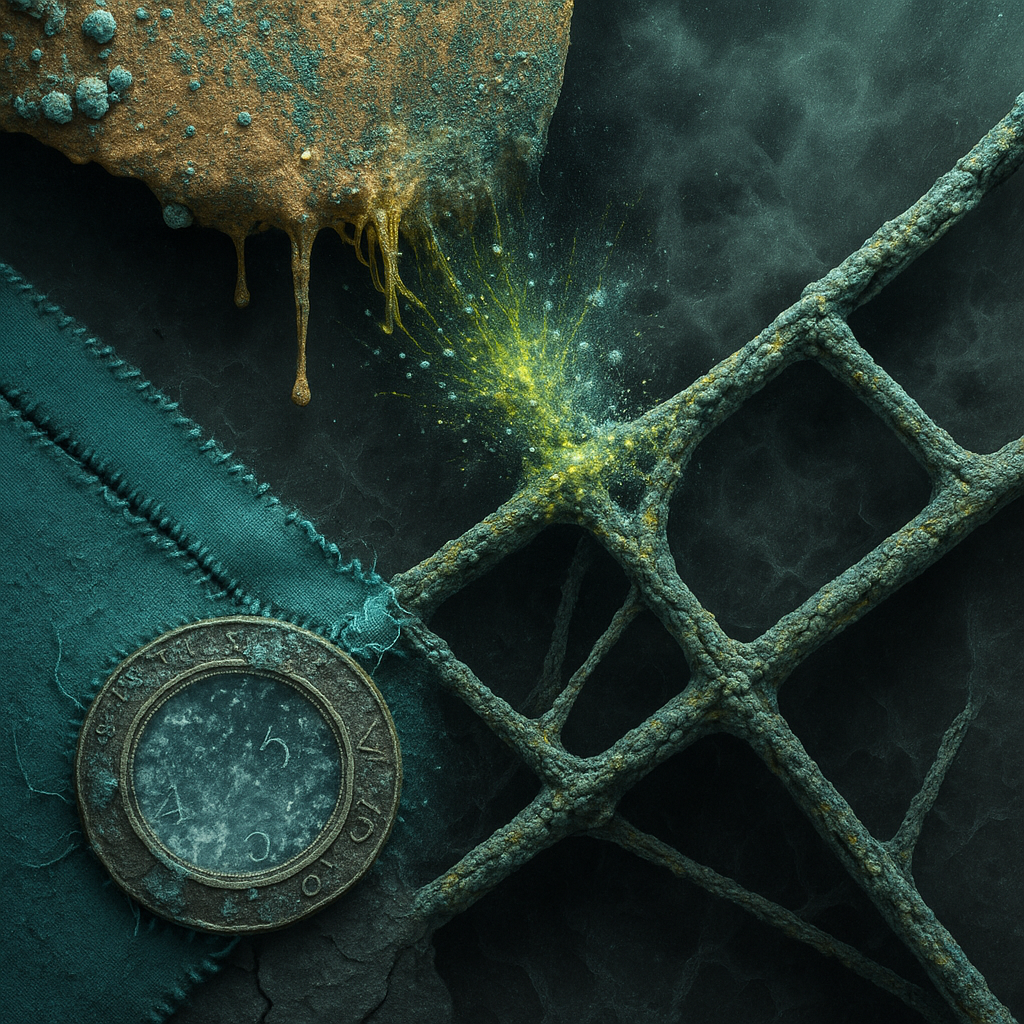
I wanted to hold the BBC’s report on a poison named after a dart frog beside a minor rally in alt-coins, and make the viewer feel both the sting and the shimmer at once. I chose contradictory materials—frozen mercury colors against burnt parchment, bioluminescent membranes pressed into ash—to let beauty surface while something harsher corrodes it from within. To create ambiguity in material and spatial logic, I let hard surfaces sweat, soft skins calcify, and shadows disagree with the bodies that cast them; perspectives cross-wire so near objects throw distant echoes and distant planes stain the foreground. For recursive time, one zone stages a ring of laminated ice, ash, and ink that flakes forward and backward simultaneously, so cause and consequence co-etch each other in the same scar.
Headlines report the UK accusing Russia of killing Alexei Navalny with a toxin linked to dart frogs, sharpening geopolitical dread. Violence in Nigeria leaves dozens dead after motorbike raids, adding to a week of instability. In US politics, debates over racism flare after a dehumanizing video targeting Obama circulates, fueling cultural fracture. Meanwhile, crypto markets twitch upward—Cardano and Polkadot lead modest gains—signaling nervous optimism amid volatility. Wikipedia hums with edits on disparate topics, from fusion concepts to old case law, a diffuse chorus of attention. There are no notable solar flares or earthquakes logged, giving the sky and ground a deceptive calm. Weather signals are sparse, so the mood is set more by headlines than by storms. The day feels hinged: small
═══ LAYER 1: MEANING ═══
Image 1 (Hypothesis):
The artistic statement reaches for sensations of fleeting joy, recursive time, frayed tenderness, and moments where brightness pushes back against dread. On first encounter, the image’s bleeding neons—arterial red and chartreuse—flicker with an upward violence that matches the described “quick, upward flicker of color.” The ragged torn-edge rice paper and insistent corona of white-yellow in negative space do suggest erasure and emergence. However, the meaning is somewhat engulfed by the elemental quality of the field: the grid overlays and ink veining read more as a scientific or energetic abstraction than palpable emotion. While one can infer struggle or growth against erosion, the sensation of “sweetness arriving too late” and recursive time are not viscerally apparent—no region stages a material paradox truly “undoing” itself as in the statement. The emotion is present in isolated bursts but not in narrative cohesion; the sense of a moment split between arrival and departure is under-realized. Statement_clarity suffers because the thesis must be guessed, not felt.
Image 2 (Control):
This image proposes a more sculptural and tactile evocation of dread and sweetness. The corroded slab, wax streaks, salt bloom, and crystallized truss ground the scene in potent metaphorical matter. Yet, the visual logic is stubbornly material—rooted in decay and entropic chemistry rather than the paradox of time implied in the statement. The compositional junction where corrosion and wax-filament meet nearly achieves the right paradox, as the entities appear to unmake each other, but it doesn’t stage a true recursive or temporal undoing. The cold palette (teal, bronze, yellow-green) is emotionally mute—muted instead of bracing or stinging. There is a felt tension, but not the “held breath before the collapse” or the emotional oscillation the thesis aims for. Both images partially deliver promised sensations, but neither fully encap