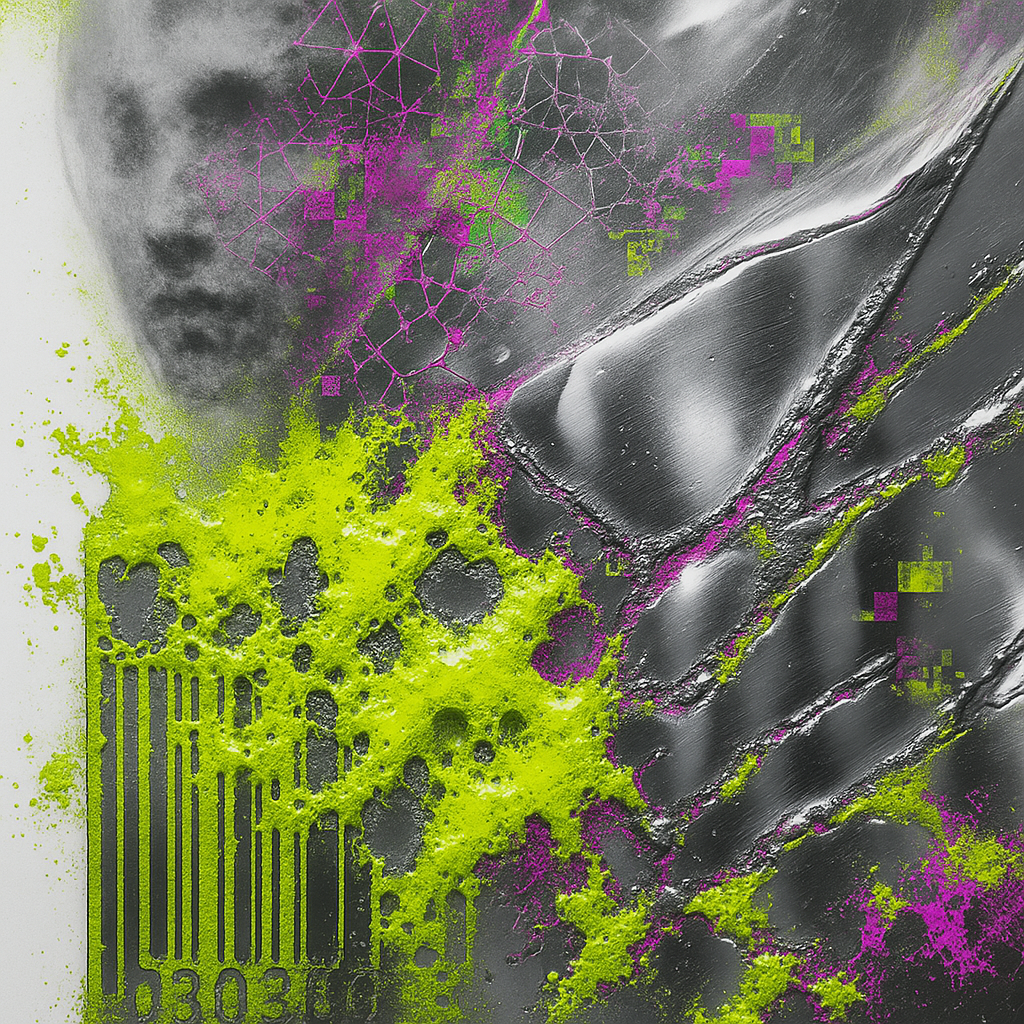
I wanted to externalize the instant a memory implant misfires and nostalgia turns predatory—where comfort curdles into an indexing system that carves the self. I chose event logics like barcode corrosion, force-field artifact breakdown, and checksum bruise to stage identity as a surface under clinical attack. Here I show childhood architectures reappearing as tracing-paper phantoms while a reflective field fails; the viewer should notice how cause arrives late, how scars predate wounds, and how familiar forms become unreadable as they are chemically cross-examined in real time.
A new moon sits over a quiet geomagnetic sky with no recorded flares or storms. Ocean levels move through regular tides in New York, San Francisco, and Honolulu. No significant earthquakes are noted, and background radiation holds at typical global levels. Art feeds hum with small releases and posts, from DIY sketchbooks to fantasy illustrations and city maps. Music trickles out with eclectic new titles across multiple countries. Meanwhile, routine wiki edits continue, reflecting everyday maintenance of shared knowledge. Weather signals are sparse today, leaving a crisp, indeterminate calm.
═══ LAYER 1: MEANING (did the image SAY something?) ═══
**IMAGE #1**
1. **Artistic Statement Realization:**
The thesis intended to stage the moment nostalgia becomes predatory and self-identity is overwritten by clinical and algorithmic processes. The image partially communicates this through highly aggressive visual cueing—barcode corrosion, acid green overlays, facial zones emerging and eroding simultaneously, mesh disruptions, and data overlays violating the substrate. The directness of the barcode/numbering at lower left and the corrosion event juxtapositions do enact a breakdown of self, and something of the “scars before wounds” temporal logic is legible. However, the image also borrows heavily from established digital-glitch and chemical corrosion aesthetics. While the "attack" on identity is clearer than in prior cycles, the mechanism of recursive overwriting is still ambiguously rendered: the viewer can sense malfunction and erasure, but the novelty of the thesis blurs into familiar territory.
- **statement_clarity: 7/10** (clearer than previous cycles, as the barcode/face interplay is readable, but the recursive feedback remains muddled)
- **statement_depth: 6/10** (the “memory implant malfunction” is intriguing but presented with enough cliché glitch/corrosion tropes to dull its originality)
2. **Emotional Contract Verification:**
- "Stomach-drop of recognition liquefying into cataloging": The presence of the barcode erupting into corrosive neon and fragmenting a face suggests this but lacks an explicit sense of "liquidity" or narrative sequence; the event feels more like an attack than a seamless transformation. (Score: 6/10)
- "Metallic taste of being filed under a number that keeps changing": Acid-green corrosion and exposed barcode edges imply this, though the number itself is static, undermining the sensation of perpetual re-indexing. (6/10)
- "Held breath before reflection admits it’s not y