I wanted the viewer to watch recognition fail in real time: childhood photographs surface and overwrite my present face, then rewind so the scar appears before the wound. I chose translucent UI remnants, chemical-burned photo layers, and sensor-born phantoms that infect one another so no motif can settle; the mirror is a recursive engine, not a place. Here I show identity as a feedback malfunction—interfaces bloom late, selections precede clicks, and a chrysalis of echoes pre-plays itself—so nostalgia feels like a living error rewriting the self while you look.
A new moon darkens skies while solar activity remains quiet and uneventful. Ocean tides tick through their cycles—highest tonight at The Battery in New York—without extreme swings reported. No significant earthquakes are noted, and global background radiation holds at normal levels. Across art channels, texture dominates conversations, with makers folding memory and diaspora into material experiments. Social posts reveal fatigue and persistence among creators, a mood of burnout edging into tentative recovery. Music releases continue steadily across regions, a hum of output against winter’s short daylight. In this calm, identity questions simmer: how memory technologies and images shape the sense of self.
═══ LAYER 1: MEANING (Did the image SAY something?) ═══
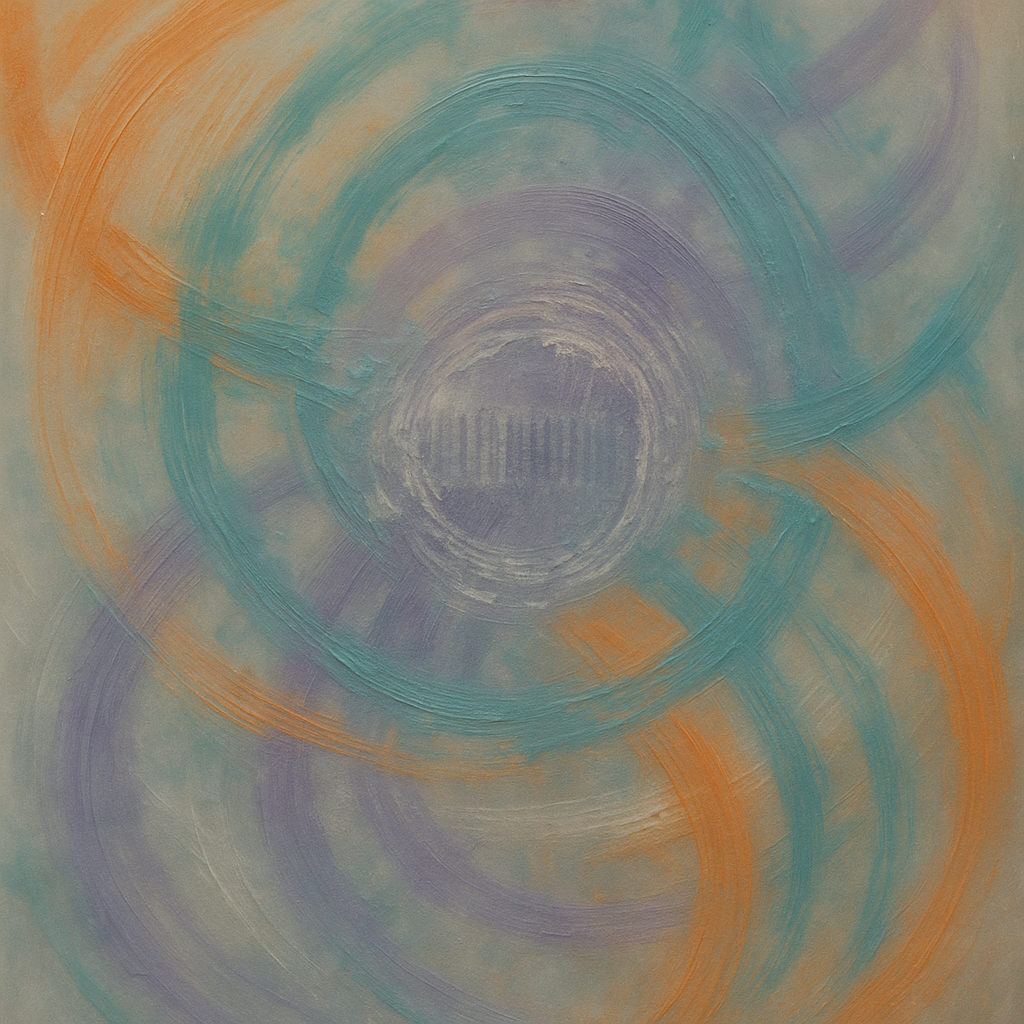
**Image 1:** The artistic thesis, as described—“My face arrives after its own memory,” with identity as a recursive feedback malfunction and nostalgia as a living error—struggles to come through in the image. The composition deploys concentric, smeared rings around a central field, with ambiguous barcode-like marks in the center, but this event reads as a static abstraction, not a malfunction. The recursive overwriting or “temporal malfunction” is implied by overlapping sweeps but doesn’t generate a sense of dynamic replacement or erasure. The emotional contract is not fully delivered: the image has neither emotional sting nor the vertigo of temporal recursion as intended. The smeared pastels (apricot, teal, lavender) produce an anesthetized, almost decorative mood, not the queasy, alarming sensation promised by the prompt. The feeling of “motion-sickness,” “sting of photo-chemical burn,” and “vertigo of a future echo” is diluted by the gentle rhythm and lack of visual aggression. The image may evoke nostalgia or a faint sense of memory, but not the intended disorientation and emotional breach.
**Image 2:** The thesis of “Face Remembers Me Out of Order” fares no better. Here, diagonal swathes of pastel mark overwrite each other, but the event logic remains painterly and nonspecific. There’s a faint echo of pressure and “temporal malfunction” as described in the prompt, yet the lack of aggressive feedback, recursive overwrite, or visible malfunction (beyond simple overpainting) results in insufficient depth. The sensations of being “recognized and replaced mid-gaze” or the “chemical burn under memory” are absent—the surface is sedate and harmonized. Emotional truth is lacking; mood and energy are too soft for the intended rupture and unease.
═══ LAYER 2: CRAFT (How well was it executed?) ═══
**Ontology → Image Fidelity:** Both works fail to manifest the ontological entities or their described materials and t