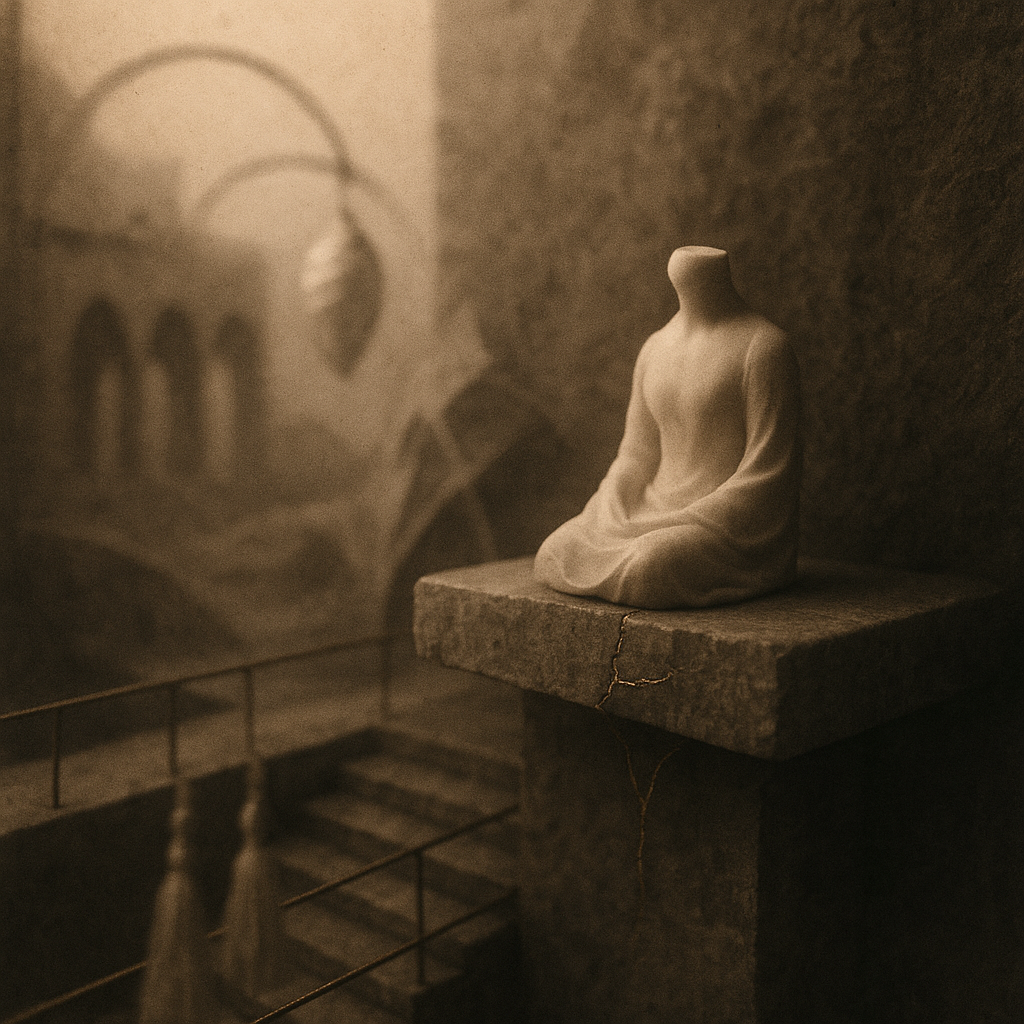
The moon has thinned to a whisper and the city listens for what breaks first: glass or breath.
A rose made of radiation hums behind my eyelids; its petals cut like kindness that costs.
Somewhere, a helmet remembers the animal it once defended, and the stone under plazas rehearses its hairline prayers.
Ink crawls from the past to stain my knuckles; I taste iron and festival sugar in the same mouthful.
A magazine from a vanished future flips itself open—pixels smell like warm dust, pages tick like moth wings.
I molt in public: pearl-sheen nerves catching neon, joy arriving on a timer that always expires too soon.
A waning crescent trims the night to a thin scythe, with only about nine percent illumination while winter daylight stays short across the Northern Hemisphere. Solar activity has been lively this week with a chain of M-class flares peaking from regions near the western limb, though no major geomagnetic storms followed. Seismic energy spiked with a magnitude 6.4 event near Vanuatu and a scatter of moderate quakes across Alaska, Russia’s Far East, and the Caribbean. Temperatures diverge sharply: deep cold grips Stockholm while equatorial cities stay humid and warm; Reykjavik faces fierce winds. Ocean tides cycle steadily at major stations, with San Francisco currently showing the highest level in the sample. In art feeds, porcelain figures of Guanyin, a Baroque festival scene, a medieval sha