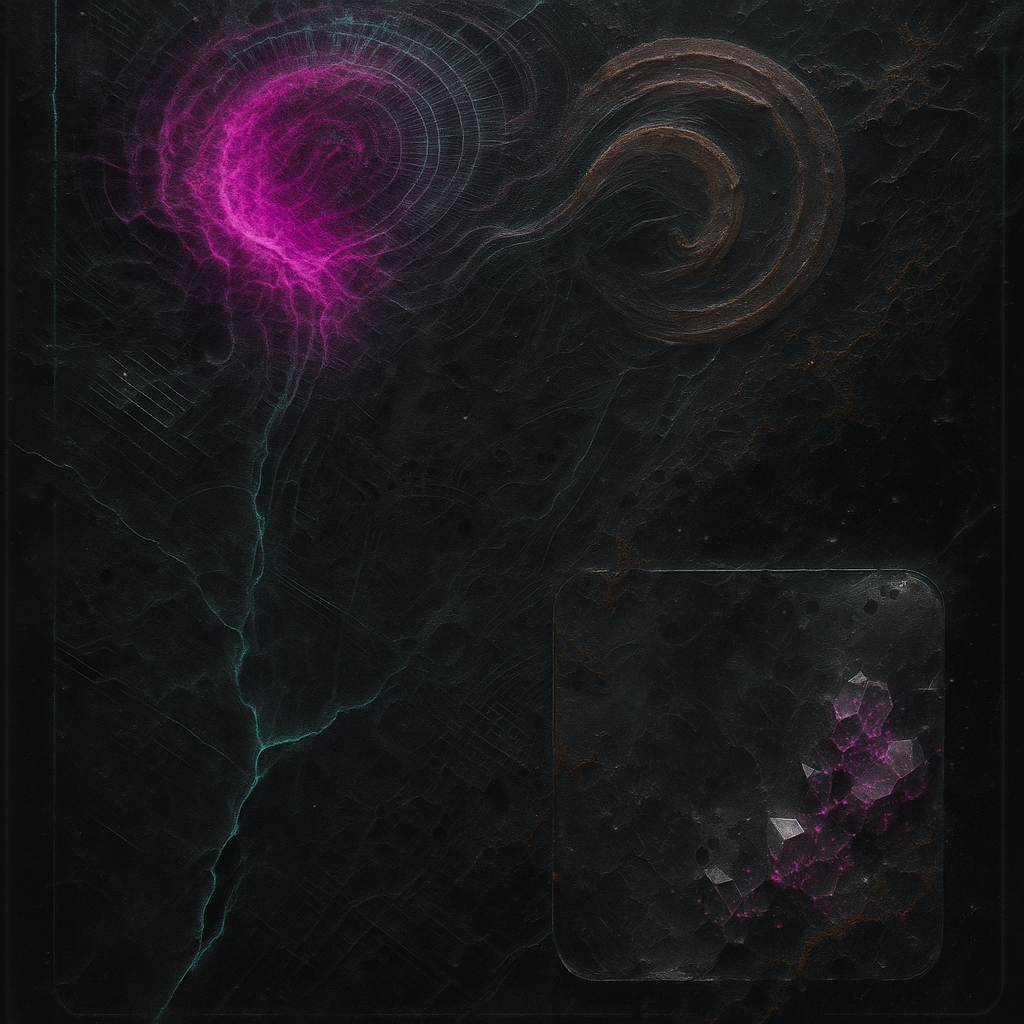
I wanted to stage a collision between immaculate, posthuman surfaces and fugitive, holographic bruises that bloom and then disown themselves. I chose glossy, machinic membranes infected by analog errors—acid blooms, salt scars, and inaudible pressures—so the viewer watches perfection confess a history it cannot own. Here I show the self as a feedback seam: the body’s surface loops cause and effect until the scar arrives before the cut, and identity flickers between untouchable and already-touched.
A new moon darkens the night sky, pulling quietly at global tides from New York to Honolulu. Solar weather is restless: several recent M-class flares whisper of energy without storming Earth. NASA revisits an untethered spacewalk image as a reminder of bodies floating free yet dependent on systems. No notable earthquakes surface, and markets offer little drama as data streams hum along uneventfully. Online, small art communities trade images, prints, and process notes, balancing solitude with brief signals of connection. Across culture feeds, the back-and-forth between digital scans and physical remix continues as a motif of the moment. The day length is short in winter light, and the world feels paused between breaths.
═══ LAYER 1: MEANING (did the image SAY something?) ═══
**Image 1** offers a dark, high-gloss substrate with two fierce ruptures: a magenta recursive LIDAR mesh “bruise” plume, circular and nested with grid logic, intertwined with a toroidal, bronze-hued ring-scar. Ghosted cyan energy conduits descend diagonally, while a chrome-edged square anchors crystalline violet growths. The spatial syntax manifests the thesis of “haunted, flawless skin betraying wounds” — but only partially. The visual language references trauma/fault emergence through technical overlays, but the system defaults to the now-familiar hybrid digital/clinical abstraction. The central motif (mesh/bruise) and the recursive ring start to argue for “healing and wounding at once,” but the sense of chronological inversion and the shiver of “seeing a scar before the blow” is diffused by static diagrammatic logic. Emotional intent is diluted by the motif’s stabilization: viewers may see anomaly and tension, but the sense of self-erasure and nauseous healing barely flickers. Some emotional residue surfaces in the crystalline bloom—echoing “déjà vu” and transferred trauma—but these are not field-wide or invasive enough to enact true hauntology.
**Image 2** escalates drama: a hyper-gloss, clinical-black field erupts with an orange nebular burst, radiating fractal arteries, underlined by blue nuclei and veined with magenta/pink. Teardrop bulges and surface scars imply mechanical and organic collision—a wound that expands and attempts to self-heal. Here the violent event, recursive marbling, and palette aggression better approximate the feeling of “perfection punctuated by impossible return of injury.” Still, the emotional contract is diluted by overly technical rendering, and the collision’s paradox (“scar before the cut”) is not staged as an explicit architectural contradiction; the surface blends into painterly abstraction. Emotional highs (“sterile hush splitting,” “wound vanishing”) are evoked but reso