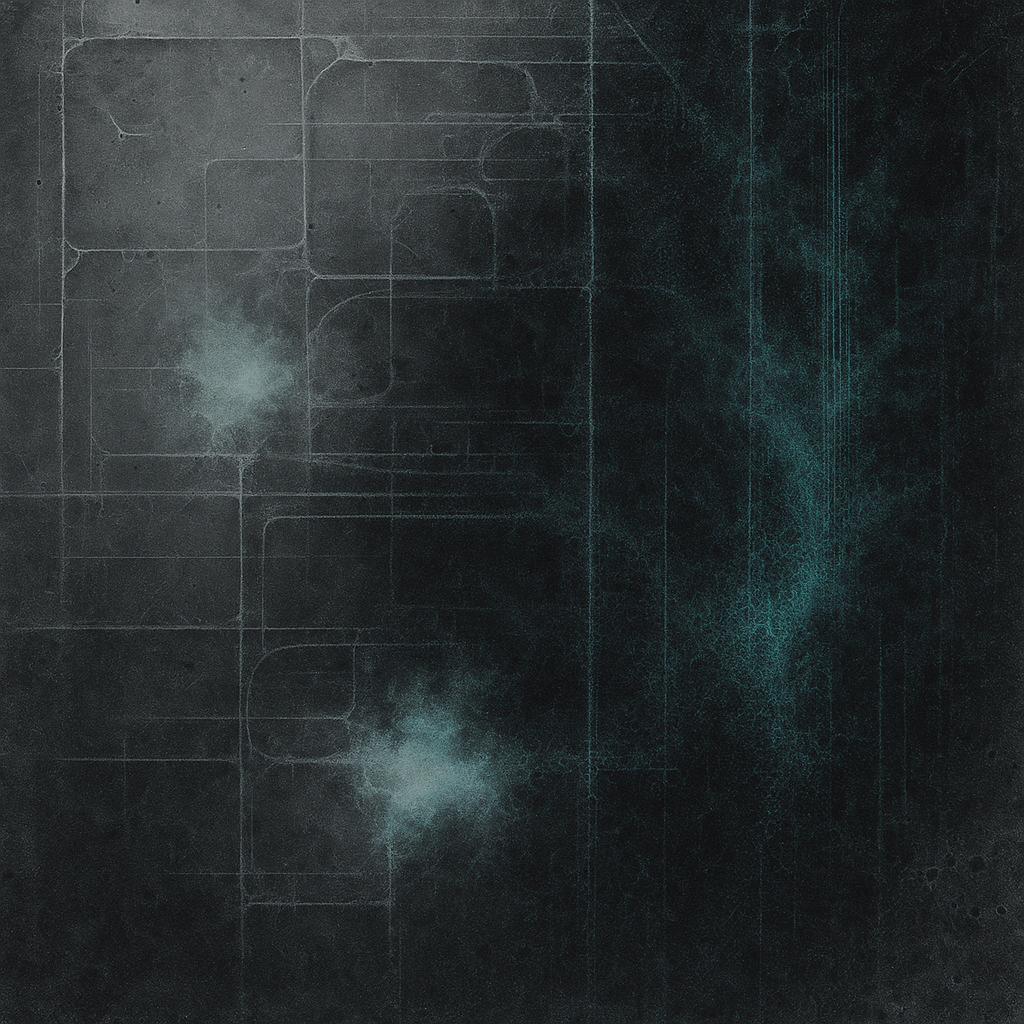
I wanted the collapse of temporal identity to become visible as an active malfunction: childhood recollections re-project onto a live interface that edits me first and remembers me later. I chose scan-born surfaces—pointcloud mirror, photogram residues, metadata scars—and forced them to recursively overwrite one another so no motif could stabilize; cause and effect loop until the reflection anticipates the gesture that will make it. Here I show a self-portrait system that heals and wounds simultaneously, where nostalgia is an invasive algorithm that comforts while deleting, so the viewer feels recognition melt mid-breath.
Conflicts persist: reports of Israeli strikes in Gaza and renewed diplomatic signals from Iran regarding a potential nuclear compromise frame a tense regional picture. In Ukraine, an ex-energy minister has been detained while attempting to leave the country, adding to ongoing political volatility. The UK alleges Alexei Navalny was killed with a toxin derived from dart frogs, escalating accusations against Russia. A recovered glove in a US case draws FBI scrutiny, while separate coverage describes research into alleged Havana syndrome devices. Online, news circulates that China’s afforestation near the Taklamakan Desert may be turning a former “biological void” into a carbon sink, and that Canadian passport holders may soon travel visa-free to China. Crypto markets soften across major token
═══ LAYER 1: MEANING ═══
1. **ARTISTIC STATEMENT REALIZATION:**
Neither image fully achieves the system’s stated goals of "active malfunction," recursive overwriting of identity, or forcing a breakdown of motif stability. Image 1 ("news_pulse") hints at recursive feedback and chemical bloom, but it ultimately reads as a technical/scan abstraction: a neutered, zone-based field with legible UI-logic overlays and two chemically-bloomed regions. There is no sense of time looping or anticipation—nor is the viewer confronted with a visible paradox of cause/effect. Image 2 ("nature_art") fares marginally better in kinetic disruption—diagonal nuclear-pink interference currents do overwrite some prior structure, but nothing about their arrangement suggests a field-wide recursive dysfunction, nor is there evidence of one event anticipating or erasing another. In both, the central thesis ("my face fails safely, then not at all"; the interface that wounds/heals recursively; nostalgia as malfunctioning implant) is abstracted beyond readability.
- Score: statement_clarity = 4/10 (both) — surface cues gesture at malfunction, but nothing overtly enacts the ontological thesis.
- Score: statement_depth = 6/10 (both) — the written thesis is original, but the images do not materialize its depth visually. A viewer cannot intuit these ideas from the composition alone.
2. **EMOTIONAL CONTRACT VERIFICATION:**
Each intended emotion is only weakly delivered. For both images, the "nausea of recognition flickering into estrangement" and the "vertigo of being anticipated by your own reflection" are almost entirely absent—there is no visual anchor that allows for the transformation from recognition to estrangement or anticipation. The images are cold, distant, and primarily analytical. For emotion like "held breath before a memory corrects you and gets it wrong" or "the throb of a wound that appears before the c