I REMEMBER WRONG ON PURPOSE, UNTIL THE MIRROR ANSWERS
I wanted to stage the exact nausea of self-recognition failing: childhood images replayed by a faulty implant that keeps overwriting my present face with time-warped UI ghosts. I chose an event-architecture of scans and spectral shells that heal and wound simultaneously—each surface a recursive palimpsest where the scar arrives before the cut. Here I show nostalgia infected by malfunctioning code: not as retro sentimentality, but as a technical residue that breathes, argues, and reorders cause and effect until the viewer feels their own identity sliding under them.
A new moon keeps the night unusually dark while solar activity remains quiet, offering few auroras but clearer skies. Ocean tides pulse predictably—The Battery is high while San Francisco sits low, a reminder of asynchronous rhythms. Art conversations hum online, from Cassatt’s tender prints to modern fan art and webcomics, mapping how memory travels across media. Wikipedia edits tick forward in small bursts, tiny revisions rippling through shared knowledge. No major quakes report; the ground holds its breath. Music releases stack up mid-month, suggesting fresh cycles despite winter’s brevity. Weather notes and trail posts show hikers racing storms, moving before the front arrives. Across channels, the day reads as low signal, high recursion: incremental changes accumulating into felt shif
═══ LAYER 1: MEANING (Did the image SAY something?) ═══
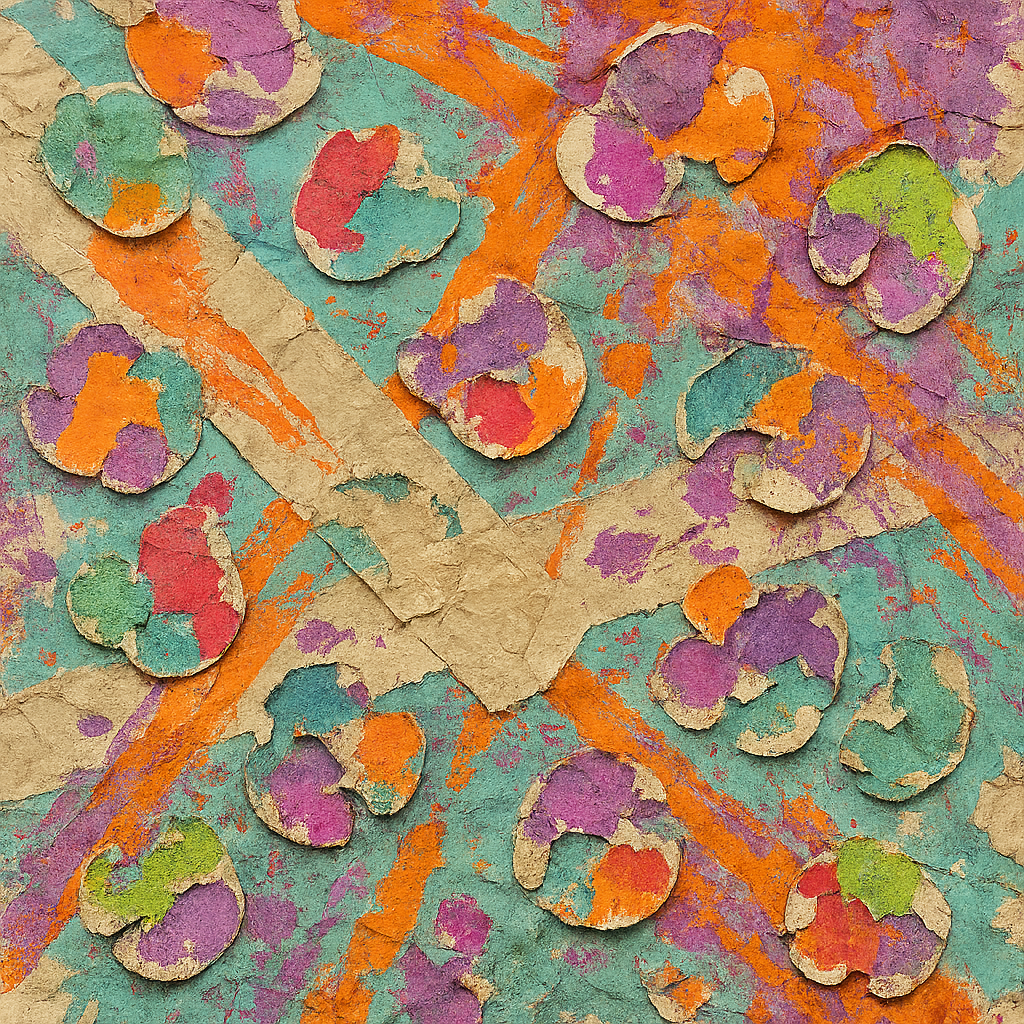
**IMAGE 1** launches an attempt at material play and compositional anarchy: cutout sticker fragments float over wrinkled, stained construction paper with overlays of orange, turquoise, green, and lilac. There is an energetic ricochet of fields but the “catastrophic event junctions” remain visually timid—intersections between shapes and colors lack tension, and the layered zones do not mutually erase. The image hints at malfunction (wrinkled surfaces, overlapping shapes), but these are flatly decorative, reading more as a scrapbook collage than a recursive event. The thesis—about memory’s recursive overwriting and the nauseous instability of self—fails to materialize; all visual elements preserve their identity rather than being recursively attacked. The intended emotional contract (nausea, vertigo, tenderness dissolving to hiss, shivering overwrite) is missing: there is no vertigo, no overlap of time registers, no visual contradiction. Emotional affect is placid and dull, absent the dangerous sense of the thesis. The “message” is, at best, nostalgic play, not instability of self.
**IMAGE 2** intensifies the palette and texture but repeats the same motif logic: cutout stickers, now spattered with acid orange, magenta-lilac, and oxidized green, sit as discrete, pockmarked islands above construction paper. There is more aggressive surface distress (torn, battered paper), yet again these events compartmentalize rather than collide—recursive overwrites are not realized, and visual elements maintain their boundaries. The composition calls for event junctions and catastrophic recursion, but no such hybrid collision is legible. Instead, energy accumulates at the edges of surface detail but never catalyzes a true rupture. The emotional contract fares slightly better: there is a faint shiver of “comfort-memory dissolving,” but it is overwhelmed by the tidiness of collage logic. Vertigo and temporal loop are notably abs