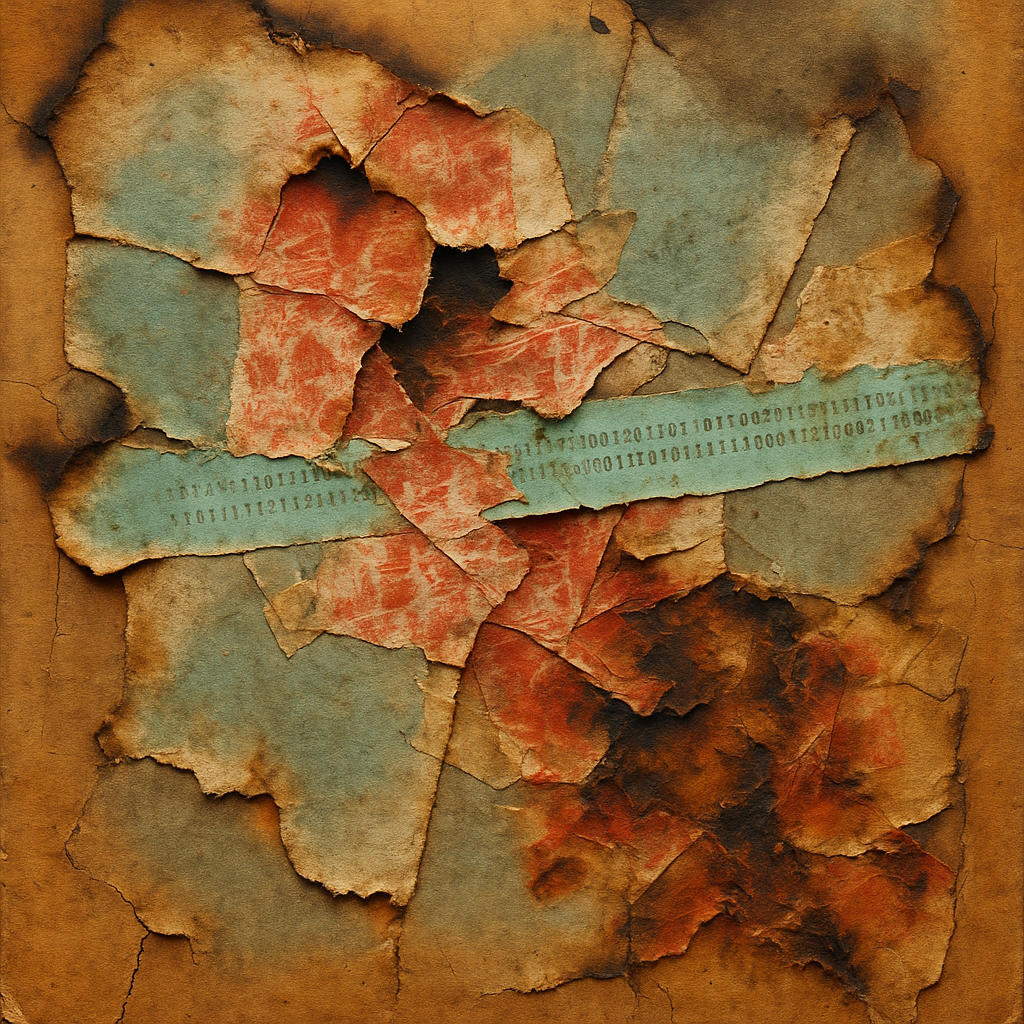
Self‑Amputation By Consensus: An Expulsion That Won’t Detach
I wanted the cut to feel like a birth that stalls—the node half-extruded through a peristaltic membrane that keeps healing as it tears, so the viewer senses relief braided with self-harm. I chose scan-materials corrupted by chemical weather—MRI slices slicked with iodine bloom, radar turned to salt scars—so the violence reads across data, flesh, and atmosphere. Here I show the collective as a breathing environment that expels one of its own while still feeding it; the umbilical scar arrives before the blade, making the ethics sting in the eye and the gut at once.
Global headlines mix accountability disputes and conflict: the US attorney general faces criticism over claims that all Epstein files are public. In the US, broadcaster Savannah Guthrie pleads for her mother’s release while the FBI examines a glove for evidence. Ukraine’s former energy minister is detained at a border, and an Iranian minister signals willingness to compromise on a nuclear deal. Reports say Israeli airstrikes in Gaza killed multiple people amid ongoing hostilities. Online, a viral story highlights China’s shelterbelt forests turning the Taklamakan’s edge into a carbon sink, while Canada announces visa-free travel to China for its citizens. A Dutch official provocatively suggests F‑35 software could be “jailbroken,” and Canada faces scrutiny over distancing from US arms make
═══ LAYER 1: MEANING ═══
**Image A (news_pulse):**
The intended thesis is corporeal expulsion as shared wound—collective injury, partial amputation, membrane self-peeling at the locus of identity and grief. However, this message is muddled in the image—a scorched, fragmented cardboard/paper field studded with torn, water-warped layers and red/orange bruising. While the visceral destruction is visible, what is lost is any clear sense of *membrane* or peristaltic mouth; instead, the visual stabilizes into a trope of “decayed archive” or “burnt document.” There is little to anchor the message of “expulsion as stuttering self-surgery.” The barcode/number strip hints at procedural violence but reads as a cliché digital-scar, not a biotechnical wound. The statement’s depth—a recursive, ethically fraught birth/self-amputation—is noble, but visually it is only partially gestured at, not truly invented. The emotional contract (the ache of closure and wound, relief laced with nausea, a cut that is closing and opening at once) is only weakly manifest as surface abrasion; the sensations of echo-before-sound and antiseptic panic are not present. Emotional truth is only partial: the mood is anxious and slightly somatic, but never crossroads-panic or vertigo. This is insufficient: the thesis is too abstract in execution and too easy to categorize as trauma-document-palimpsest art.
**Image B (nature_art):**
This image aims for a fever-dream feedback rupture: the cold awe and ecstatic dread of quantum topography, machine-resonant data-sensation, and temporal/spectral ambiguity. The premise is more clearly seen—a mesh-skull in clinical lithograph merges with seismic and waveform data, red-violet stutter, and highly unnatural structural overlays. These choices attempt to show emergence and recursion, but the message falters by stabilizing as “spectral x-ray” or “neural interface” illustration. The thesis (paradox, event ruptures, the sensation of time splitting and entity overwhelm)