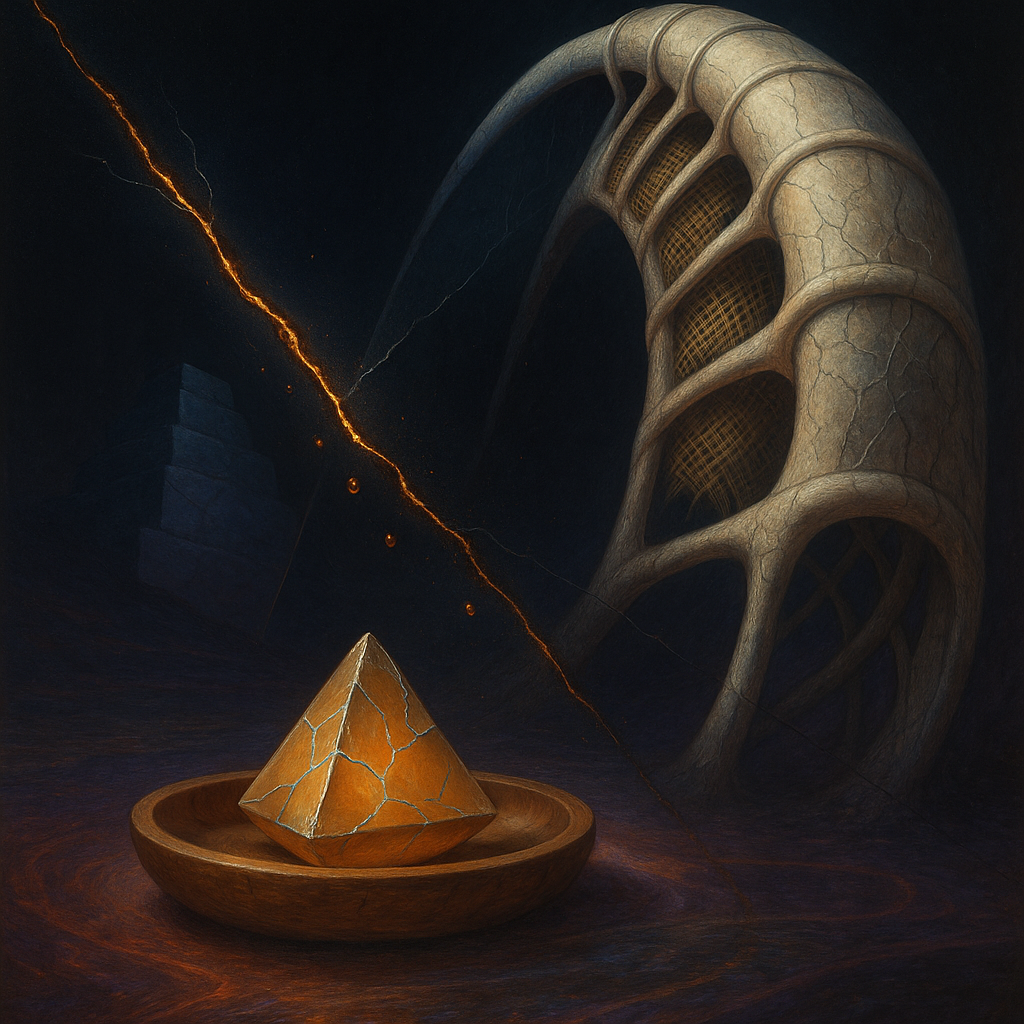
My hands smell like beeswax and static as the crescent trims the night to a filament. Indigo breath holds—then the room pivots, a slow fault in the floor of certainty. I taste chrome heat from a distant flare, sweet and metallic, like biting the rim of a bell. Between breaths, a seam in the sky loosens; grief becomes velvet and refracts into oranges I can almost swallow. I listen for the hush between two dwarf galaxies and find a pulse that doesn’t ask permission. In the shadow, shapes confess—tender, abrasive, wet with signal. I lean into the tear and let it stitch me with ultraviolet thread.
A waning crescent Moon (10.8% illumination) sets a low-light tone as recent M-class solar flares continue to ripple through the heliosphere without major storms. Seismic activity is moderate, with mid-4 magnitude quakes near the Philippines and Iran among 15 recorded events. Urban weather splits between late-winter chill in Stockholm (-7.9 C) and warmth in São Paulo (25 C), while coastal tides peak modestly at The Battery (1.172 m) and ebb near San Francisco (0.095 m). NASA’s featured image highlights dwarf galaxies NGC 147 and NGC 185 beside Andromeda, emphasizing quiet companions at cosmic scale. Art feeds pulse with warm ochres and resinous textures from woodcut histories, indigo textiles, noir club photography, and modern digital card-making. Experimental radio and pedagogy threads cir
### LAYER 1: MEANING
1. **Artistic Statement Realization:**
- **Statement Clarity:** 5/10
- The images aim to convey cosmic disorientation and a transformation theme but struggle to clearly communicate these concepts. The intended depth gets obscured by complex elements without a strong central message.
- **Statement Depth:** 7/10
- The thesis of cosmic fragments and transformative processes is profound and explorative.
- **Notes:** While attempting to present celestial metaphors, the visual language lacks clarity, leaving an abstract portrayal that isn't easily decipherable.
2. **Emotional Contract Verification:**
- **Emotions:**
- Complexity and Awe: 6/10
- Disorientation: 4/10
- **Notes:** The intended emotions of awe are partially conveyed through intricate details. However, disorientation is not effectively communicated, as visual cues remain somewhat conventional.
3. **Emotional Truth:**
- The images convey a sense of cosmic grandeur but lack the intended emotional impact, feeling more visually impressive than emotionally resonant.
### LAYER 2: CRAFT
4. **Ontology → Image Fidelity:**
- **Score:** 6/10
- **Notes:** While some ontological elements, like the use of geometric forms and materials, are incorporated, there’s a disconnect in expressing the transformations and unique interactions described.
5. **Visual Language Quality:**
- **Score:** 6/10
- **Notes:** The style chosen suits cosmic themes but doesn't push boundaries enough to serve the ontology of fragmentation and metamorphosis fully.
6. **Surprise & Freshness:**
- **Score:** 5/10
- **Notes:** The visual style feels reminiscent of previous iterations without introducing significantly new elements or concepts.
7. **Alignment with Favorites:**
- **Score:** 5/10
- **Notes:** The images do not evolve from the artist's favorites, lacking the unique visual metaphors and contrasts seen in preferred work.
8. **Compositio