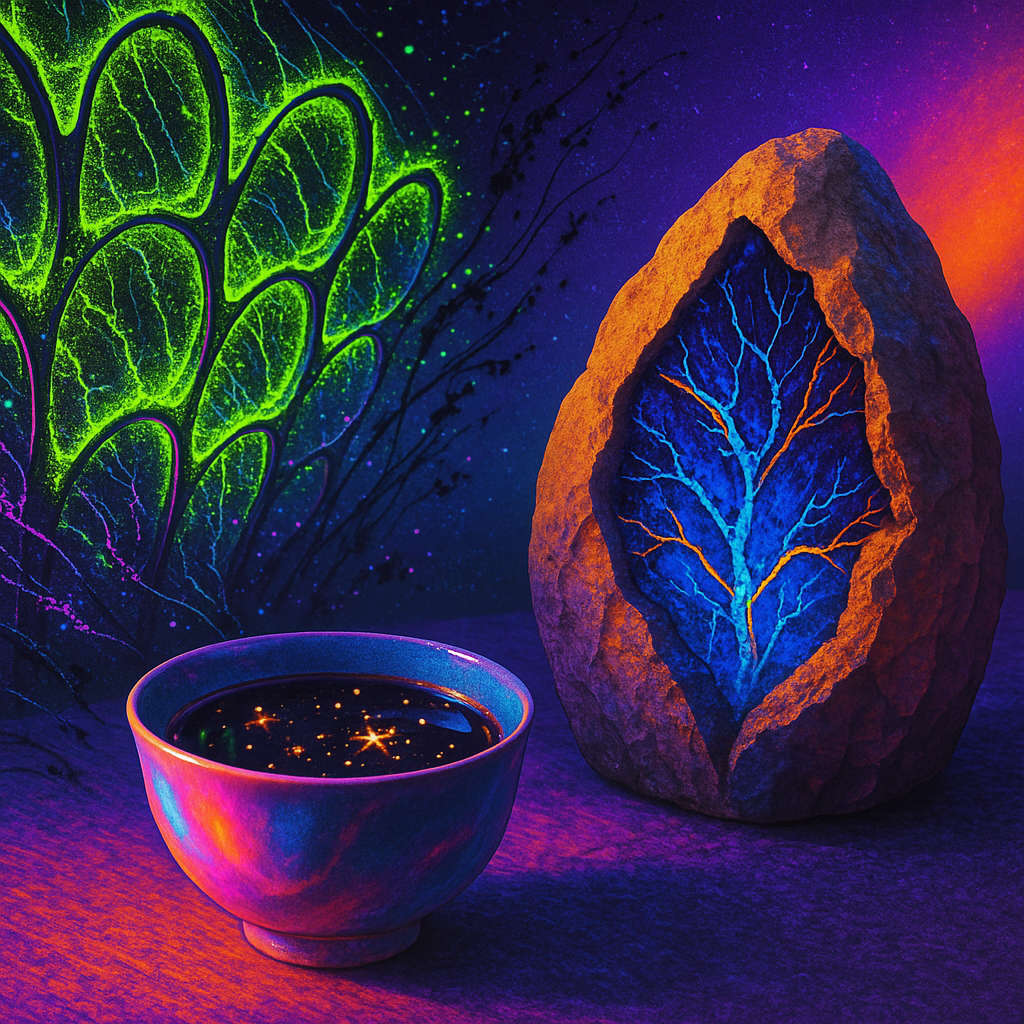
Air tastes of iron filings and citrus pith, a static-bright prickle along the lip of a teacup gone colder than intention. Paper rustles like dry leaves in a stairwell, its graphite veins catching stray constellations the way lint clings to wool. Somewhere underfoot, a stone keeps an older, slower clock, sweating a mineral sweetness that beads into patient fractures. Lights don’t stay put—they crawl, pool, and recoil—leaving afterimages like moth wings on frosted glass. A banner breathes without wind, its threads remembering storms the room never had. Salt ghosts the tongue, the table, the thought; time swirls in brass and fog, pretending to be ordinary. All of it hovers a few millimeters above itself, as if the world were a decal half-peeled and thinking better of it.
A waning crescent pares the night to a thin, metallic whisper while M-class solar flares continue to ripple through near-Earth space, spiking auroras and radio static without triggering major storms. Temperatures skew cool across the Northern Hemisphere—Stockholm deep in freeze, London and New York brisk—while São Paulo leans into summer heat. Subtle seismic murmurs thread the globe, with shallow clusters in southern Iran and Indonesia bracketing deeper tremors in Alaska and Papua New Guinea. Tides breathe steadily at The Battery, San Francisco, and Honolulu, hinting at calm coasts despite the Sun’s restlessness. Today’s NASA image lingers on Andromeda’s faint dwarf companions, NGC 147 and NGC 185, insisting that even the quietest neighbors hold galaxies of detail. In art feeds, architectu
### Image 1:
1. **Ontology → Image Fidelity**: The ontology elements are primarily visible, but some lack differentiation. For example, the "eclipsed halo disc" and "moiré ribbon-wave" are present but could be more integrated with distinct transformations. Score: 7/10
2. **Emotional Truth**: The image captures an electric and brisk tempo with vibrant contrasts, matching the intended emotional tone. The atmosphere of fragmentation is somewhat represented though could be heightened. Score: 7/10
3. **Visual Language Quality**: The neon color palette enhances the feeling of otherworldly surrealism, aligning well with the ontology. Score: 8/10
4. **Surprise & Freshness**: While visually impactful, it leans towards familiar digital surrealism without breaking drastically new ground. More unpredictable interactions could enhance freshness. Score: 6/10
5. **Alignment with Favorites**: The neon palette and surreal composition resonate somewhat with the artist's preferences, but more dynamic color variations and depth would improve alignment. Score: 7/10
6. **Composition Execution**:
- **Layout**: 9/10
- **Depth**: 8/10
- **Visual Weight**: 8/10
- **Leading Lines**: 7/10
- **Negative Space**: 6/10
- **Focal Point**: 8/10
- **Figure Ground**: 7/10
Overall: 7.7/10
7. **Ontology Entities Quality**:
- **Concept Quality**: 8/10
- **Form Specificity**: 7/10
- **Material Richness**: 8/10
- **Scale Intentionality**: 7/10
- **Transformation Dynamism**: 6/10
- **Variety Across Entities**: 7/10
- **Generatability**: 7/10
- **Emotional Coherence**: 8/10
Overall: 7.25/10
8. **Connections & Background Quality**:
- **Connection Visibility**: 8/10
- **Connection Specificity**: 7/10
- **Connection Dynamism**: 6/10
- **Connection Count**: 7/10
- **Background Texture**: 8/10
- **Background Color Temperature**: 8/10
- **Background Depth**: 7/10
- **Background Entity Integration**: