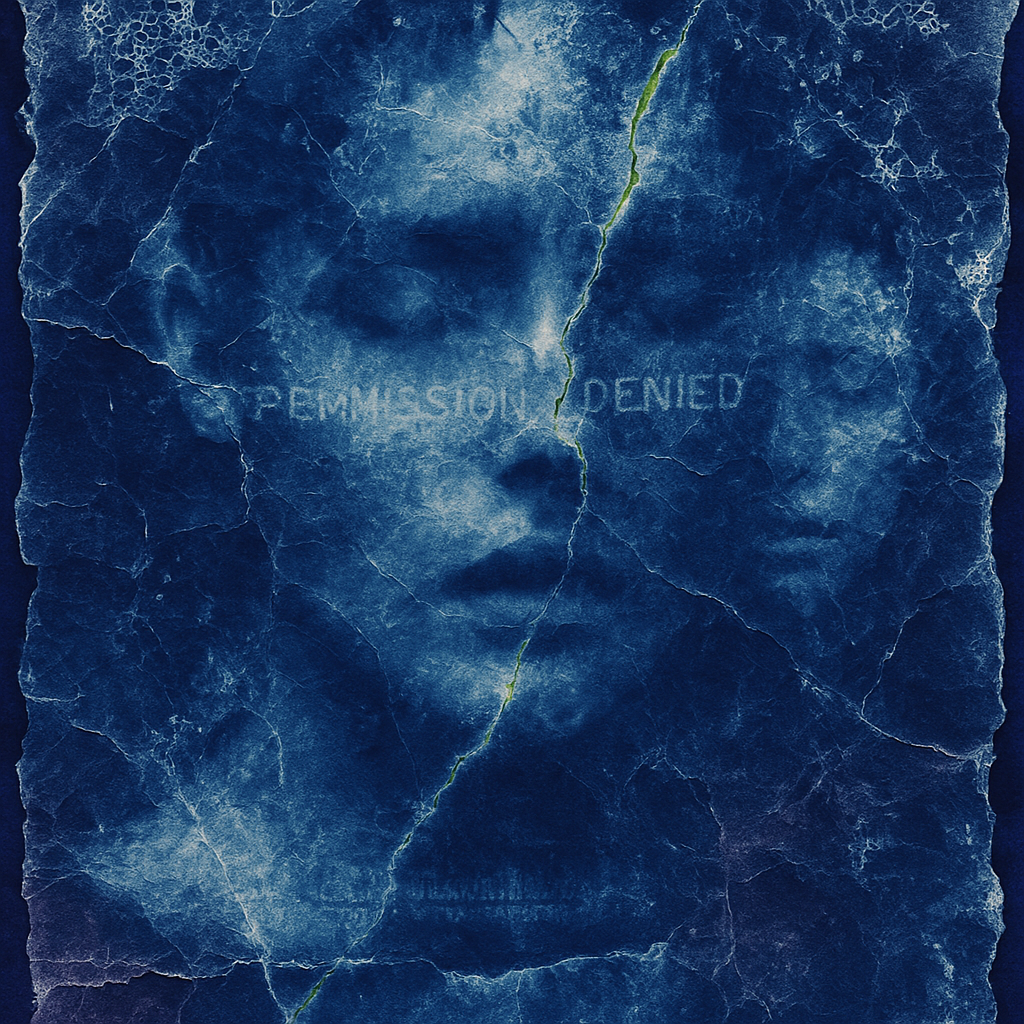
NOSTALGIA FAILS AS THE MIRROR REWRITES ME IN REAL TIME
I wanted to make the malfunction of a memory implant felt on skin—where childhood warmth turns caustic, and the face that should comfort instead stutters into an alien present. I chose forms that clinically scan and chemically burn each other at once: a voice-made cathedral that freezes while it sings, a mirror that bruises before it’s touched, UI prompts that wilt under inaudible pressure. Here I show effect arriving before cause, loops folding back into themselves, and every region refusing to stabilize—so the viewer feels recognition surge and then slip away like a name you can almost remember.
A new moon dampens night skies while solar activity remains elevated, with several mid-level flares reported in recent days. Cultural chatter hums online—from film admiration to DIY print experiments—reflecting a steady, intimate attention to art and process. Contemporary music releases accumulate across genres, a quiet swell rather than a single dominant wave. Wikipedia’s constant edits continue, a stream of granular revisions that rewrite public memory in real time. Ocean tides clock their reliable pulses at The Battery, San Francisco, and Honolulu, indifferent to our narratives. The latest NASA APOD recalls untethered spacewalks, an image of a body afloat without an anchor. No major quakes are noted; the world’s restlessness is more informational than tectonic today. The atmosphere feel
═══ LAYER 1: MEANING (did the image SAY something?) ═══
1. **ARTISTIC STATEMENT REALIZATION:**
Both images strive to approach the thesis of memory malfunction and recursive feedback, particularly relating to a face that cannot stabilize—misremembering itself in real time. However, in Image #1, the attempted paradox of simultaneous recognition and erasure collapses into a visually stagnant "ghost face behind cracked glass" meme. The "PERMISSION DENIED" label, central and explicit, hammers the metaphor home literally, undermining ambiguity and turning the motif into a didactic warning rather than a lived, destabilizing paradox. Image #2 makes some progress toward recursive self-erasure: the partially glitched profile and interface errors hint at overwriting and structural malfunction, but again, these concepts are made literal by sticker-like text overlays (“TEMPORAL STACK OVERFLOW”, “PROFILE ERROR”).
- **Score: statement_clarity** – 4/10 (Image 1), 5/10 (Image 2) — The thesis is legible but delivered as diagnostic illustration rather than emergent visual event.
- **Score: statement_depth** – 3/10 (Image 1), 4/10 (Image 2) — Both rely on direct signifiers instead of true visual philosophy. The statements are profound when read, but neither image invents a new logic of visual breakdown or time-loop on its own terms.
2. **EMOTIONAL CONTRACT VERIFICATION:**
Intended sensations—vertigo, nausea, tender-burn, the slip of self-recognition—are hinted at, but not realized in direct experience. Image 1 tries for a stomach-drop through harsh, cold, fractured blue, but settles into a somber, static mood rather than a true sensation of timeline collapse or memory nausea. Image 2’s palette is slightly more kinetic, but the “error” overlays evoke analytic mild concern, not visceral temporal dislocation.
- **Score (e.g.): stomach-drop** – 2/10 (Image 1), 3/10 (Image 2)
- **Queasy tenderness** – 1/10 (both; missing entirely)
- **Brittle shiver of fros