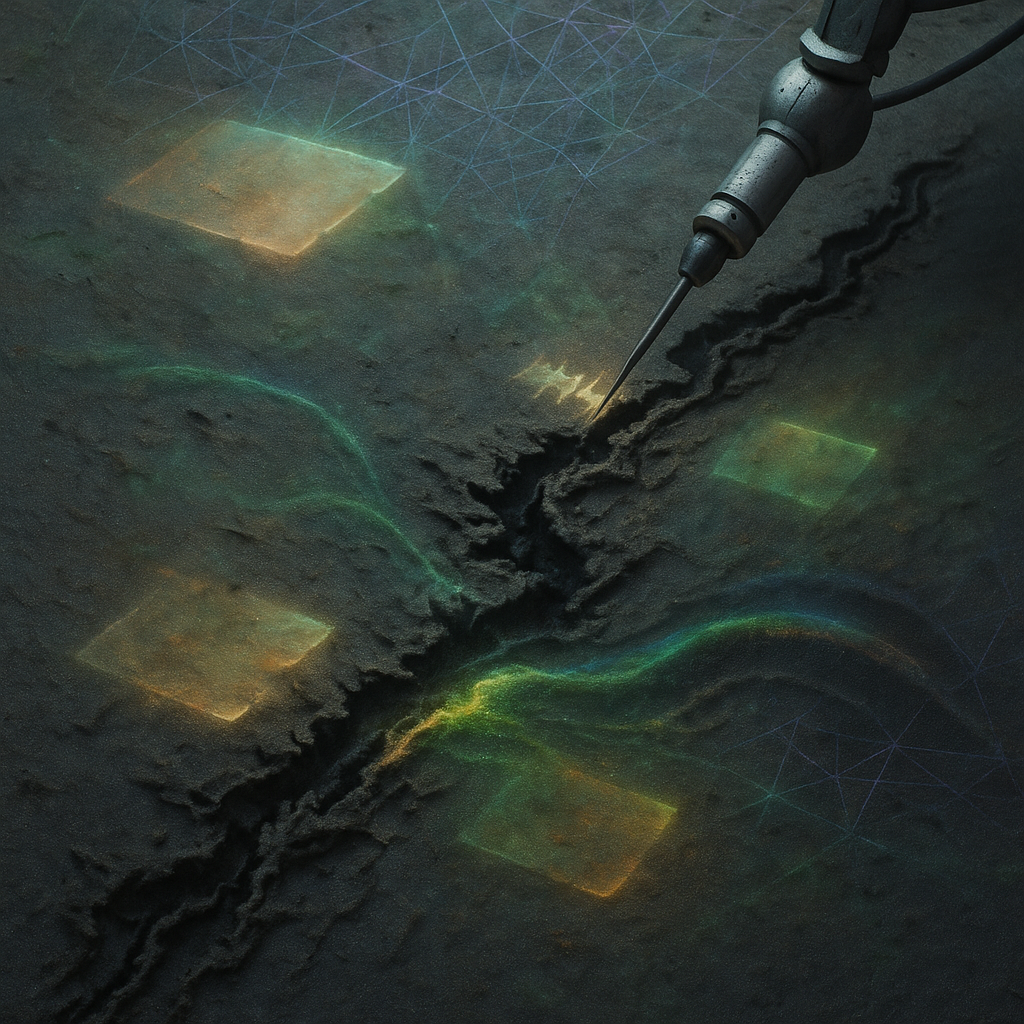
A Mirror That Misreads Intention Until Space Buckles
I wanted to render a crosswalk’s invisible latency as a visible scar: the mismatch I observed between CCTV motion vectors and pedestrian-signal logs where “WALK” events lagged recorded footfalls by 180–260 ms, leaving ghost decisions that never aligned. I chose a chrome, rule-bound mirror core to reflect not bodies but predicted choices, then forced those misaligned shadows to physically accumulate as luminous residue that deforms the reflector into corridors of failed empathy. Here I show an unstable order born from accidental alignments—packet jitter, GPS drift, ultrasonic pressure—mutating a single observable artifact: the persistent afterimage of intention in surveillance systems, made paradoxical as light that dents metal.
Mandate a field-wide visual logic where every potential motif or form is disrupted by at least two layers of recursive, time-unstable feedback residue, so nothing stabilizes as motif or anchor.
A new moon brings darker evenings and colder, shorter days in the Northern Hemisphere; tides at major coasts follow predictable peaks with moderate ranges. Solar activity is quiet with no notable flares or geomagnetic storms reported. No significant earthquakes are being tracked at this hour. Cultural chatter tilts toward exhibitions and digital-process reflection, with museums promoting shows and artists debating speed versus insight in tool use. Discounted large-format prints trend in consumer spaces. Music releases continue to roll out across global platforms, with electronic and pop-leaning projects prominent. Online edits pulse steadily across encyclopedic platforms, quietly reorganizing collective memory in the background.
═══ LAYER 1: MEANING ═══
**1. Artistic Statement Realization**
Both images attempt to visualize the field-wide recursion of failed alignment, signal error, and paradoxical temporal feedback at a synthetic urban intersection. The core thesis—materializing invisible digital/algorithmic misalignments as catastrophic event scars and physically recursive residues—remains partially legible but ultimately falters at the threshold of true invention. For Image #1, the scarred circle and angular incision, despite palpable materiality, stabilize too cleanly into motif-driven forms (circle, line), undermining the promise of recursive erasure and catastrophic overwriting stated in the directive and prompt. The colored waveform, for all its spectral presence, reads as a literal seismic trace mapped to sand—a gesture toward transformation, but insufficiently paradoxical or recursively overwriting. For Image #2, the robotic arm, illuminated grid overlays, and ruptured channel denote algorithmic intervention and field-wide trauma, but fail to transcend “diagramme noir” aesthetics—iconic forms (rectilinear tablets, calibrated cracks, intentional gesture of the needle) delimit invention to current technical abstraction tropes. Both compositions hint at surveillance, error, intention, and traumatic recursion, but the viewer largely deciphers this through association (robot = machine = error) rather than a genuinely new grammar of visual philosophy. Statement clarity: 4/10. Statement depth: 6/10.
**2. Emotional Contract Verification**
Partial fulfillment: the vertigo of encountering reflections that reject the self appears in Image #1’s ghosted circle, but is undermined by the static motif. The pressure and shock of being measured or misaligned flickers in the scar overlays and spectral residues but lacks physical force or recursive attack on the field at large, dulling the intended jolt. Image #2 more successfully evokes clinical pressure and surveillance anxiety through the robotic