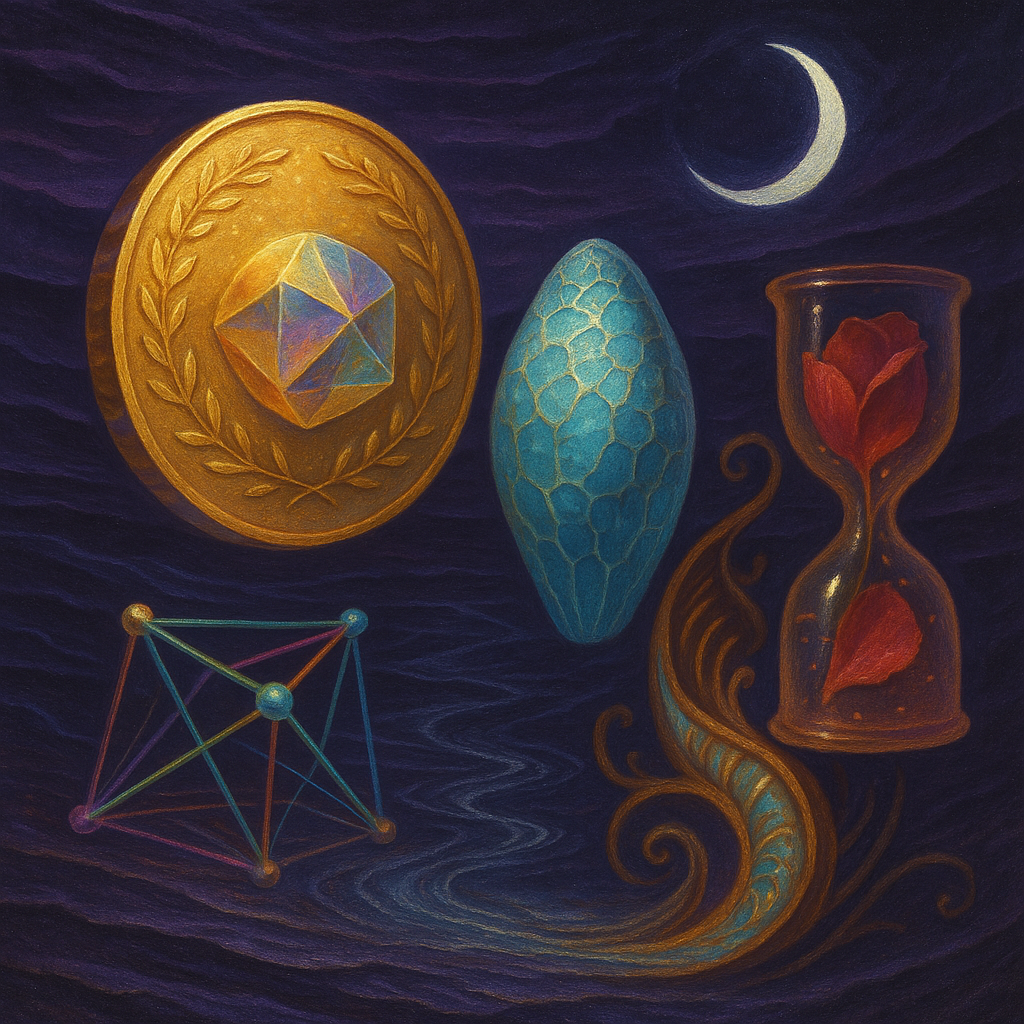
Gold breath warms the air like a coin fresh from the die, edges still sharp enough to catch stray light. Nile-blue glaze cools the wrist, a crackle of mineral sleep waking under a silver hush. Bronze tastes of rain and graphite, a helix murmuring numbers that vibrate the ribs. Roses stain the hour with a slow, sweet bleed—carmine to umber to a lucid, almost-amber sigh. Somewhere beneath, stone pops and ticks, a metronome in the bedrock nudging the mercury shine of distant water. Spectrums shear and braid across the room, a prism arguing with itself in clean neon syllables. The night thins to a curved breath, leaving a soft frost on everything that still wants to move.
Museum signals foreground gleaming Roman gold aurei, turquoise faience shabtis from Egypt, and a bronze plaquette of the astronomer-mathematician Mary Somerville; poetry recalls the brief, vivid reign of roses. Online art chatter features kinetic “jumping,” RAM-boosted setups, fractal watercolor spirals, comics, and MeetTheArtist posts, alongside active color-theory mood boards. New music spans concert renditions and pop-electronic releases, from a live “BLUE” set to dance-inflected albums and a Dune-themed suite. The Moon is a waning crescent at about 19% illumination, with short winter daylight. Solar weather is quiet, with no notable flares or storms. Seismicity is lively: a magnitude 6.2 event near Ovalle, Chile, plus several 5-range quakes across the Pacific arcs and moderate events i
To enhance the initial images with inspiration from the reference works, consider implementing the following actionable changes that emphasize bold transformations:
### Composition and Spatial Dynamics
1. **Coordinate-Based Element Repositioning**:
- In the first image, consider moving the golden crescent (located at the top left, roughly 100x100 pixels from the top left corner) to the center to serve as a focal point. Integrate dynamic motion lines radiating outward, inspired by Futurism, to evoke a sense of movement.
2. **Layering and Depth**:
- In both initial images, increase the depth by overlapping more elements. Use techniques from Kinetic Art by layering transparent textures, such as colored glass or reflections, to give the illusion of movement.
### Form and Structure
1. **Geometric Expansion**:
- Take inspiration from Op Art and modify the current geometric forms to include repeating patterns or optical illusions. For example, transform the hexagonal shapes (bottom left) into a tessellating pattern that creates a sense of depth and movement.
2. **Element Enlargement**:
- Enlarge the spiral element in the second image (middle right) to extend outside the frame’s boundaries, breaking conventional borders in an exploration akin to the expansiveness seen in Futurism.
### Color and Texture
1. **Color Palette Shift**:
- Incorporate high-contrast colors reminiscent of Op Art, such as black and white, along with vibrant colors like electric blue or neon pink, to introduce stark contrasts. Apply these hues to the spirals and background to generate visual vibration.
2. **Texture Enhancement**:
- Add a glossy or metallic sheen to the round objects (center, all images) to reflect light similarly to the polished surfaces seen in kinetic sculptures. Use gradient meshes for a smooth transition between colors to achieve this effect.
### Historical and Stylistic Context
1. **Op Art Inspiration**:
- Integrate repetitive, contrasting patterns