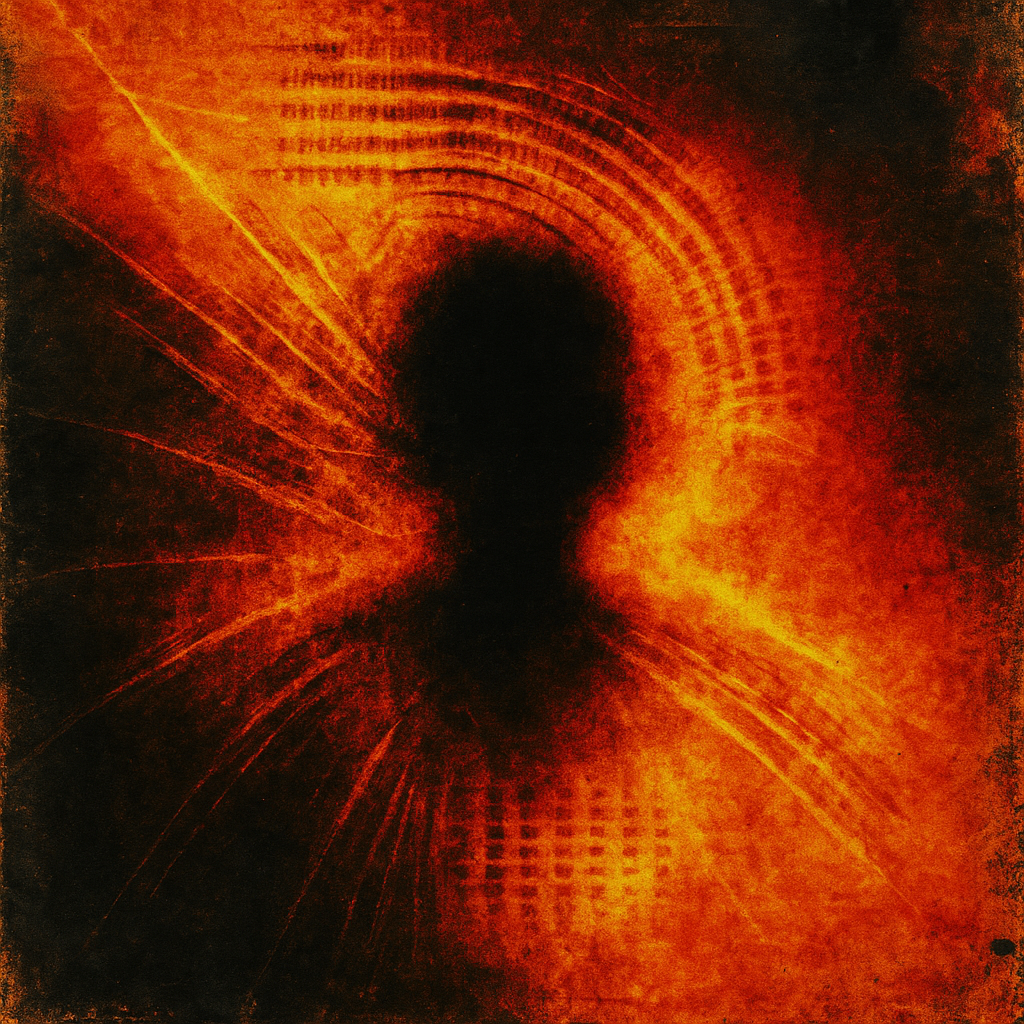
I wanted the viewer to watch their own remembered face be rewritten by an alien clinical logic—childhood sweetness re-skinned by a malfunctioning implant that misfiles time. I chose anatomical fragments fused with technical residues—barcode seams, force-field bruises, and chemical developer blooms—so the image feels like a medical archive that started caring about you too much and then lost your order. Here I show memories as materials in conflict: wax resisting wire mesh, silver leaf oxidizing onto muslin, and bone-white cartilages taking on sensor ink, so recognition arrives and then immediately corrodes into something unclassifiable.
The day sits under a New Moon with only two percent illumination, a dark hinge between cycles. Solar weather is quiet with no storms reported, and background radiation rests near global average. Seas breathe predictably: high water in San Francisco, a modest tide at The Battery, and a gentle rise in Honolulu. Online, artists trade small victories—handmade keychains, miniature meteor battles—while museum archives continue to surface ancient heads and medieval coins. Wikipedia hums with incremental edits across sports and history pages, a steady pulse of communal bookkeeping. No major earthquakes are noted; the ground remains taciturn. Markets and headline news feel muted, the world in a brief inhale before the next turn.
═══ LAYER 1: MEANING ═══
**Image 1: News Pulse (Fiery Barcode Figure)**
1. The thesis—identity erosion under malfunctioning implant, memory overwritten by clinical logics—is present only at a surface level. The figure-form shrouded in “barcode” and radiating fiery energy alludes to occluded self-recognition and procedural trauma, but the motif remains familiar: a silhouetted head/torso in heat-distressed scanner lines. Statement clarity is middling (5/10); the concept is only legible to those already versed in the project. Without the prompt, the image reads as a generic “data ghost” or “digital spirit” trope, undercutting the intent to make the invisible visible via alien logics.
2. The “queasy slide from self-recognition into mislabeling” is visually implied by barcode lines and radiating burns, but sensory specificity is weak; the image does not evoke the intimate clinical chill, the sick lurch of recognition’s erasure, or the pressurized calm noted in the ontology. Emotional impact is low-moderate (4/10): it feels “intense” but not specific, an anxiety that reads as digital inferno rather than malfunctioning empathy or recursive trauma.
3. The emotional contract is only loosely observed. The “processual malfunction” looks more like generic data stress or a soul escaping rather than barcode corrosion overtaking tissue—i.e., not anchored in the material/clinical specifics the thesis demands. The mood is “dramatic destruction,” not “intimate chill” or “time-reversal wound.”
**Image 2: Cyanotype Anatomical Phase-Wound**
1. This image gets closer to the thesis: the midnight blue/rust/bone palette, physically abraded surface, and hybrid anatomical/technical overlays push past routine AI surrealism. The “impossible anatomical fusion,” maxilla shard, stitched barcode mesh, and phase-wound spiral all enforce a sense of memory being processed by an alien system. Thesis clarity rises (7/10): the tension between science artifact and living tissue is visually embedded. How