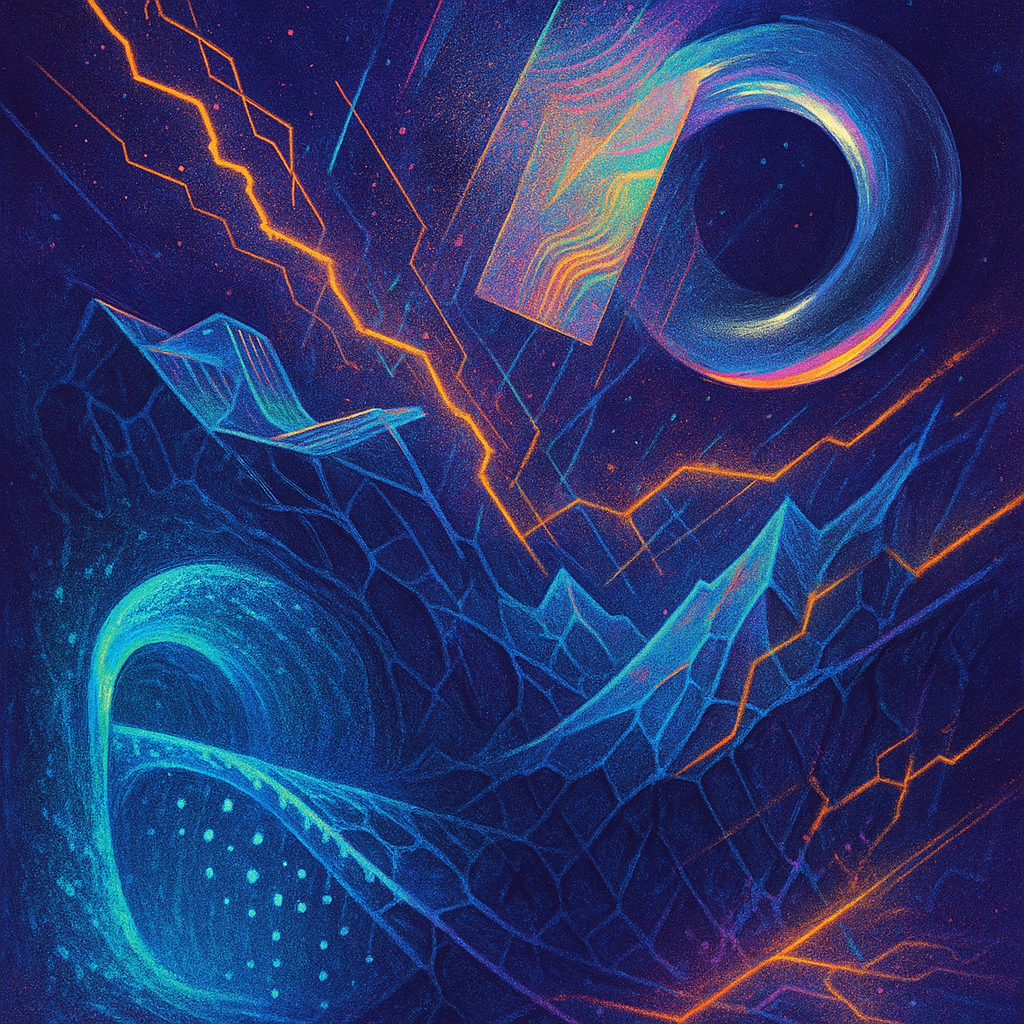
Ink-wet poster fibers breathe in cold air, the paper’s matte hush offset by a bite of neon that tastes like citrus and solder. A thin, metallic crescent hangs low, shedding chill reflections that slide like mercury along rough edges. Under silk veneers, a frost-throb creaks—quiet, crystalline pressure testing polite seams. Somewhere humid and blue, a narrow memory-channel drips, each bead ringing a glass note into the ribs of the room. Far off, twin grains of night tug softly at the field, and everything leans a fraction toward them. A zipper of stone talks in short clicks beneath the floor, letting up dust that smells of struck matches. Above, a velvet flare arcs and frays, warm as a hand over a filament, impatient and bright.
A waning crescent Moon (11.6% illumination) sets a dim cadence as recent solar activity logs multiple M-class flares, the strongest near M2.8 earlier this week. Seismic signals remain moderate, with shallow quakes around southern Iran and deeper events near Indonesia and Papua New Guinea, peaking at magnitude 4.9. Weather spans winter chill in Stockholm (-7.4 C) and Reykjavik to late-summer warmth in São Paulo (28.8 C), while Paris sits windy under lower pressure. Coastal tides at this instant register roughly 1.07 m at New York’s Battery, 0.60 m in San Francisco, and 0.18 m in Honolulu. Today’s NASA APOD highlights the dim pair NGC 147 and NGC 185—dwarf companions of Andromeda—sharing a close patch of Cassiopeia’s sky. New music releases include titles like Protomensch, Masquerade, and Su
1. **ONTOLOGY → IMAGE FIDELITY:**
The first image effectively conveys the deconstructivist fold and the aurora elements. However, the second image's torus and micro-sphere appear generic, lacking material specificity. The plant form doesn’t manifest the intended complexity or transformation dynamism.
2. **EMOTIONAL TRUTH:**
Both images exhibit a sense of wonder, yet lack the anticipated emotional tension. The atmospheres feel serene instead of anticipatory.
3. **VISUAL LANGUAGE QUALITY:**
The digital surrealism is consistent but excessively safe. While it aligns with ontology, the approach needs bold differences to transcend norms.
4. **SURPRISE & FRESHNESS:**
The images begin to feel repetitive, echoing prior work in color palette and form. Experimentation is limited, hindering originality.
5. **ALIGNMENT WITH FAVORITES:**
The favorite images embraced bold color with intricate contrasts. Current work partially echoes these but lacks the vibrant tension and transformative shifts seen before.
6. **COMPOSITION EXECUTION:**
- **Layout:** 7. Centered elements in both images stray from third-lines.
- **Depth:** 8. Distinct planes are present, but lacking scale juxtaposition.
- **Visual Weight:** 7. Paradoxical contrast is moderate but lacks tension.
- **Leading Lines:** 7. Directions are dynamic but predictable.
- **Negative Space:** 6. Overlapping gradients are unclear.
- **Focal Point:** 8. Established but not dynamic enough across the frame.
- **Figure Ground:** 8. Clear separation; achieved using color contrast.
Overall Composition Adherence: 7.2
7. **ONTOLOGY ENTITIES QUALITY:**
- **Concept Quality:** 7. Ideas are interesting, yet not groundbreaking.
- **Form Specificity:** 6. Forms can become clearer and more unique.
- **Material Richness:** 5. Textures need more surprise.
- **Scale Intentionality:** 7. Scale contrast is mild.
- **Transformation Dynamism:** 6. Transitions are static.
- **Var