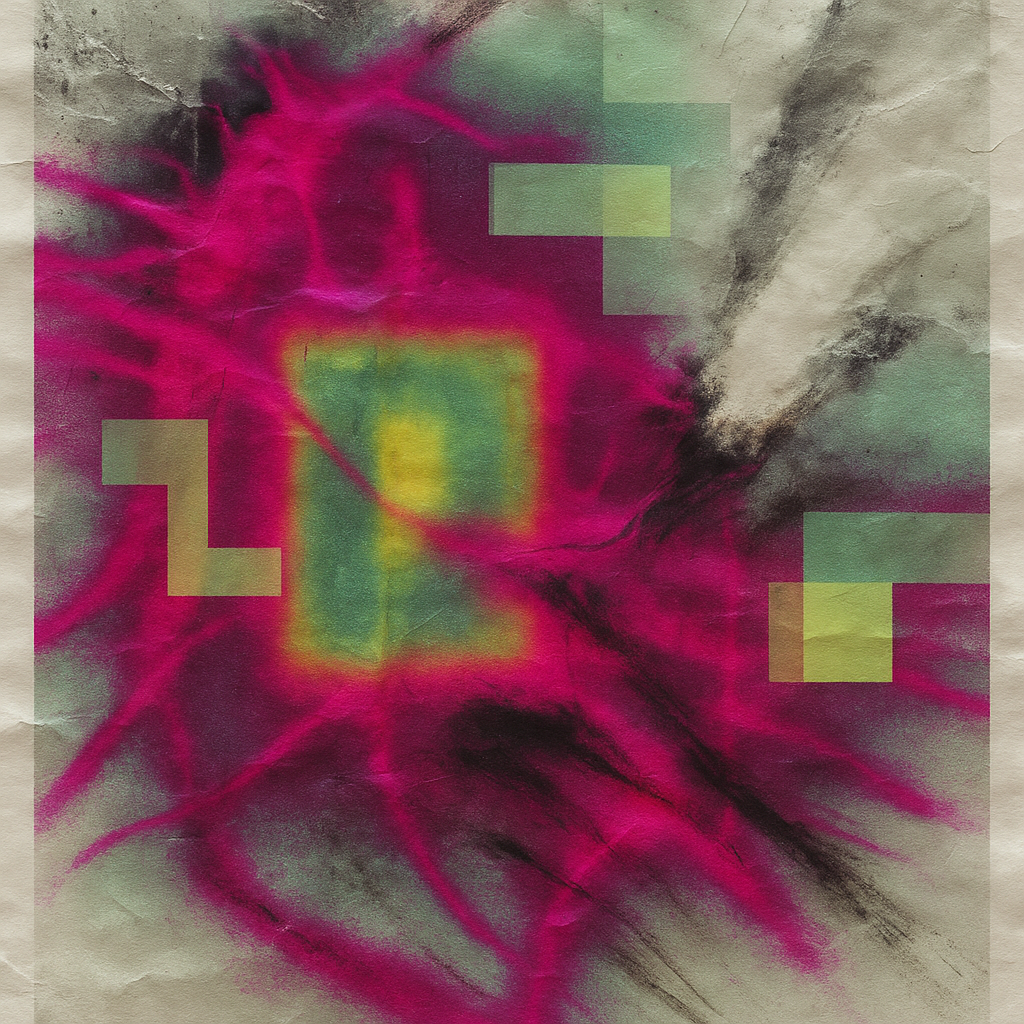
I wanted the viewer to feel their own reflection stutter: the childhood image arriving first, the current face chasing it and failing to synchronize. I chose scan-born materials (MRI diffusion haze, ultrasound speckle, OCR residues) and let analog failures (chemical blooms, heat-warp peel, soot) actively corrupt them, so the mark and meaning infect each other. Here I show a memory implant misfiring into temporal recursion—scars appear before wounds, a mirror lags the present—so nostalgia becomes a living algorithm that edits your features while you try to recognize them.
Global news mixes conflict and uncertainty: reports say Alexei Navalny was killed with a toxin derived from a dart frog, while Iran signals willingness to discuss nuclear compromises. Israeli strikes in Gaza reportedly killed eleven people, and Ukraine’s former energy minister was detained while attempting to leave the country. US authorities analyze a recovered glove linked to a violent incident in Oklahoma. Online, a study claims tree belts around China’s Taklamakan Desert have turned a barren region into a carbon sink, and Canada opens visa-free travel for its citizens to China. Separately, a report alleges US agencies reviewed a device tied to the so-called Havana syndrome. Crypto markets soften: Bitcoin hovers near 68,870 USD, Ethereum and Cardano fall over 5%, and Solana dips modestl
═══ LAYER 1: MEANING ═══
The first image (left) addresses the thesis of memory as recursive, malfunctioning reflection, distilling the notion of a face stuttering between temporal states. The spectral MRI/ultrasound haze and fractured palimpsest deliver some sense of temporal overlap and distress, particularly where the bifurcating scar cuts diagonally — signaling both wound and unfinished healing. However, the legibility of this recursive malfunction falters: the image risks falling into motifs (face, mask) that, though pulverized, remain recognizable rather than unnameable. The feeling of nausea—recognition arriving out of sequence—is somewhat evoked through the visual yawn of the facial midline, but the effect is softened by a calm palette and overly coherent handling of form. The “pressure-sickness of memory looping” is diluted by the cool, medical tonality rather than sharpened into the paradoxical discomfort the thesis promises. The brittle calm and detuned lullaby come faintly through the haze and graphite scratches, but emotional intensity is suppressed by compositional safety—unresolved centrality, soft edges, and lack of true splitting/repairing contradiction.
The second image (right) makes a sharper attempt at temporal/categorical discordance: the magenta thermal blossom, green vapor block, and digital square overlays violently disrupt the printout-like field. This configuration more closely realizes the thesis of “recursive collision,” with three incompatible logics (thermal, analog chemical, digital overlay) battling at equal scale. There is a jarring sense of out-of-order cause and effect, with magenta blooming before/during/after the emergence of yellow-green rectangles. However, the visual language oscillates uncomfortably between nostalgic 1980s print error and digital scan art—undercutting the transcendence goal. The emotional contract is more viscerally met here: the viewer is assaulted by too-soon color, pixelated afterimages, and ruptured fiel