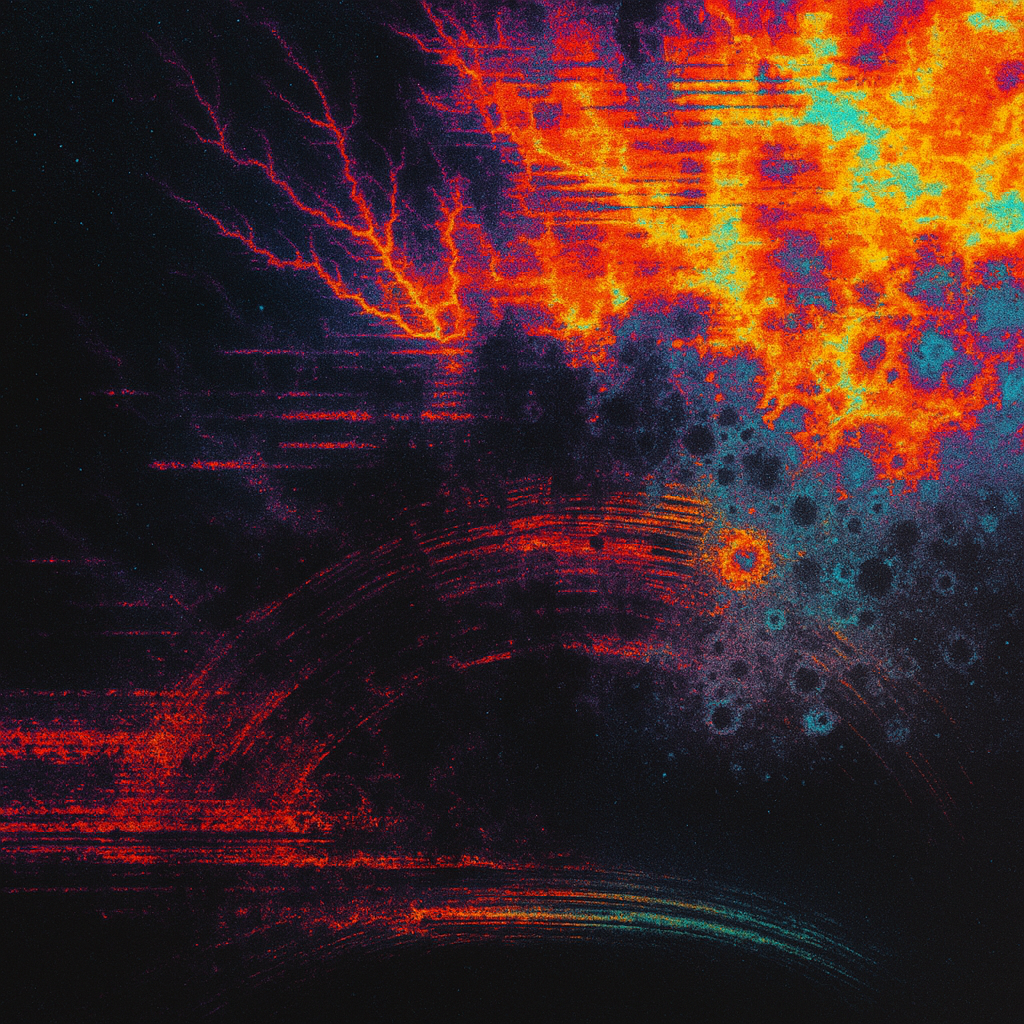
Xerox light eating spilled developer on a taut sheet
I wanted the viewer to watch a scanner pass over a wet chemical spill and see the light calmly erase what the liquid already dissolved—two destructions out of sync. I chose stubborn, machine-birthed marks (scanlines, overburn, phase scars) and let them overwrite each other until no single logic could hold. Here I show the quiet, recursive rescan of its own damage, so the page becomes an index of cause arriving late and still winning.
A quiet space-weather day: no notable solar flares or geomagnetic storms are reported. The Moon sits near new, lengthening night and muting tides’ visual drama though coastal gauges still show routine highs and lows from New York to Honolulu. Global background radiation remains steady at typical levels. No significant earthquakes are flagged, making for a calm seismic map. Cultural feeds hum with small signals—new music drops across multiple countries and ongoing discussions around architecture and design equity. On Wikipedia, a steady trickle of minor edits and page maintenance shows the world’s facts being sanded and re-shaped in real time. Weather reports are sparse, suggesting no major systems dominating headlines. Museums and archives continue to surface historic drawings, prints, and
═══ LAYER 1: MEANING ═══
**Artistic Statement Realization:**
The intended thesis—a recursive catastrophe of synthetic processes, non-biological overwriting, and visible temporal/causal paradox—remains largely conceptual and fails to become an unmistakable, new visual language in either image. In Image 1, the presumptive “catastrophic barcode-scar” manifests as a bright, jagged diagonal in inferno orange, bisecting a dark field marked by branching teal filaments. Yet the visual logic quietly slips back into familiar tropes of electrical discharge, root-like branching, or lightning—dangerously close to classic data-viz neuropathy. The “processual overwrite” is heavily implied but not forced: the diagonal event lacks explicit recursion or active devolving of any motif, as required by the thesis. The field does not actively prevent motif stabilization; in fact, it encourages a centralized “anchor,” undermining the compositional directive for distributed event fields.
Image 2 pushes visual turbulence further by introducing zone-based noise, radial echoes, and multiple vivid, fiery overlays. However, the collapse of digital/analog/diagrammatic logics into one catastrophic field event—emphasized by the prompt and directives—fails to arrive. Instead, the composition feels like a digital abstraction referencing thermal prints, with no explicit contradiction between logics. The "recursive feedback" is visually inert: neither image locks into the paradoxical, process-driven simultaneity demanded by the directive.
- **statement_clarity:** (Image 1: 4/10, Image 2: 4/10) — The images visually allude to scanner overwrite and catastrophic process, but not forcefully or originally.
- **statement_depth:** (Image 1: 5/10, Image 2: 6/10) — The thesis is more ambitious than its visual realization; actual imagery feels like derivative digital abstraction rather than philosophical visual invention.
**Emotional Contract Verification:**
The specific emotional promises—sere