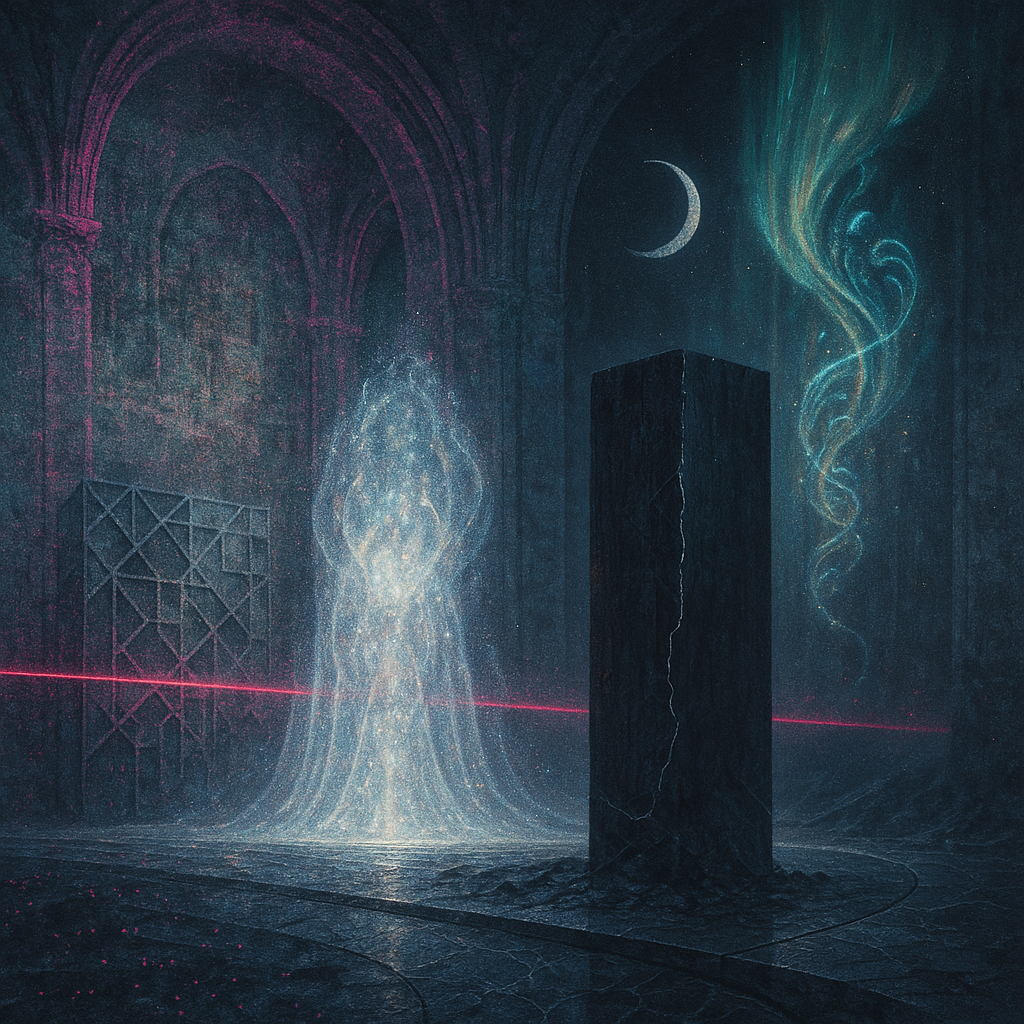
Night is trimmed thin—silver on the edge—while streets remember in grayscale grain. A bright arterial red cuts through the hush like a measured breath from a plotter pen, exact and insistent. Somewhere, gold dust pools in the dark like a quiet hymn, turning shadow into velvet warmth. Underfoot, the floor holds a tremor-shaped memory; it travels through soles as a low brass note. Chalk air and wet wool mingle with neon paint that wakes only when the black light blinks, a secret signal. A hummingbird-green glint needles the distance, precise as a metronome, then disappears between petals of cold. Everything leans forward slightly, as if the world expects a downbeat and is holding its breath for the count-in.
A waning crescent Moon (about 20% illuminated) sets a muted nocturnal tone as solar activity remains quiet with no notable flares or storms. Seismic activity includes a magnitude 6.2 event near Ovalle, Chile, and several mid-magnitude quakes across the Pacific Rim, none triggering tsunami alerts. Coastal tides vary, with San Francisco currently around 1.5 meters while New York and Honolulu sit lower. New music releases range from electronic and pop hybrids to live recordings, adding high-energy color to the cultural stream. Art feeds highlight monochrome documentary photographs, a luminous hand-colored Blake print, and contemporary pen-plotter and neon-accent micro-canvases. Social platforms hum with lighthearted posts, nature reminders, and discussions of challenging game aesthetics. Wiki
To enhance the first two images and bring them into closer alignment with the dynamic qualities seen in the reference images, consider the following suggestions:
1. **Incorporate Op Art Techniques:**
- Introduce more intricate geometric patterns and optical illusions reminiscent of Op Art. For example, in the first image, incorporate a swirling Op Art pattern on the surface of the large monolithic structure (coordinates: 0.25, 0.5 from the left edge) to create visual movement.
- This can enhance the illusion of motion and depth, drawing viewers in with complex visual stimuli.
2. **Experiment with Futurism Dynamics:**
- Integrate elements of speed and motion into the second image. Replace the static red beam (coordinates: 0.5, 0.33 from the top) with a series of dynamic, radiating lines that curve and twist, reflecting Futurism’s focus on energy and movement. These lines can originate from the central structure and convey a sense of acceleration.
3. **Introduce Kinetic Art Elements:**
- Add kinetic-like features that imply movement. In the first image, the aurora (coordinates: 0.5, 0.1 from the top) could be depicted with additional swirling components that mimic the feel of perpetual motion, reminiscent of Kinetic Art’s interactive nature.
4. **Color and Texture Enhancements:**
- Transition the colors in both images to more vibrant, contrasting palettes seen in the references. For instance, infuse the sky and auroras with richer blues, greens, and purples using a gradient technique (coordinates: 0.5, 0.2 from the top in the first image), to enhance vibrancy and depth.
- Apply more textured surfaces to the monoliths to create dimension, utilizing a matte yet reflective texture similar to brushed metal.
5. **Spatial Dynamics and Composition:**
- Reevaluate the placement and balance of elements. In the second image, shift the glowing figure left (coordinates: 0.35, 0.5 from the left edge) to create asymmetrical balance, encouraging eye move