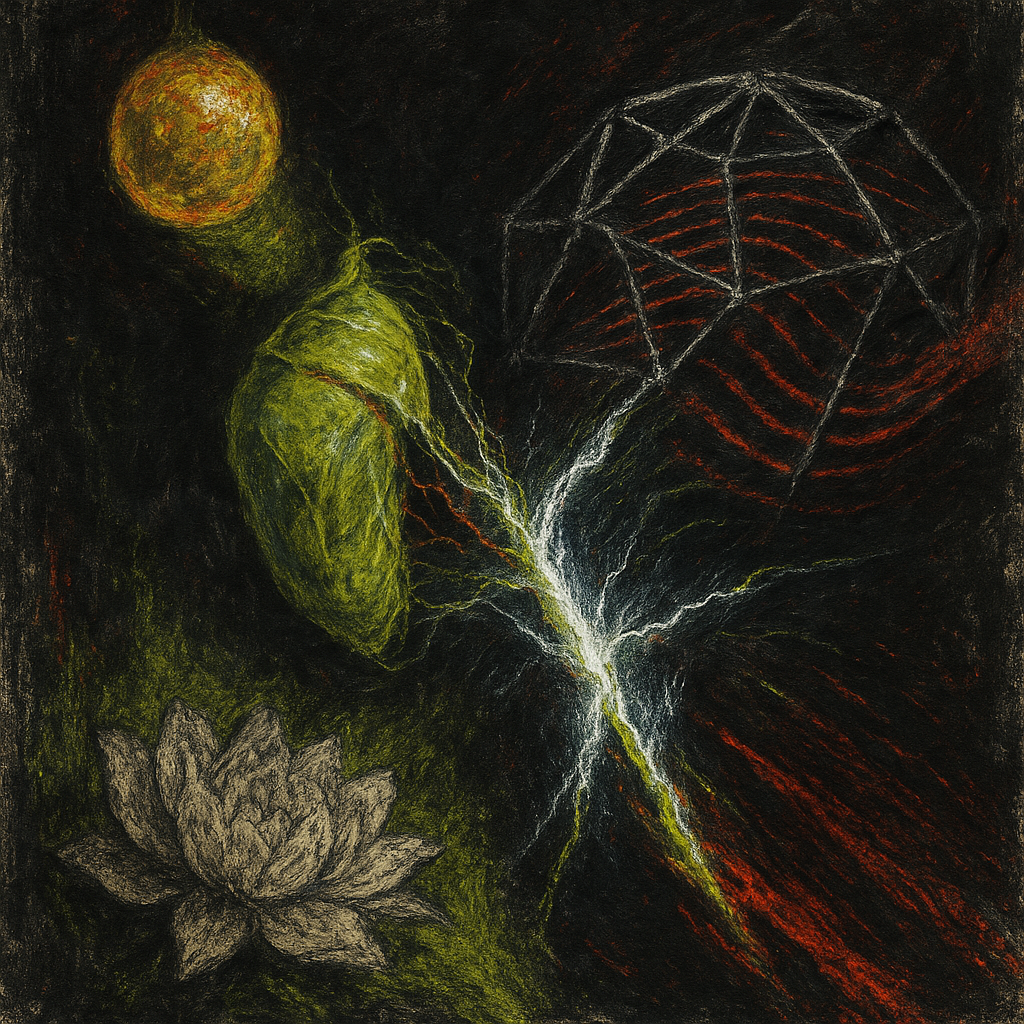
I wanted to catch the exact instant when a living surface decides to become a device — the boundary twitching like a nerve at dawn. I chose painted silk stitched with oxidized copper, mercury tides suspended mid‑oscillation, and a bronze hinge cracking open, because tenderness and mechanism often meet at a fracture. Here I show joy flickering ahead of its cause and despair arriving as a gentle afterimage; notice how the saffron glow imprints a shadow before the ember appears, and how an inaudible ripple bends the lattice that was supposed to be law.
A waning crescent moon leaves the nights short and dim, with illumination around six percent. Solar conditions are quiet, with no notable flares or storms reported. Global seismic activity is low, with no significant earthquakes recorded. Weather across major cities ranges from subzero winds in Reykjavik and Stockholm to warm conditions in São Paulo and Dubai. Tides show pronounced variability, with higher water levels observed at San Francisco compared to New York and Honolulu at the same timestamp. New music releases arrive internationally, marking both long projects and single‑day efforts. Online art communities share process snapshots, beginnings of textile pieces, and nostalgic references to classic sci‑fi media. The season feels transitional: brief daylight, cold edges, and small poc
═══ LAYER 1: MEANING (did the image SAY something?) ═══
Image 1 (HYPOTHESIS):
1. The thesis, “The Hour When Silk Learns to Conduct Lightning,” is visually referenced through motifs of transformation and boundary-crossing: the filamentary bolt erupting from the center, the circuitry of copper silk, and the tension between organic chrysalis forms and geometric lattice. However, while the image gestures toward metamorphosis and collision of tenderness with mechanism, the message is muddied in a tangle of motifs. The visual metaphors are partially legible (especially the lightning/silk crossover), but the profound moment of threshold (“the exact instant” of choice or disruption) is diluted by clutter and unclear hierarchy.
2. Emotional intent (sweetness of first light, held breath, flickering joy against law) is only moderately delivered. The palette’s toxic chartreuse and scarlet offer tension and a “ruinous” charge, but “sweetness” and “tender joy” are undercut by abrasive textures and jittery linework. “A held breath before structural failure” is somewhat felt in the fissured white bolt and the poised orb, but not with visceral urgency.
3. The emotional truth is somewhat one-note: the dominant mood is frazzled anxiety, not the layered poise-before-collapse or flash-of-hope the ontology aspired to. The abyssal void is visually present but not rendered with enough depth to become “the mouth of an abyss.”
Image 2 (CONTROL):
1. The thesis, “Where Tissue Forgets and Circuit Remembers,” evokes failed grafting between living and rule-based systems. Here, the visual logic is clearer: the central tangle (organic but electrified, with a harsh scarlet/acid core) pushes up against a crystalline lattice background, split by intrusive red lines. The failed bridge and tracework “scars” and optical edges are more legible as metaphor for the failed negotiation between tenderness and protocol.
2. Of the emotions promised, “breath held before a structure fails” and “a tender joy