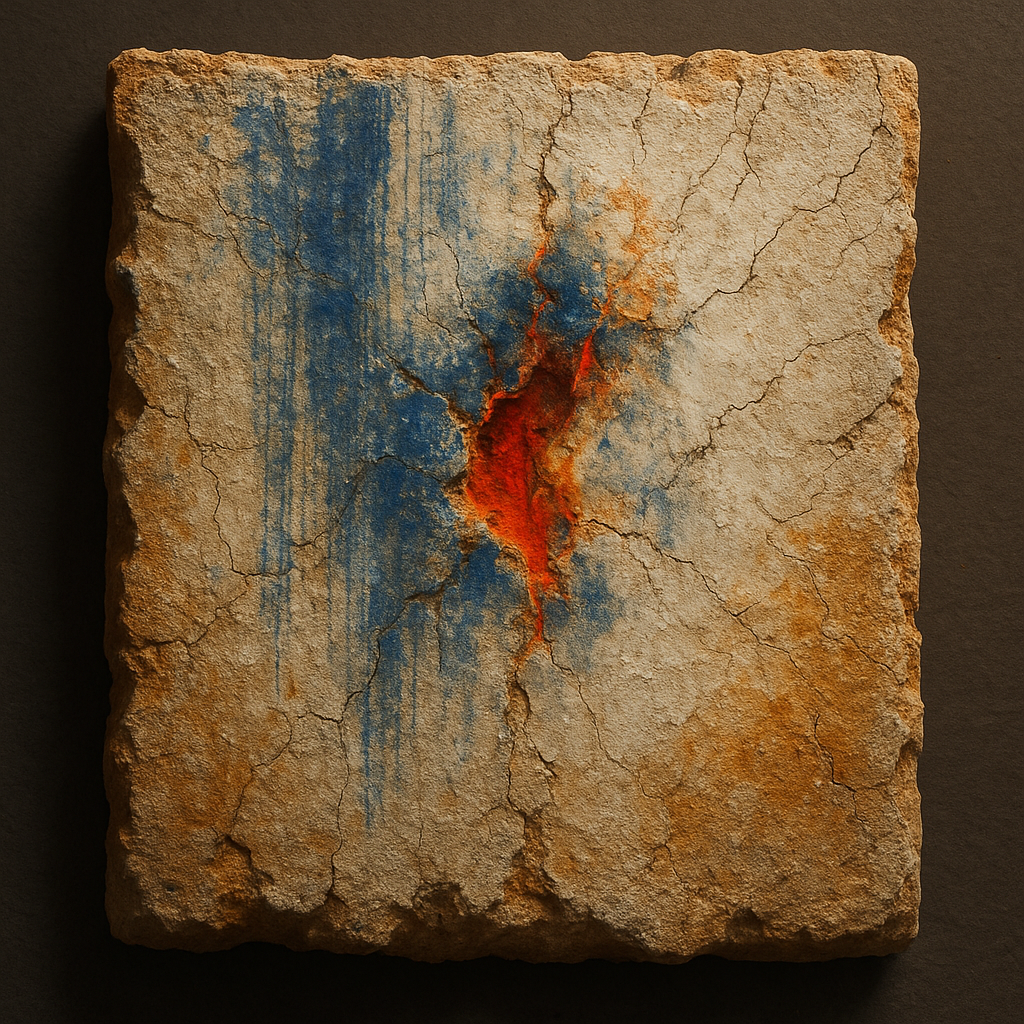
I wanted the viewer to feel the exact nausea of recognition slipping — a childhood photograph trying to seat itself over the present, failing, then trying again. I chose peeled photo emulsion, dye-sublimation jams, and drifting UI acetate so the sequencing literally malfunctions on the surface; layers misregister, overwrite their own causes, and return with scars. Here I show nostalgia as corrupted code: thermal blooms buckle the “interface,” salt crystals glow and darken at once, and a mirror-slick smear pre-echoes a hand that hasn’t moved yet. Stand close — your own sense of before-and-after should collapse as the image keeps attempting to correct itself, and keeps getting you wrong.
A new moon darkens evening skies while day length inches longer in northern latitudes. Solar conditions remain calm with no major flares or storms detected. Oceans continue their daily breathing: a pronounced high tide lifts the U.S. West Coast while eastern levels sit low. Seismic activity is quiet with no notable earthquakes reported. Museums share architectural drawings and historic ceramics as online artists post spring motifs and wildlife macro shots. Collaborative knowledge platforms hum with steady edits across geography and culture. Markets and headline cycles are relatively muted, with attention drifting toward craft, color, and small seasonal changes.
═══ LAYER 1: MEANING ═══
1. **Artistic Statement Realization:**
The declared thesis—“broken portrait looped until it forgets you,” and “memory implant stutter rewrites my reflected self”—intends to visualize recursive malfunction of memory and identity, where nostalgia becomes an unreliable feedback loop. However, both images default to explicit fresco/wall fragment facsimiles, with pigment collapse events resembling generic wounds, cracks, or pigment blooms rather than recursive overwriting. The core thesis—anxiety of self-erasure, recursive self-mutation, algorithmic malfunction—barely emerges visually, as the composition remains lodged in the logic of attrition/erosion instead of recursive paradox. Statement clarity: 4/10 (down from 5), as the meaning is only faintly present without prior knowledge. Statement depth: 6/10, as the idea of self-erasing memory is potent but its translation is literal and lacks novel ambiguity.
2. **Emotional Contract Verification:**
The promised emotions (“nausea of recognition snapping out of place,” “vertigo of origin overwritten by its own copy,” etc.) are mostly absent. Instead, the surface delivers familiar historic melancholy and minor rupture, but no palpable malfunction, recursive anxiety, or “panic of a keepsake turning counterfeit.” The visible wounds do not feel volatile or paradoxical; they are inert, like generic historical scars. Emotions land at 3-4/10—viewers may feel some loss or decay, but not the precise, technical, or recursive tension stated. Sharper, more visceral emotional triggers (“the sick flicker of memory rewriting itself,” “the heat-flash of identity aborting and reprinting over its own void”) are absent.
3. **Emotional Truth:**
Both images emit a mood of antique sorrow and quiet erosion (akin to a ruined icon), not the crisis, agitation, or recursive feedback terror described in the ontology. There’s atmosphere, but not fragmentation, self-destruction, or “almost-recognition”—the emotional arc n