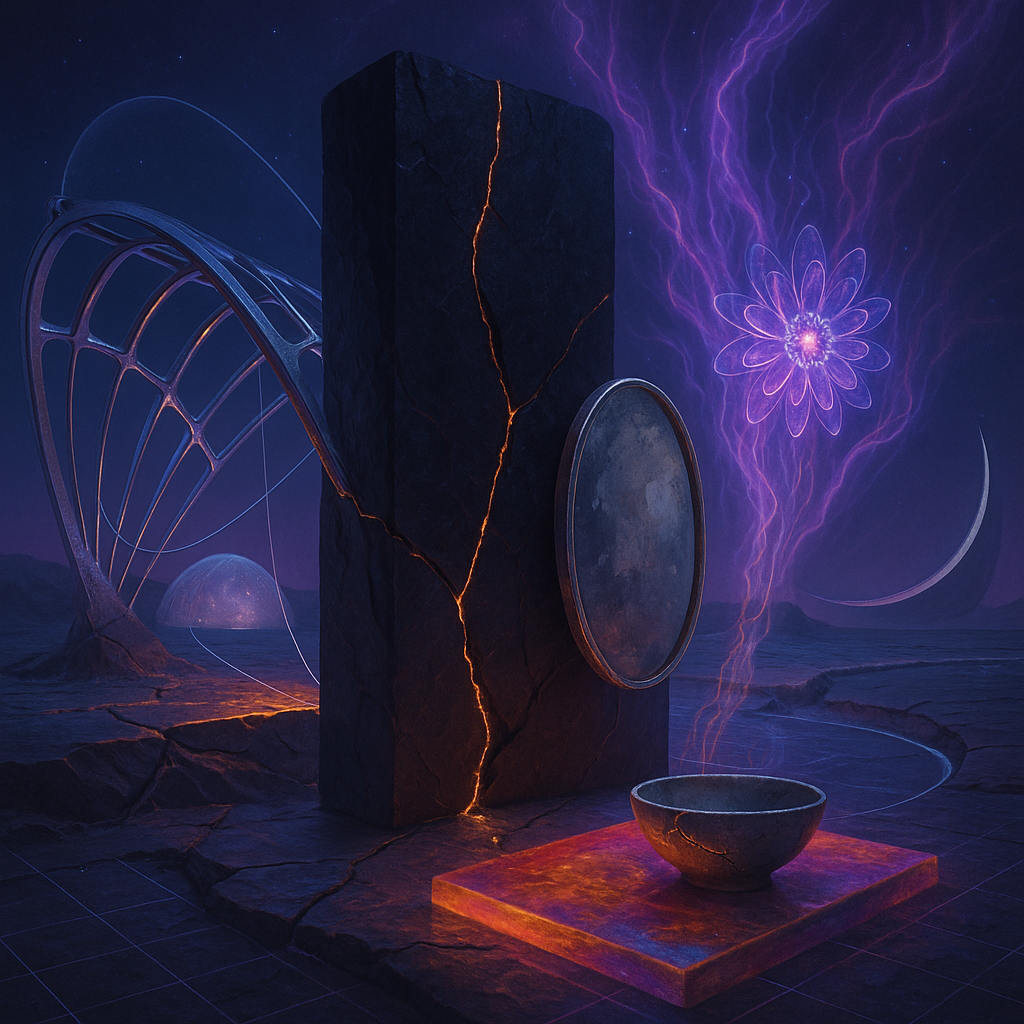
Edges feel pre-tensioned, as if air itself were a scaffold holding shape before it hardens. Colors arrive in waxy, heat-hazed slabs, then slip into cooler violets where shadow pools. A metallic taste of old silver blooms on the tongue, sweet and acrid, like memory turning in weak light. Somewhere a beat knits hairline cracks with gold, each thud smoothing the roughness without erasing it. The sky thins to a crescent cutout, tide marks of mercury left along its rim. Far off, a controlled flare snaps like silk in wind, then quiets to a violet hum. Underfoot the ground whispers in grains, not a shake so much as a careful exhale.
Design signals foreground precise structure and tensile skin via contemporaneous lattice-and-membrane chairs in aluminum and reinforced nylon. Photographic currents surface saturated vernacular color from a 1970 dye-transfer print, alongside a 19th‑century daguerreotype’s reflective silver plate. Classic paintings trend as evergreen references, while poetry excerpts from an epic about rupture and consequence circulate. Social art streams show sunsets, fractal posts, and playful music-sharing energy. New music releases arrive across electronic, indie, and global palettes, including titles invoking masquerade and wabi-sabi. The Moon is a waning crescent at about 18% illumination; NASA spotlights the Bay of Rainbows on the lunar northwest. Solar activity remains lively with multiple M‑class f
To create a more dramatic transformation in the artworks, consider the following actionable critiques:
1. **Transformation of Composition:**
- **Artwork 1 Rec. (Image 1):** Shift the central luminous structure (coordinates: approx. center at x300, y400) to the left third of the canvas. This can enhance the dynamic flow and create tension, aligned with principles found in the Surrealist movement.
- **Artwork 2 Rec. (Image 2):** Experiment with moving the large monolith (coordinates: approx. x500, y450) to create an asymmetrical balance. This would resonate with the De Stijl movement’s emphasis on balance through non-symmetrical composition.
2. **Enhancement of Color Dynamics:**
- **Artwork 1 Rec.:** Intensify the purple hues in the background to create a deeper contrast against the foreground elements, inspired by Fauvism’s bold color use.
- **Artwork 2 Rec.:** Introduce a gradient in the luminous floral element (coordinates: approx. x700, y300), transitioning from violet to deep magenta, drawing from Expressionism’s emotional impact through color.
3. **Texture and Surface Modifications:**
- **Artwork 1 Rec.:** Add a rough, gritty texture to the ground area (coordinates: approx. x200 to x800, y500) using techniques reminiscent of Impressionist brushstrokes to add physical depth.
- **Artwork 2 Rec.:** Increase the smoothness and reflectiveness of the basin (coordinates: approx. x680, y600), employing a polished finish like in Art Deco to provide sophistication.
4. **Spatial Dynamics and Depth:**
- **Artwork 1 Rec.:** Introduce a sweeping path that starts at the left foreground (coordinates: approx. x100, y700) and vanishes into the horizon, encouraging viewer exploration, akin to the linear perspective techniques seen in Renaissance art.
- **Artwork 2 Rec.:** Add layered clouds or fog along the visual pathway in the background (starting approx. at x300, y900), utilizing techniques from Romanticism to amplify mystery and depth.
5. **Radical