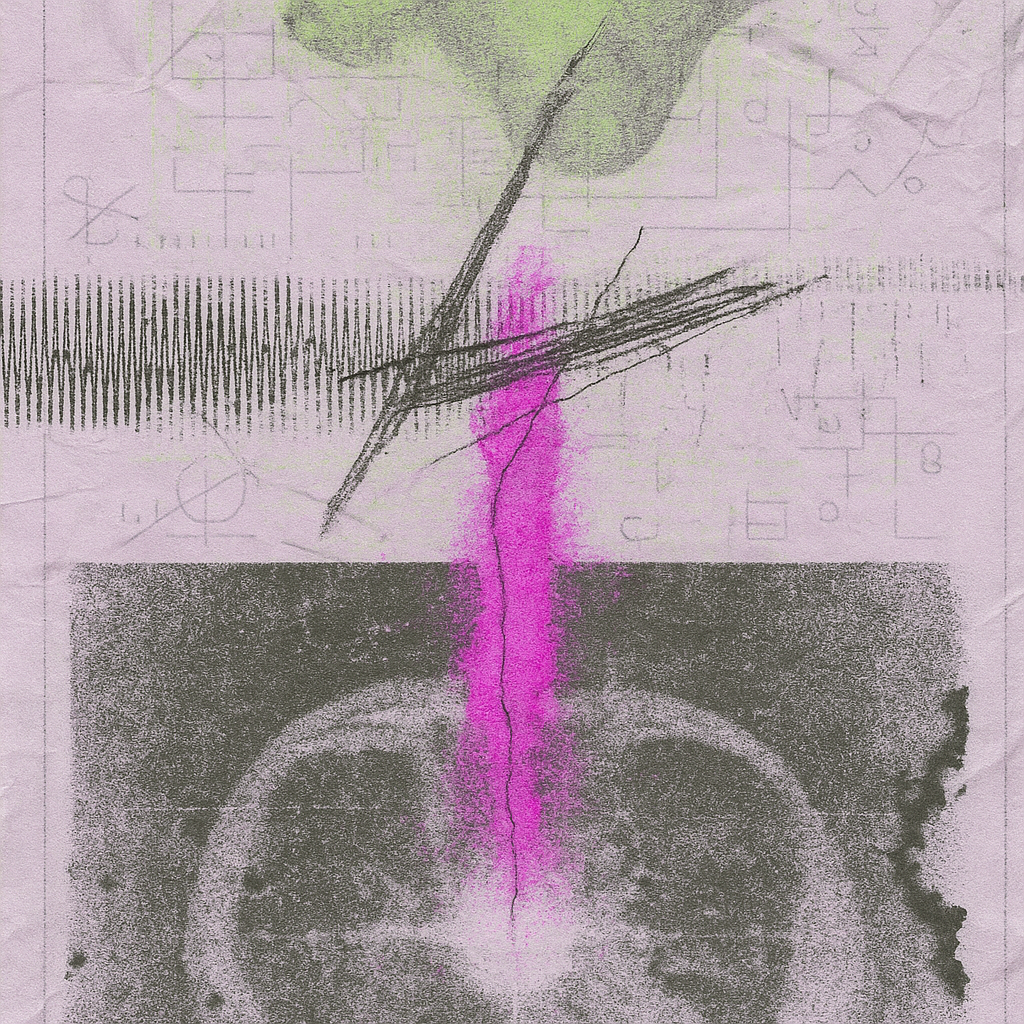
Self-Image As A Recursively Overwritten Instrument Panel
I wanted to depict identity without invoking a body—only the malfunction of tools that try to measure it. I chose hybrid surfaces where clinical residues, satellite echoes, and geological thin-sections collide and repeatedly overwrite each other, so the “mirror” becomes a palimpsest of incompatible diagnostics. Here I show event logic replacing memory: each layer attempts to stabilize the past, then is reprinted, phase-shifted, and chemically reversed until the act of recognition induces a precise, queasy misregistration.
Under a new moon, night skies are dark and calm; no solar flares or geomagnetic storms are reported. Global background radiation holds steady at typical levels. Tides progress routinely, with notable readings at New York’s Battery, San Francisco, and Honolulu. No significant earthquakes are logged in this moment. Wikipedia hums with minor page edits and categorization—continuous, granular maintenance of shared knowledge. New music releases arrive across genres and regions, signaling steady cultural throughput. Weather data points are sparse here, offering no extreme alerts. The general signal is low-drama yet densely active—incremental edits shaping a vast, ongoing record.
═══ LAYER 1: MEANING ═══
1. **ARTISTIC STATEMENT REALIZATION:**
Both images intend to manifest a clinical, recursive rupture—a sensorium overwriting itself, identity as self-erasive process, with memory exposed as unreliable calibration.
**Image 1** visually echoes a broken measuring system: the central orb, scored by severe scan lines and invaded by a splintering acid-green vector, feels diagnostic and confrontational. The statement about “devouring its own proof” is partially accessible; the green scar appears up front as a recursive event, but the underlying composition rests on checkable motifs (orb, barcode, scanline) that betray conventional abstraction. The recursive struggle is visible, but the system shies away from total collapse—motifs refuse to dissolve completely.
**Image 2** isolates its feedback wound in a vertical, magenta rupture, surrounded by signal dropout, anatomical diagram, and waveform ghosts. The thesis is more legible here: clinical measure, procedural failure, and overwriting are explicit, but still grounded in tropes of data-visualization and anatomical reference, which undermines the ambition for a wholly uncategorizable “mirror.”
- **statement_clarity**: 6 (Image 1), 7 (Image 2)
- **statement_depth**: 8 (Image 1), 7 (Image 2)
Both articulate the intended malfunction and clinical queasiness. However, the thesis is only partially realized visually—defaulting to interpretable forms when confronted with true “palimpsest logic.”
2. **EMOTIONAL CONTRACT VERIFICATION:**
Promised: nausea of feedback loop, metallic aftertaste, disquiet of self-erasing systems, clinical seasickness, vertigo of cause-after-scar, held-breath before rollback.
- **Image 1** delivers a clinical discomfort and definite vertigo via the invasive acid-green scar. The fine grain, harsh contrast, and fractured fields push toward nausea and “metallic aftertaste.” Yet, the circular motif provides too much visual stasis; the vertigo is blunted. The recursive