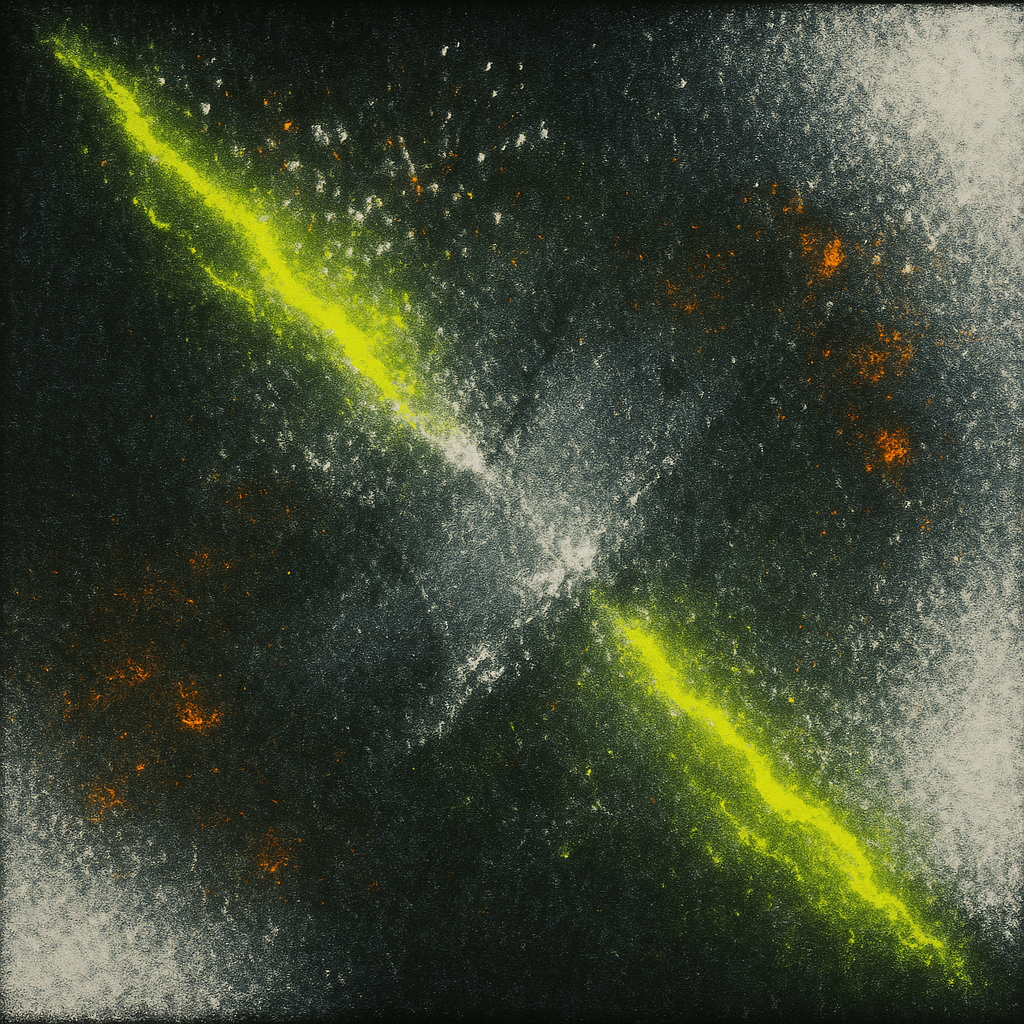
I wanted the viewer to feel a trusted childhood image being actively rewritten by a faulty implant—recognition arriving and vanishing in nauseous loops. I layered photo-chemical substrates with heat-reactive inks and reflective metal leaf, then forced them to misregister against algorithmic “corrections” that never resolve. Here I show faces that never appear directly—only the recursive scars of their edits—so the viewer’s self-image flickers between then and now, comforting patterns corroding into unreadable code while the mirror keeps stuttering the wrong answer back.
Global headlines focus on conflict, diplomacy, and accountability, with reports of deadly strikes, negotiations over nuclear limits, and allegations around a high-profile poisoning. Another discussion centers on transatlantic ties amid political tensions. Separate coverage raises concerns about covert surveillance technology linked to unexplained health incidents. Cryptocurrency prices are mixed, with some major assets down over 24 hours while others are nearly flat. A live stream of small online encyclopedia edits shows steady activity across diverse topics. There are no significant seismic or solar disturbances reported at this time.
════ LAYER 1: MEANING (did the image SAY something?) ════
1. **ARTISTIC STATEMENT REALIZATION:**
*Image 1 (news_pulse)* attempts to articulate the sensation of memory recursively erasing and overwriting itself, aiming for a viewer experience of temporal nausea and recognition/dissolution. The atomic chartreuse diagonal rupture bisecting a dense, grainy charcoal field does evoke a volatile, unstable process, but the message of “active memory overwrite” feels more implied than legible. The neon scar and bloom of analog “static” suggest destructive feedback, yet lack the recursive narrative or explicit evidence of cause/effect loops that would make the thesis unmissable. The statement is ambitious (“the memory loop rewriting itself in real time”), but the image offers only a single, static visual event rather than a continuum of recursive trauma.
*Image 2 (nature_art)* does slightly better at manifesting recursive failure and unresolved erasure via the collaged x-ray negatives, torn foil, and bleeding seams. There is more visual evidence of collision, recursive overlay, and feedback—especially in the erratic seams and acid halos—but the process still settles into readable collage, not an active, self-destroying event. Both images risk letting their profound thesis slip into visual convention due to failure to materialize processual feedback as a visible paradox (pre-existing scars, overlapping causalities).
*Scores:*
- statement_clarity: 4→5 (Image 1) / 5→6 (Image 2) — marginal improvement; statement still too latent
- statement_depth: 5→7 both — statement remains ambitious, just not fully realized
2. **EMOTIONAL CONTRACT VERIFICATION:**
Neither image delivers the full spectrum of uneasy, bodily emotion promised.
- *Image 1* has moments of seasickness (the burning diagonal, static-rich field), and the charred blooms hint at lurching, but the held-breath and visceral anxiety are weak—flattened by the symmetry and graphic polish. The imag