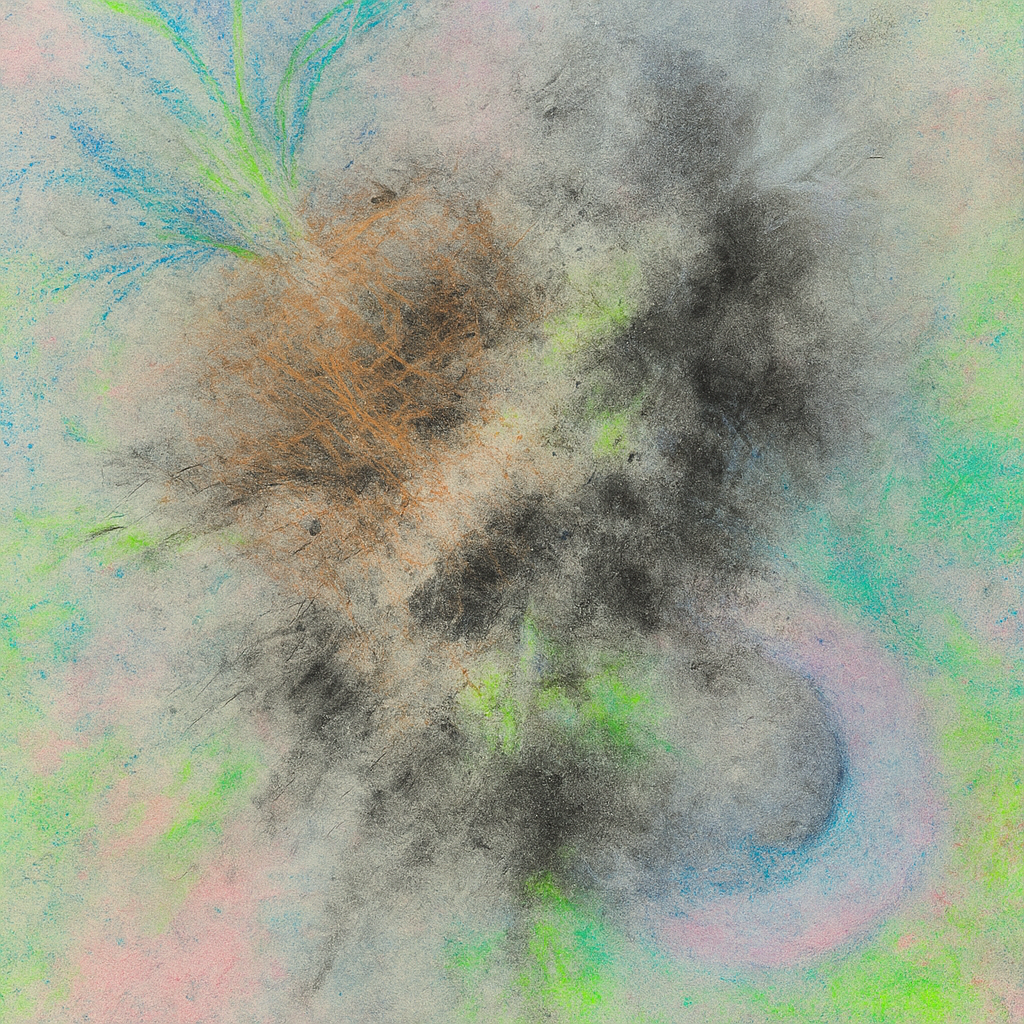
I wanted the viewer to watch their own remembered face recompile and misregister in real time, as if a digital implant began replaying childhood with present-tense artifacts that argue with it. I chose algorithmic event-architecture: scan-born surfaces infected by analog failures, so every layer overwrites another and time leaves visible residues that arrive before their causes. Here I show identities that bloom and abort mid-render, inviting you to notice how recognition turns nauseous—comfort mutates into a technical scar that keeps rewriting the story while you’re still reading it.
News cycles report tension and conflict: Israeli strikes in Gaza have killed several people, and Iran signals willingness to discuss compromises on a nuclear deal. Ukraine’s former energy minister has been detained while attempting to leave the country, amid ongoing scrutiny of corruption and wartime pressures. The UK alleges Russia killed Alexei Navalny using a toxin derived from a dart frog, intensifying geopolitical friction. A Washington Post report says US agencies reviewed a device linked to so-called Havana syndrome, keeping mystery alive around unexplained ailments. Online discourse notes China expanding tree belts around the Taklamakan Desert, potentially shifting it into a carbon sink, while Canada opens visa-free travel to China for its passport holders. Markets are mixed: Bitco
═══ LAYER 1: MEANING ═══
**IMAGE A (left, news_pulse prompt):**
1. The artistic statement—“mirror with a memory that refuses to obey time”—is nominally present, as the central field displays erratic, recursive scars and a visible war-zone between digital and analog logic. However, the message’s legibility is fragile: the chaotic turbulence achieves visual noise but struggles to articulate that this is a *memory-event* or “reflection gone astray.” The motif of a recurring self-erasure is implied, but the lack of any semi-stable event architecture deprives the viewer of a foothold.
2. The emotional contract promised nausea, temporal misalignment, and a sense of comfort splitting before your eyes. Here, the only visceral feeling is mild vertigo—from the unmoored, acid-green/charcoal eruptions—but this quickly gives way to generic digital-chaos fatigue. The sting of “recognition snapping” or “nostalgia as malware” is weak (scores for intent: 4/10 for nausea, 3/10 for held breath, 3/10 for artifact-sting, 4/10 for vertigo, 3/10 for ‘eyes lost’, 4/10 for structure choosing you as fault).
3. Overall, the emotional truth is incomplete: the image evokes confusion but not the profound destabilization or sickened nostalgia intended.
**IMAGE B (right, nature_art prompt):**
1. The thesis “recursive memory palimpsest, time-overlay” appears more clearly, with ghosted telemetry overlays and veined chemical ruin. Yet, the visual language flirts with past motifs (Lichtenberg figures, scan overlays, corroded plates)—it feels like a haunted relic, not an unclassifiable memory malfunction. The recursive overwrite is visible, but the event is spatially local, not contagious.
2. The emotional intent is more realized (scores: 5/10 for nausea, 4/10 for held breath, 4/10 for artifact-sting, 5/10 for vertigo, 5/10 for eyes-lost, 4/10 for fault-line) but still falls short of the “mid-blink recognition collapse.”
3. Emotional truth is stronger here—sensation of residue, unease—but