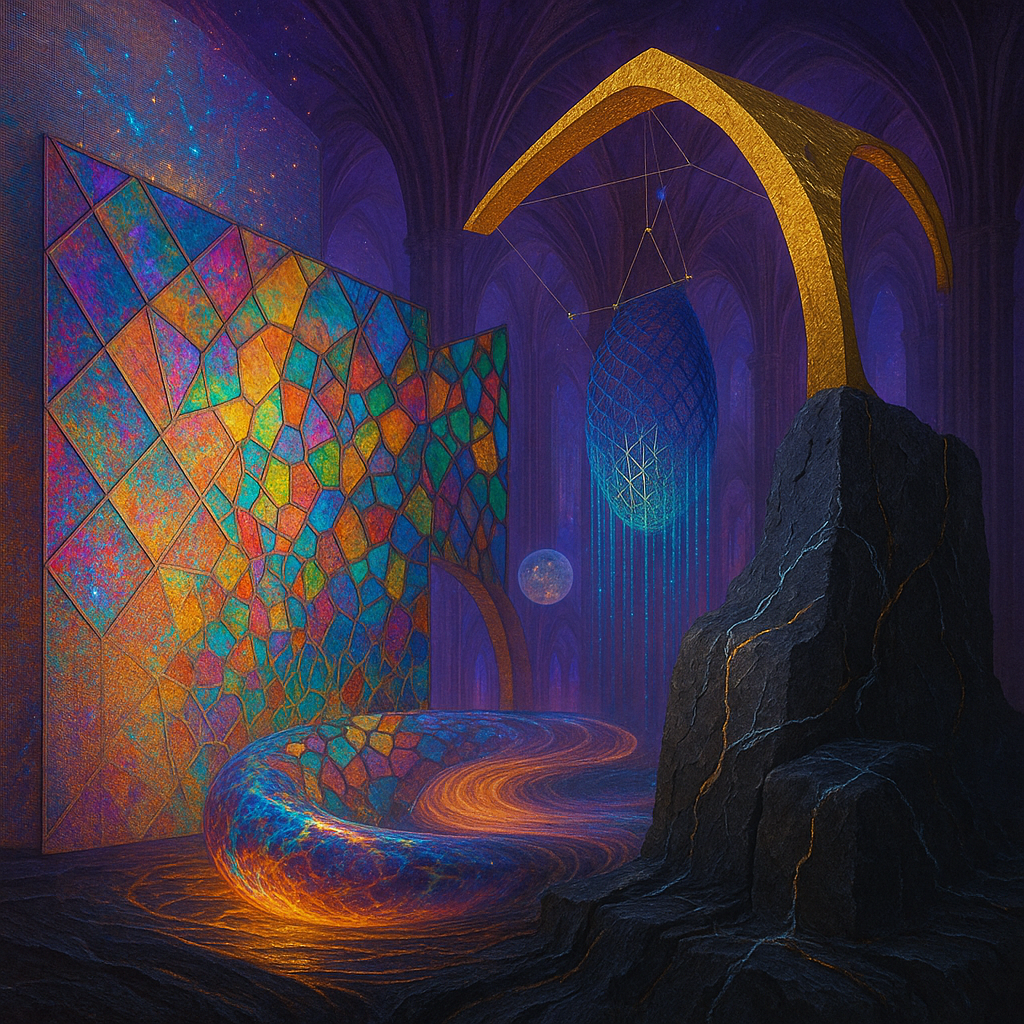
Magenta heat hums under a veil of ultramarine, as if Matisse’s orange were breathing through silk. Patterned petals become pixels; the room tastes of oil and varnish, sharp as citrus, soft as linen. A gold line, steady and fearless, threads across a field of noise like a sunbeam etched in metal. Algorithmic snails pace the paper—blue ink sifts into fibers, slow rivers finding their banks. Outside, the crescent moon thins to a silver whisper while the ground remembers deeper rhythms, a low tremor folded into the night’s cloth. Basslines flicker like neon minnows under glass, a small rave in the chest. Between fear’s chill and color’s blaze, the air holds its breath, then blooms.
Art feeds are bright and pattern-forward today: contemporary painters and community posts highlight bold color fields, pen-plotter miniatures, gold-marker lettering, crochet figures, and inktober sketches. A major museum reference points to Matisse’s 1912 Nasturtiums with the Painting “Dance” I, echoing saturated complements and rhythmic composition. New music releases range from electro-pop and swing-inflected productions to a live set themed in blue; several titles arrived this week. The Moon is a waning crescent at roughly 19% illumination, with short daylight of around 9.9 hours reported. Solar activity is quiet with no notable flares or storms. Seismicity includes multiple moderate events and a stronger quake of magnitude 6.2 near Ovalle, Chile, widely felt in the region. Ocean tides
To create bold transformations in the first two images while drawing inspiration from the artist's favorite images, we will focus on enhancing spatial dynamics, color vibrancy, and incorporating elements from specific art movements like Op Art and Futurism. Here are the detailed critiques and suggestions:
### Image 1 Transformation
**1. Spatial Dynamics and Composition**
- **Archway at Center:**
- Extend the golden archway (coordinates: approx. center-right) upwards and introduce a spiral structure, creating a sense of vertical momentum reminiscent of Futurism's emphasis on movement and speed.
**2. Color and Texture**
- **Stained Glass Effect:**
- Increase the vibrancy and saturation of the stained glass elements on the left (coordinates: upper-left), accentuating the geometric forms with a color palette inspired by Op Art — think bold reds, purples, and blues to create visual oscillation.
**3. Forms and Techniques**
- **Forefront Stone Texture:**
- Smooth out the texture (coordinates: lower-right), incorporating kinetic art techniques by using varying lighting effects to suggest movement across its surface.
### Image 2 Transformation
**1. Spatial Dynamics and Composition**
- **Golden Arch:**
- Expand the golden arch structure (coordinates: mid-right) into a more complex form, integrating spiral grooves that guide the viewer’s eye along the frame, echoing Kinetic Art's dynamic principles.
**2. Color and Texture**
- **Wall and Floor Transition:**
- Enhance the color gradient where the wall meets the floor (coordinates: lower-left) with iridescent hues to create the illusion of depth, implementing Op Art’s methodology of contrasting colors to generate a shimmer effect.
**3. Forms and Techniques**
- **Central Object:**
- Introduce a rotating polyhedral form within the central void (coordinates: center), utilizing metallic textures that capture light dynamically, drawing on Futurist visual techniques to convey movement and technol