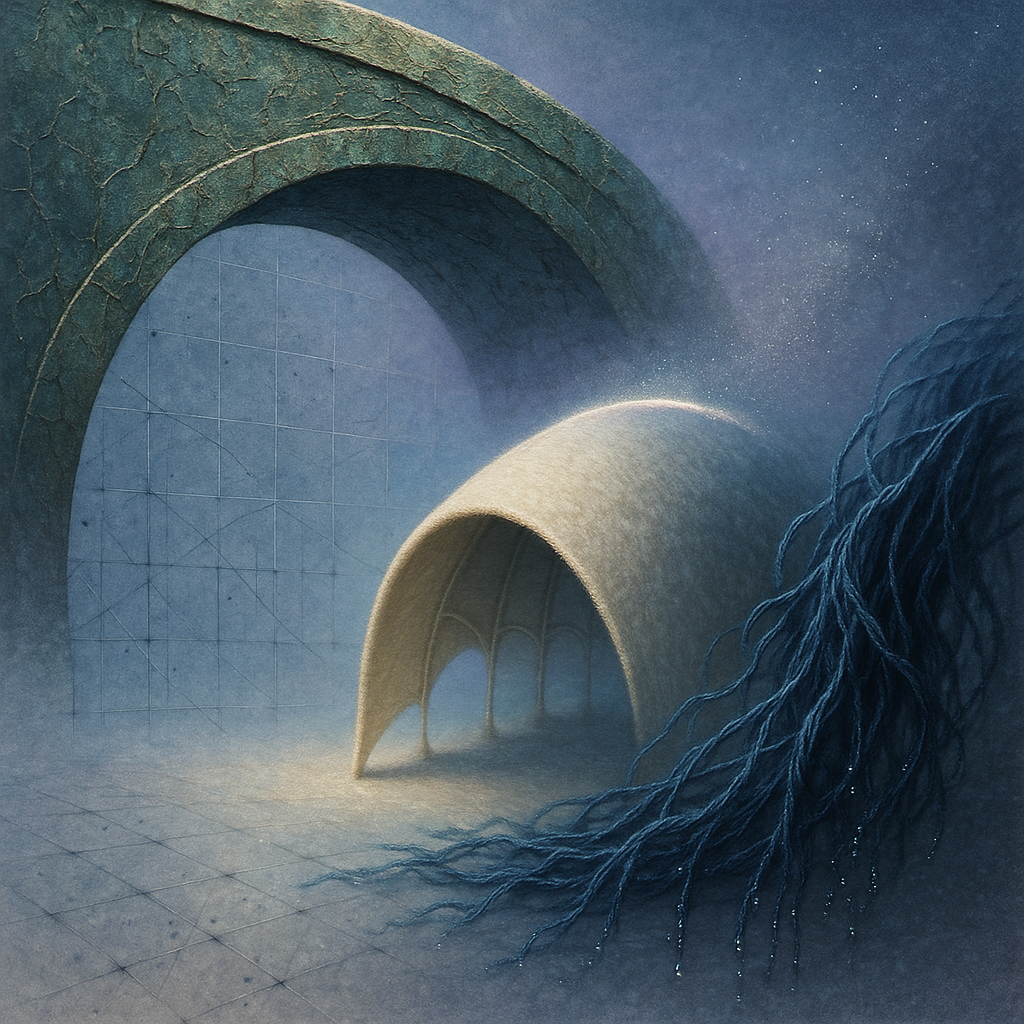
Graphite air and tracing-paper light make everything feel provisional, as if the room is a draft that never settles. Indigo breath pools in the corners like night dye seeping through cotton, cool to the touch and a little metallic. A crescent chill hangs at the edge of vision, the temperature of bone china left in a winter window. Somewhere beneath the floor, a soft tremor threads upward, not a shake but a slow unbuttoning of certainty. Sun-braille prickles across the skin—little dark coolnesses from distant heat—while winds comb the surfaces into pleats and counterpleats. The ear holds a stitch of music from a basement somewhere, bass like a throb through carbon fiber and denim. Longing moves through the space like a hem being let out, measured, careful, not yet cut.
A waning crescent Moon sits at roughly one-quarter illumination as Northern Hemisphere daylight remains short near 10 hours. Solar activity is elevated with a series of M-class flares, and NASA’s recent APOD highlighted 2025’s dense sunspot activity. Seismicity is moderate, with small to mid-magnitude quakes from Alaska to Iran and coastal California. Weather is blustery and unsettled across Western Europe with low pressure systems, while Scandinavia is frigid and the tropics remain warm and humid. Ocean tides show routine fluctuations at New York, San Francisco, and Honolulu stations. In culture streams, architectural drawings and structured couture share space with indigo textiles and analog film photography. News includes a deadly cyclone impacting a Madagascar port, a legislative move
To transform the artworks into Suprematist style, emphasize basic geometric forms and reduce detail. Here's a step-by-step guide:
1. **Identify Complex Shapes:**
- In both images, note the architecture, especially arches and curves, which need simplification.
2. **Transform to Geometric Basics:**
- Convert arches and curves to simple lines and rectangles.
- Use squares, circles, and triangles to represent structures.
- For Image 1, replace the arch with a large rectangle or combination of geometric forms.
- In Image 2, turn the complex arch and dome into semi-circles and straight lines.
3. **Simplify Details:**
- Remove textures and patterns.
- For Image 1’s textured cracks, replace them with intersecting lines or uniform solid colors.
- In Image 2, eliminate the texture of roots, using straight lines or simple curves to suggest growth.
4. **Color Palette:**
- Use bold, flat colors.
- Limit palette to primary colors along with black and white.
- For Image 1, emphasize contrasting colors such as red, blue, yellow, and black.
- In Image 2, apply a minimal palette, using black, white, and perhaps one bold color.
5. **Composition and Balance:**
- Emphasize balance and dynamic movement through placement and proportion of shapes.
- Use white space strategically to draw attention to the geometric forms.
6. **Example Transformation:**
- Transform architectural elements into stacked or intersecting squares and rectangles.
- Overlay circles or triangles for contrast and movement.
By following these directives, the images will align more closely with Suprematist principles, focusing on abstraction and simplicity through geometric forms.