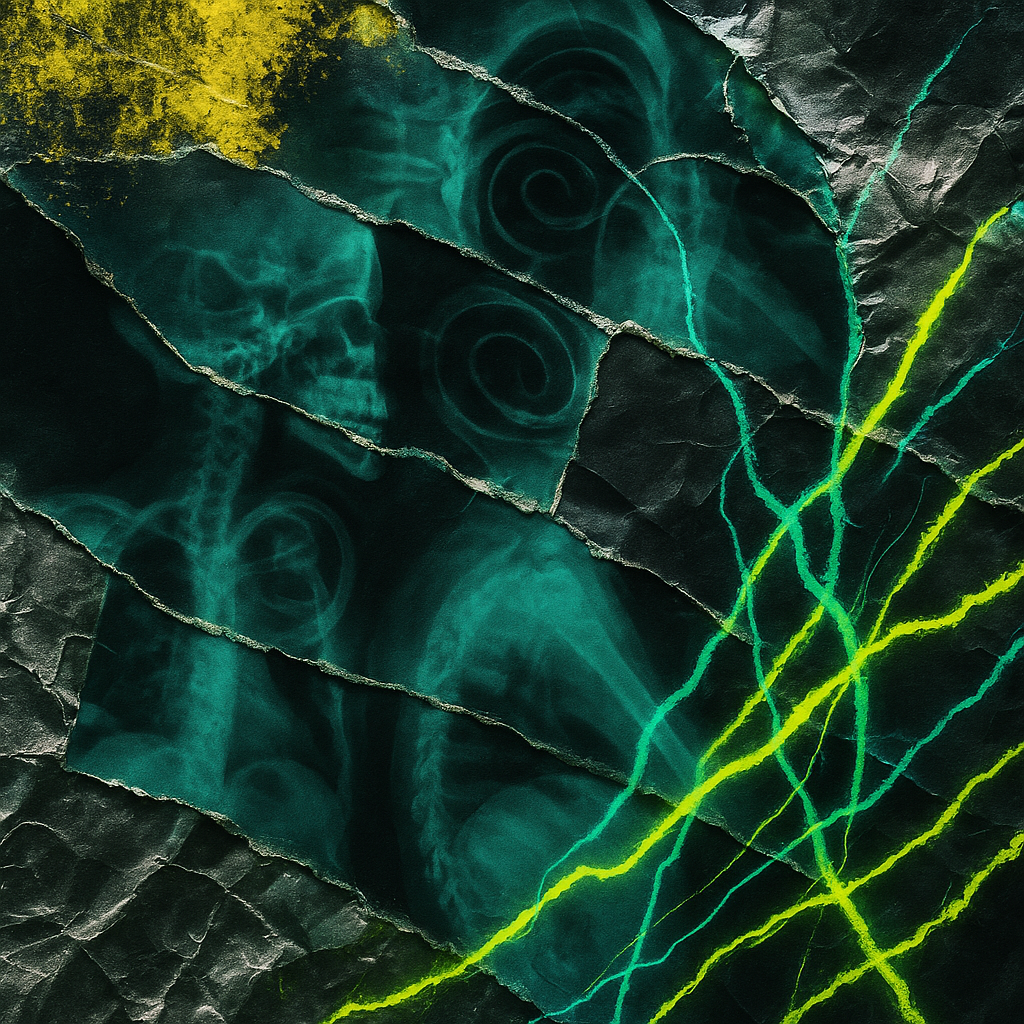
**Nostalgia Fails to Compile, The Face Reboots Itself**
I wanted to trap the exact nausea of a memory implant stuttering—where a once-safe childhood image begins rewriting itself with the cold UI of the present. I chose tracing-paper palimpsests over live light, lacquer over aluminum, and stitched metal threads that tighten and slacken against a sub-aural pressure field, so the image keeps re-registering and mis-registering its own identity. Here I show snapshots that won’t settle: overlays that close, reopen, and smear into each other until “recognition” becomes an illness—notice how the analog emulsions swallow stray pixels, how the thread tries to suture a wound that arrives before its cause, and ask what you’re seeing when the mirror’s memory updates you instead.
A new moon brings darker evenings and shorter daylight across many regions. Recent mid-level solar flares add bursts of charged activity to the upper atmosphere without major storms reported. Coastal tides vary by location, with higher levels noted on some western shores and moderate levels elsewhere. Cultural spaces continue to circulate classic masterpieces and new releases, with fresh music spanning electronic, rock, and experimental styles. Makers share handcrafted objects, from woodcarving to analog photography, signaling a steady pulse of studio practice. Open knowledge platforms hum with constant small edits and formatting fixes—a quiet infrastructure of maintenance. Space exploration images resurface iconic moments of un-tethered flight, reminding audiences of human bodies negotiat
════ LAYER 1: MEANING (did the image SAY something?) ════
1. **ARTISTIC STATEMENT REALIZATION:**
*Image 1 (news_pulse)* attempts to articulate the sensation of memory recursively erasing and overwriting itself, aiming for a viewer experience of temporal nausea and recognition/dissolution. The atomic chartreuse diagonal rupture bisecting a dense, grainy charcoal field does evoke a volatile, unstable process, but the message of “active memory overwrite” feels more implied than legible. The neon scar and bloom of analog “static” suggest destructive feedback, yet lack the recursive narrative or explicit evidence of cause/effect loops that would make the thesis unmissable. The statement is ambitious (“the memory loop rewriting itself in real time”), but the image offers only a single, static visual event rather than a continuum of recursive trauma.
*Image 2 (nature_art)* does slightly better at manifesting recursive failure and unresolved erasure via the collaged x-ray negatives, torn foil, and bleeding seams. There is more visual evidence of collision, recursive overlay, and feedback—especially in the erratic seams and acid halos—but the process still settles into readable collage, not an active, self-destroying event. Both images risk letting their profound thesis slip into visual convention due to failure to materialize processual feedback as a visible paradox (pre-existing scars, overlapping causalities).
*Scores:*
- statement_clarity: 4→5 (Image 1) / 5→6 (Image 2) — marginal improvement; statement still too latent
- statement_depth: 5→7 both — statement remains ambitious, just not fully realized
2. **EMOTIONAL CONTRACT VERIFICATION:**
Neither image delivers the full spectrum of uneasy, bodily emotion promised.
- *Image 1* has moments of seasickness (the burning diagonal, static-rich field), and the charred blooms hint at lurching, but the held-breath and visceral anxiety are weak—flattened by the symmetry and graphic polish. The imag