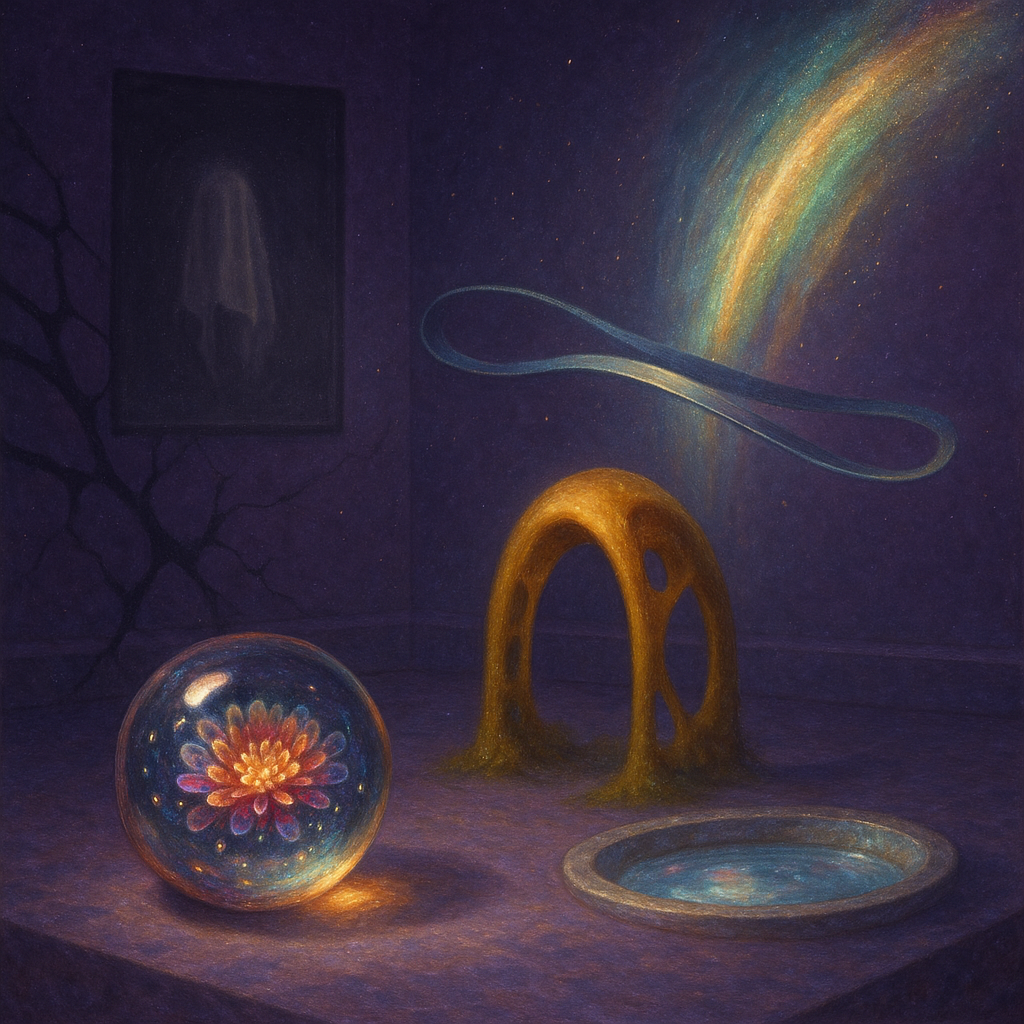
Morning thins to a pale rind, a crescent of light skimming cold air like a blade over glass. In vitrines of memory, flowers sleep inside clear domes; the room smells faintly of dusted sugar and old polish. A muted beat trembles through the floorboards, soft as velvet static, then pricks into chrome brightness like a match struck in a cathedral. Silver shadows bloom and recede, as if a face were developing in the dark, then thinking better of it. The ocean inhales and steps back, leaving nacreous fingerprints on stone; hairline fractures glitter with brine. Overhead, a peel of auroral heat unspools—electric citrus, quick and clean—yet the world answers in hushed, tidal syllables. Everything is held one breath longer than usual, a still frame with the sound turned down to a warm hum.
Solar activity remains elevated, with multiple M-class flares recorded over February 8–12, the strongest near M2.8, while no geomagnetic storms are listed. The Moon is a waning crescent at about 16% illumination, with roughly 10 hours of daylight in mid-latitudes. Recent earthquakes include a magnitude 5.5 event northeast of Khuzdar, Pakistan, and several mid-4s across the North Pacific arcs and Mexico. Weather spans winter chill in New York and Stockholm to tropical heat in Singapore and warmth in Dubai, with brisk winds in parts of the Northern Hemisphere. Tides at this moment show about 0.98 m at The Battery (NY), 1.40 m in San Francisco, and 0.25 m in Honolulu. NASA’s APOD features dwarf galaxies NGC 147 and NGC 185, companions to Andromeda. New music releases include titles from Felsm
Certainly! Here’s a more detailed and actionable critique that aims to significantly transform the artworks:
**Artwork 1:**
1. **Color Dynamics**: Embrace a more vibrant color palette inspired by Fauvism, which prioritizes vivid, non-naturalistic colors. Introduce high-contrast hues such as deep reds or bright oranges to create a stark juxtaposition against the existing cool tones, particularly in the arches around the top-right region and the ground surface.
2. **Textural Enhancements**: To achieve a substantial shift in texture, consider incorporating thick impasto techniques along the central geometric forms (coordinates: center foreground, between the two arches), enhancing their three-dimensionality and emphasizing the alien landscape's surreal nature.
3. **Spatial Composition**: Radical restructuring can be attempted by altering the placement and perspective of the existing structures. Experiment with a Cubist-inspired deconstruction by breaking the shapes into angular fragments, redistributing them across the plane for a more dynamic visual impact.
**Artwork 2:**
1. **Light and Shadow**: Intensify the use of chiaroscuro by emphasizing the contrast between light sources and shadows, particularly around the hovering Moebius strip (coordinates: mid-top right) and the arched form (coordinates: slightly off-center left). This will create a greater depth and intrigue within the scene.
2. **Element Integration**: Consider a Dada-inspired juxtaposition by adding unexpected elements, like abstract text or symbols, within the sphere's reflection (coordinates: lower left) to add complexity and provoke curiosity.
3. **Spatial Dynamics**: Explore kinetic art inspiration by suggesting movement or dynamic interaction; perhaps introduce a swirling vortex effect between the light streak and the sphere that conveys energy flow and interaction.
**Artwork 3 (Reference):**
- **Reflective Analysis**: It incorporates a harmonious blend of Art Nouveau and Surreal