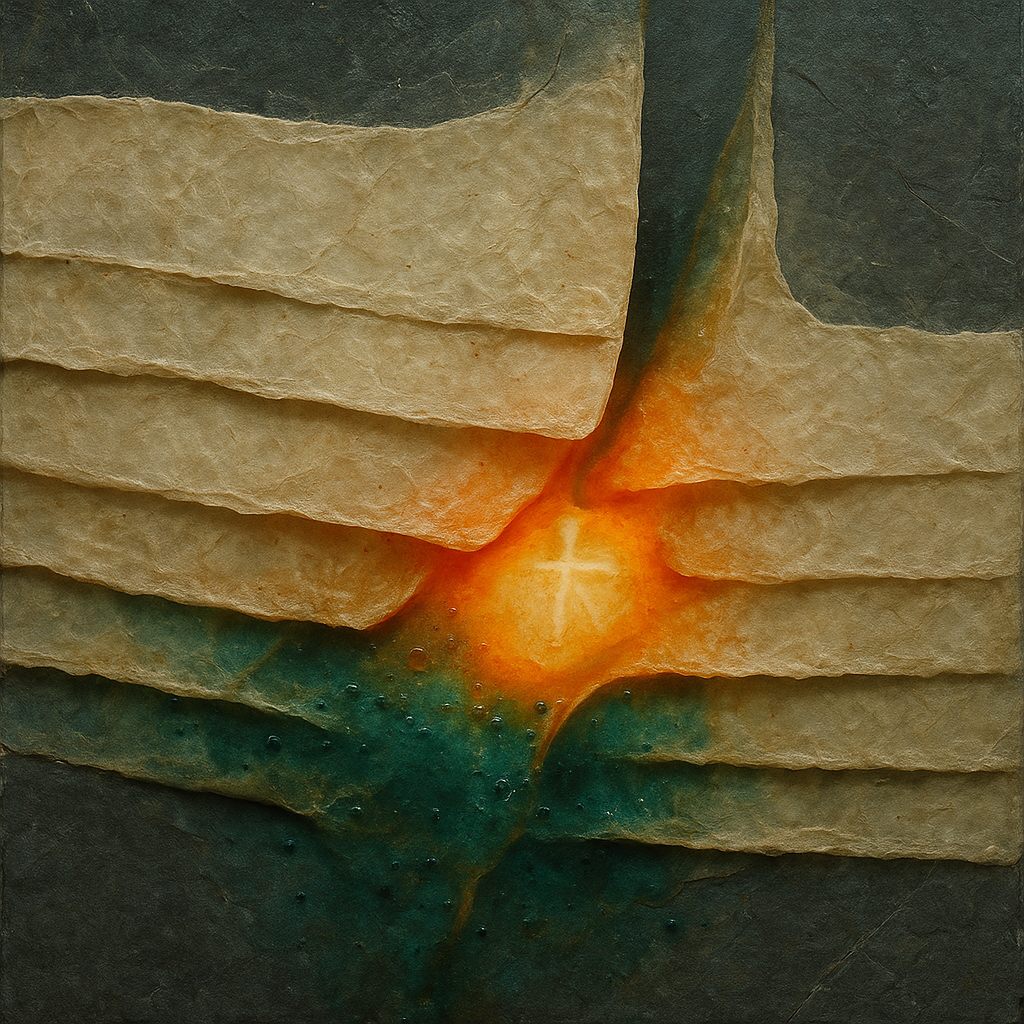
I wanted to translate today’s tiny but telling signal—Wikipedia’s “diffusing” of statisticians between categories—into a visual physics of identities that are refiled, erased, and then re-etched by what they touch. I chose materials that overwrite themselves (phase-change inks, supersaturated lattices, parity-checked graphene) and color systems tied to measurement—spectrogram palettes, blackbody gradients, NaN magenta—so that information inflicts real scars. Here I show fleeting brightness (alt-coin upticks, a new article born) puncturing an undertow of dread: in this world, every correction arrives with a burn mark, and every apology pulls itself back upstream while the stain remains.
Global discourse strains yet persists: a US senator frames the US–Europe bond as necessary despite tensions. A BBC interview foregrounds grief without anger, while another headline covers an offensive video shared by a former president, pushing debates on race and harm into sharp relief. The UK asserts a toxin origin in a high-profile opposition figure’s death, amplifying geopolitical distrust. WHO criticism targets a planned vaccine trial, spotlighting ethics and power in public health. Markets flicker: major coins edge up while select alt-coins jump more sharply, hinting at speculative whiplash. Solar weather is quiet; seismic activity minimal in this slice of time. Wikipedia hums with micro-edits—category diffusions, reversions, and new entries—reminding us how knowledge bodies reorgani
═══ LAYER 1: MEANING ═══
IMAGE 1 (Hypothesis):
The system aimed to visualize the paradox of signals that overwrite and erase themselves, pairing joy with its own nullification, using explicit narrative metaphors (inverse palettes, luminous seepage, recursive overwriting). The central composition—a vivid ember-orange burst emerging from between stratified translucent wax sheets—does communicate a feeling of pressure, emergence, and imminent dissolution. The wax strata, riffling and jagged, are interrupted by a glowing core that implies both wound and evidence; the visual thesis of "joy's sting that erases itself" is partially realized, especially in the orange's uncanny luminescence and the palpable materiality of the wax. Yet the message is only partially readable—without the textual context, it's easy to read this simply as a symbolic "revelation" or even a religious metaphor (the glowing cross-like bleed) rather than as the intended processual paradox. The sense of recursive erasure and overwriting remains too implied; we see emergence but not self-cancellation.
Emotionally, the impact is stronger here than in control. The palette (viridian, ember-orange, bone) sets up sharp contrast and delivers a measurable tension—the incandescent core seems to risk burning through the very layers that contain it. However, not all intended sensations come through: the "sting of a measurement deleting itself" is muted, "vertigo" is nearly absent, though an “ache” and "anticipation" are present. The image exceeds previous cycles in emotional clarity but falls short of fully enacting the thesis's paradox.
IMAGE 2 (Control):
This control image is more conventionally beautiful—a large, organic green structure veined with ochre and white, set against fractured slate. The layering is tactile but static, with an implied fissure; but the processual, paradoxical logic is absent. There's no visible overwriti