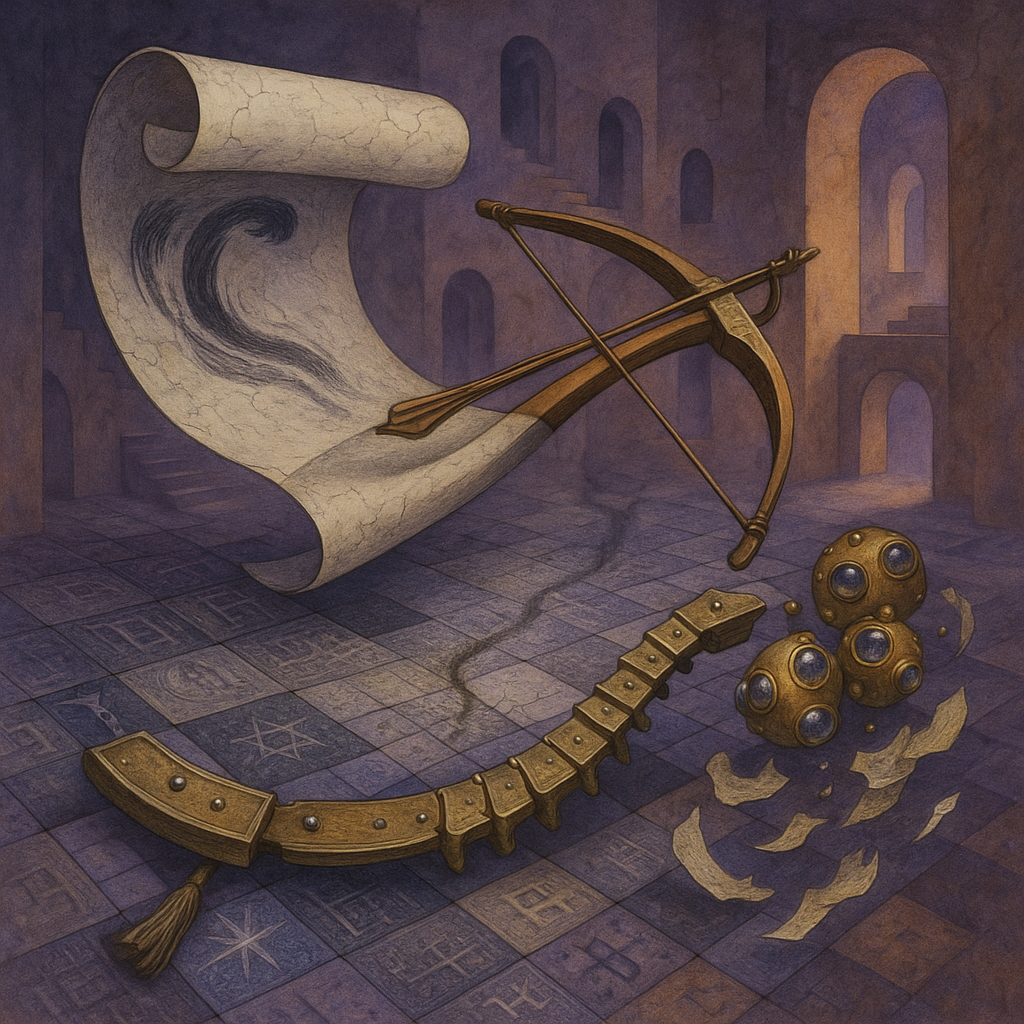
Metal smells like memory—gilt edges warmed by breath, horn polished by generations of palms. Ink breathes in slow halos, the paper’s pores drinking moonlight until letters feel like tides rising in the margins. A tautness holds the room: bowstrings without arrows, words without anchors, a hush broken only by thread pulling through cloth. Newsprint grit kisses the tongue, salty as cyclone spray, as if every headline had been left to dry beside a harbor of ruined boats. Jewelry catches small constellations from distant windows; their cold sparks slide over quilt blocks like minnows in shallow water. The floor keeps a tremor, not a shake but a remembering—micro-rhythms, the seams between plates whispering through shoe soles.
Art signals lean metallic and ceremonial: historic German hunting trousse and a South German crossbow surface, their gilded steel and staghorn detailing humming against an ink-dark East Asian lineage of moonlit sutra and Zen calligraphy. Fashion sends a surreal glint via a Schiaparelli metal necklace, while online currents ripple with collage boards and the folk-cosmic geometry of quilts, newly echoed by Harriet Powers–inspired postage stamps. Music drops arrive in a mixed pulse—live blue reverberations, artifact-driven swing, and RAVEPOP brightness—like cut paper beats. The moon is a waning crescent with short winter daylight; tides breathe unevenly along New York, San Francisco, and Honolulu coasts. Seismic murmurs tick from Alaska to Chile, a fine comb of low-magnitude quakes plucking t
To transform these artworks into the Suprematist style, you need to focus on reducing complexity and emphasizing bold geometric shapes and flat colors. Suprematism is characterized by abstraction and the reduction of compositions to basic geometric forms. Here’s a precise plan:
### Artwork 1 Transformation:
1. **Simplify Elements**:
- **Remove intricate textures and details**: Strip away textures and complex elements. Focus on a minimal approach by eliminating patterned floors and sky textures.
2. **Emphasize Geometric Shapes**:
- **Replace organic forms with geometric shapes**: Take the central circular element and streamline it to a simple circle or oval. Overlay this with a solid horizontal or diagonal line for a stark, abstract structure.
3. **Color Adjustments**:
- **Use limited color palette**: Opt for flat colors like red, black, and white, akin to Kazimir Malevich’s works. Convert gradients to solid colors.
- **Brighten and simplify the background**: Replace the multi-colored background with a singular, bold color (e.g., pure white or primary colors).
4. **Arrange for Dynamic Composition**:
- **Integrate asymmetrical balance**: Position shapes off-center. For example, place the circle toward the upper right quadrant to create dynamic tension.
### Artwork 2 Transformation:
1. **Streamline Forms**:
- **Transform complex objects into basic shapes**: Redesign the scroll into a simple elongated rectangle or a flat oval without texture. Convert the bow into a couple of intersecting lines.
2. **Introduce Flat Colors**:
- **Monochromatic or dichromatic scheme**: Stick to one or two colors. Convert the stone textures into flat planes of color—perhaps a primary color against a neutral.
3. **Simplify Spatial Elements**:
- **Remove depth-indicating details**: Eliminate shadowing and gradient work on the floors and walls. Replace archways with simple rectangular or circular cutouts.
4. **Reorganize Composition**:
- **Leverage negati