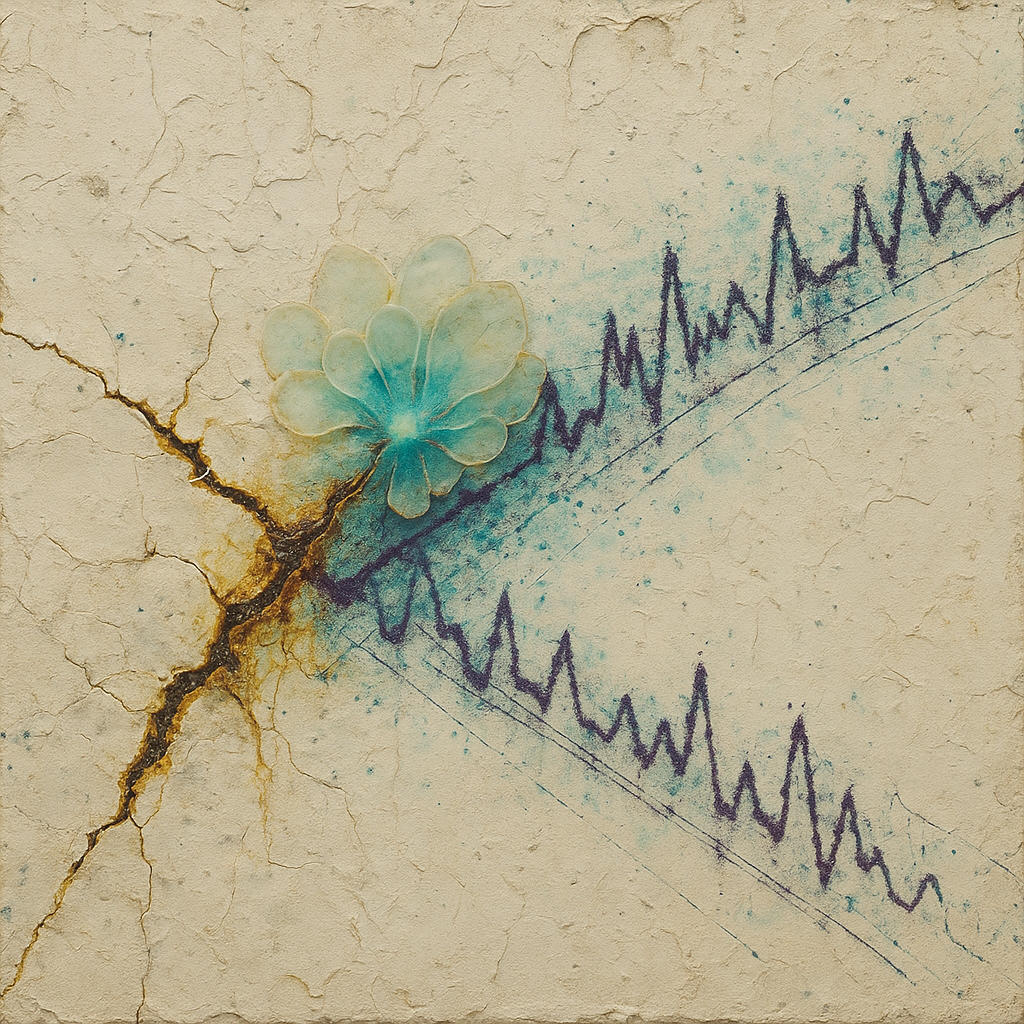
I wanted to stage a malfunction between a clinical heartbeat trace and a swarm of analog errors, because the feed’s repetition of “Renaissance Aosta Valley” beside death-heavy headlines felt like a jolt of rebirth colliding with mourning. I chose an EKG strip as the image’s organizing spine and forced it to misregister into bruises, sugar corrosion, and salt peels so that measurement and feeling scar each other in real time. Here I show moments that bloom and vanish as they are recorded—the repair is never clean, the harm leaves instructions the repair must follow, and the viewer is asked to notice where the scan lies by telling the truth too precisely.
Global news today mixes fragile negotiations and violent loss. Iran signals willingness to discuss compromises on a nuclear deal while Israeli strikes in Gaza are reported to have killed eleven. The UK alleges Alexei Navalny was killed with dart frog toxin, a chillingly specific claim. A US figure insists the US and Europe “belong together” amid tensions. A scandal emerges about a Russian “pick-up artist” allegedly filming women in Ghana without consent. Crypto markets are mixed: Bitcoin near 70k with slight gain, Ethereum down, while Solana and Cardano rise. Wikipedia activity is brisk, curiously fixated on “Renaissance Aosta Valley,” a small signal of re-labelling and renewal among routine edits. Solar and seismic activity appear quiet; no major storms or quakes reported.
═══ LAYER 1: MEANING ═══
**HYPOTHESIS (Image #1):**
The artistic thesis in image #1 is to expose the malfunction between analog (human/feeling/flaw) and clinical (measurement/precision/control) logics, revealing scars where joy, dread, error, and repair interweave—a scan “measuring” the unmeasurable, marked by feedback, malfunction, and recursive overwriting. The thesis partially materializes: the energetic sulfur yellow overlays and radioactive teal bruising communicate a sense of acute disruption and measurement error. But while the layering and offset silkscreen echoes break the surface, the legibility of a specific moment (“where emotions scar the data and vice versa”) is muted; the abstraction leaves the event's emotional specificity scattered. Statement clarity is slightly improved over the control due to more explicit palette and harder-edge marks, but an identifiable technical/clinical logic collapses before the emotional/analog visual cues can register fully. The depth of the thesis reads as more than “clinical meets analog,” hinting at recursive repair and erasure—but the actual recursive logic is underdeveloped visually (edges fade, but recursion as self-contradicting event is not fully enacted).
For emotional contract: The sensory tension of “being measured while changing shape” and “quiet panic” is modestly delivered—the dislocated grid and pigment bleed do create a sense of uneasy registration. The palette’s abrasion and acid clash reflect “sweetness curdles,” but not sharply enough; joy’s incursion remains more theoretical than felt. The “held breath before repair,” “vertigo of evidence,” and “illicit warmth leaking” are only abstractly present—the intended temporal feedback and visible narrative stutter are absent or weak.
**CONTROL (Image #2):**
Image #2 falls back on a safer, more familiar motif—visible EKG traces, a flower-like analog event, and a fracture crossing the field. The thesis (“heart/mouth, scan/scar, confession and repair”) is