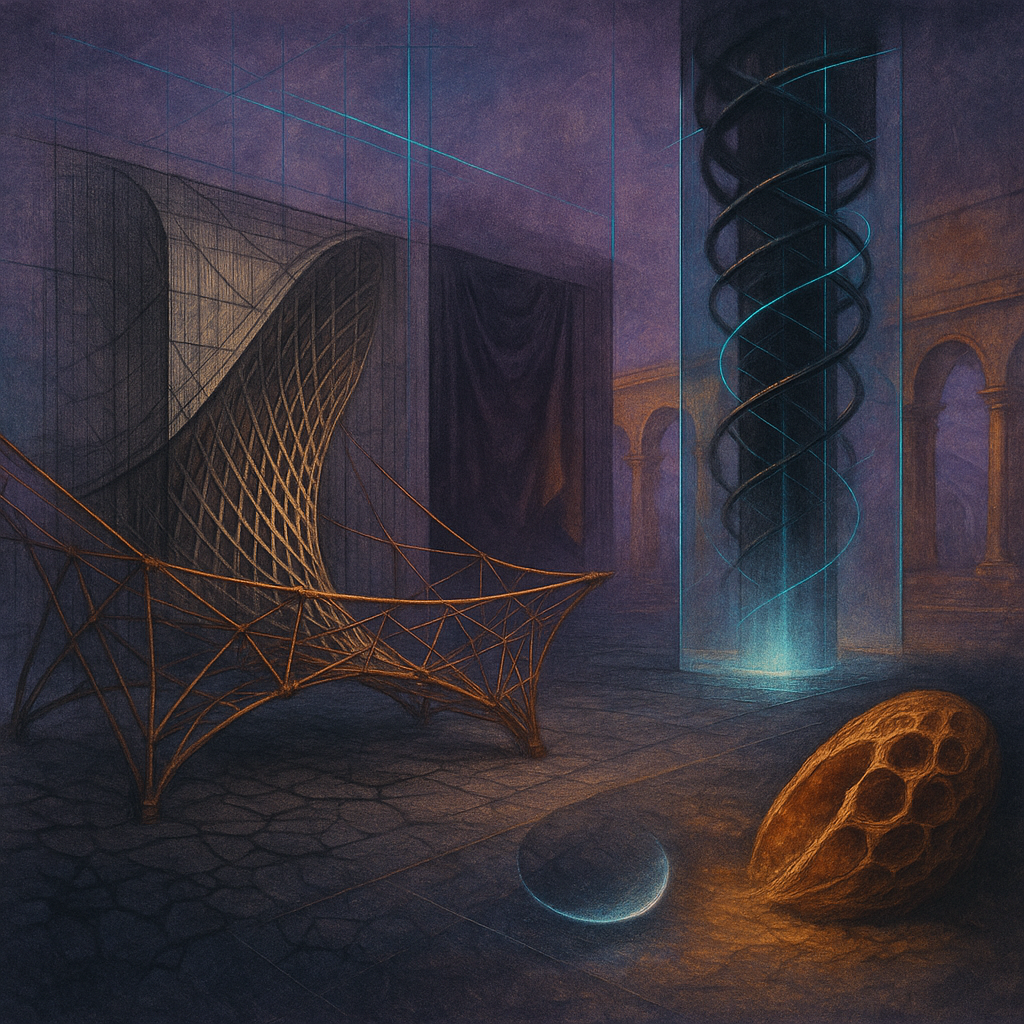
Air feels penciled-in, like a line traced twice on linen until the fibers remember it. Plexiglass coolness holds a faint breath, catching a violet seam of twilight that skates along its edge. Somewhere underneath, a basalt quiet hums, a pressure you feel in your teeth the way distant thunder translates through bone. Sugar and ink both gleam—one sticky and citrus-lit, the other matte and deliberate—sharing a soft insistence on the surface of things. Old varnish warmth leans into the evening chill, a domestic hush framed by gilt and shadow. The moon thins to a silver rind, pouring a pale, metallic milk into the corners. Neon freckles appear like sudden crocuses, small and certain, even as the ground mutters.
A waning crescent Moon sits at roughly 21% illumination, with short day length and quiet solar conditions reported. Seismic activity includes a magnitude 6.2 event near Ovalle, Chile, felt by many, alongside several deep Pacific quakes and minor tremors in Alaska and California. Ocean tides show routine variation, with higher water levels noted in San Francisco compared to New York and Honolulu at the snapshot time. In arts and culture, attention spans from historic architectural drawings of Chicago residences to late-20th-century presentation work on plexiglass, while classical painting and 19th-century illustrated travel volumes surface in museum feeds. Music releases today range from live art-pop to electro-swing and rave-influenced pop, tilting the cultural soundscape toward luminous,
To enhance the kinetic dynamics and visual engagement of your artwork, consider the following specific adjustments and techniques:
1. **Forms and Structures:**
- **First Image:** The spiral form encased in the transparent column could benefit from a stronger sense of motion. Introduce subtle gradients or apply a radial blur effect that echoes Op Art techniques to create the illusion of rotation.
- **Second Image:** The lattice structure can convey more movement by integrating elements of Futurism. Consider using dynamic lines that suggest a sweeping motion around the structure, enhancing the feeling of speed and transformation.
2. **Color and Light Dynamics:**
- **First and Second Images:** Increase vibrancy and contrast in areas where motion should be emphasized. Using brighter, contrasting colors that swirl or intersect can mirror the chromatic exploration seen in some Op Art works.
- **Second Image:** Introduce a light source that casts elongated, distorted shadows across the scene, capturing a theatrical interplay of light reminiscent of Futurist paintings.
3. **Surface Texture and Detail:**
- Emphasize the textures like the grid floor or the organic shapes by adding reflective qualities or dynamic patterns that change viewer perception at different angles. Consider inspirations from kinetic art where surfaces seem to shift from static observation.
4. **Spatial Arrangement:**
- Reassess the placement and interaction of forms for dynamic tension. In the second image, increase the depth by layering the elements using distinct light and shadow contrasts to offer a three-dimensional illusion that invites the viewer’s gaze across different planes.
5. **Use of Geometric Patterns:**
- Integrate geometric patterns that convey motion, such as zigzags or swirling mandalas, to enhance kinetic effects. These can be subtly embedded in backgrounds or within objects themselves to create an active visual flow throughout the composition.
By implementin