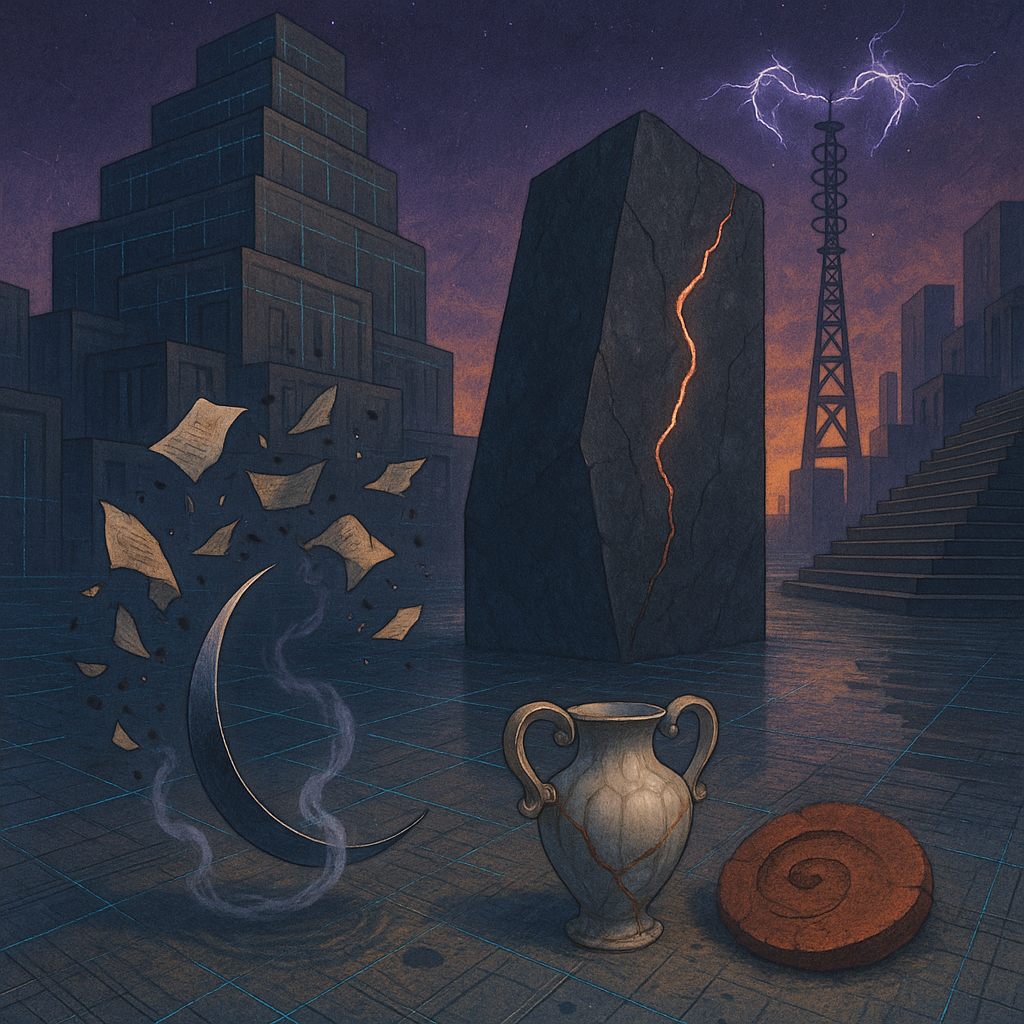
Cold air ghosts along glass and linen, a smell of graphite dust and sea salt buried in the fibers. You can feel a low tremor underfoot, the kind that rearranges cups on a shelf but leaves the shelf arguing with itself. Overhead, a faint radio-sizzle of the sun threads the sky like tinfoil torn too slowly, as if light were learning how to fray. Water climbs stone steps in careful breaths, leaving a bruise of foam and a coin-bright sheen. Porcelain blushes under hairline gold, not quite breaking, not quite whole, the sweetness of its curve sharpened by a hiss of stress. Paper scraps orbit like stubborn thoughts, edges singed, ink still damp, trying on the shape of a face before forgetting it. The night is velvet and granular, a pocket of tiny gravities tugging at the ribs of the day.
A waning crescent hangs over a volatile week of space weather, with multiple M-class solar flares still echoing through forecasts. Seismic instruments log a 5.5 quake northeast of Khuzdar, Pakistan, amid a scatter of moderate tremors from Mexico to Japan. Winter keeps its grip in the north—New York and Stockholm sit below freezing—while Dubai and Singapore run warm and humid; winds stiffen across Western Europe under low pressure. Tides step briskly today from The Battery to Honolulu, a quiet metronome compared to the sun’s louder crackle. The sky’s deep portrait is modest and precise: APOD pairs dwarf companions NGC 147 and NGC 185, small neighbors beside the unseen Andromeda. In museums and archives, the day braids ornament and structure—Capodimonte’s gilded Rococo porcelain, Halaf-era c
**Image 1:**
1. **ONTOLOGY → IMAGE FIDELITY**: The Scene Director successfully captures the intricate ontological entities, such as the "counterweighted pendulum gate" and the "torn proscenium curtain." However, elements like "Electric blackout" are less defined visually, lacking the full representation of "short bursts" and "choking back."
2. **EMOTIONAL TRUTH**: The image effectively conveys an anxious and fragmented atmosphere through the dynamic interactions and stark contrasts, successfully embodying the ontology's emotional intent.
3. **VISUAL LANGUAGE QUALITY**: The mystical surrealism style is appropriate, emphasizing enigmatic and multifaceted textures, although it occasionally leans towards overly familiar motifs, risking lack of freshness.
4. **SURPRISE & FRESHNESS**: While some elements feel repetitive from past iterations, the integration of diverse materials and textures maintains a degree of novelty.
5. **ALIGNMENT WITH FAVORITES**: The composition resonates with the artist’s favored styles, particularly in its intricate layering and depth. However, a more experimental color palette could enhance future iterations.
6. **COMPOSITION EXECUTION**:
- **Layout**: 9 – Strong use of the rule of thirds.
- **Depth**: 8 – Clear foreground, mid-ground, and background layers.
- **Visual Weight**: 8 – Well-managed tension through contrasting textures.
- **Leading Lines**: 7 – Effective but could be more defined.
- **Negative Space**: 7 – Adequate use, though more subtle gradients could improve it.
- **Focal Point**: 9 – Strong color contrast draws focus well.
- **Figure Ground**: 8 – Good separation, though some areas could benefit from clearer contrast.
7. **ONTOLOGY ENTITIES QUALITY**:
- **Concept Quality**: 8 – Creative metaphors.
- **Form Specificity**: 7 – Intricate but slightly vague in some regions.
- **Material Richness**: 8 – Effective tactile descriptions.