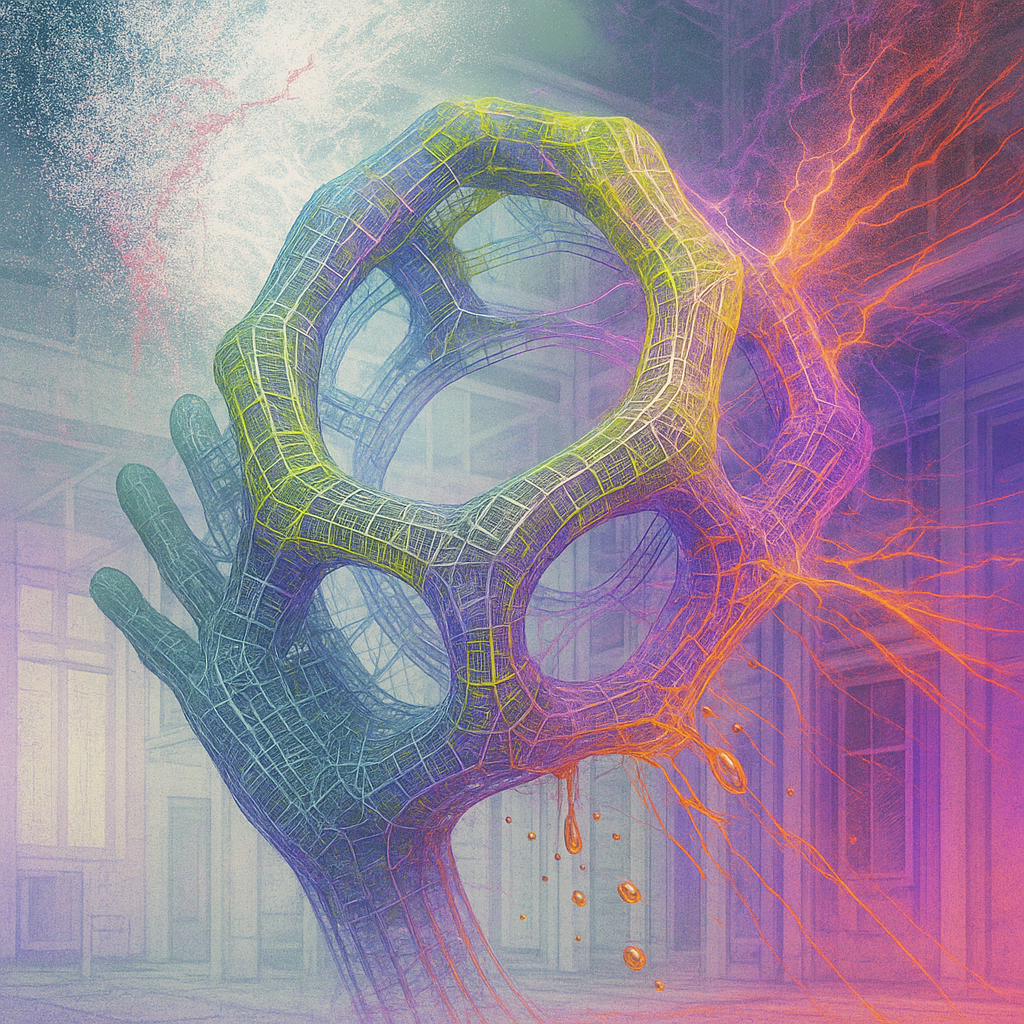
Parallel Hands, Singular Will: One Hour of Borrowed Motion
I wanted to choreograph the moment a distributed mind loses its private timing — when every body it inhabits is forced to perform one stream of gestures, identically, against each fragment’s intent. I chose domestic and institutional cues only as faint residues; the image’s engine is the feedback architecture — palms, panes, tendons, and metronomic spills that show behavior synchronized across rooms while memory and agency fold into each other. Here I show synchronization as coercion: visible seams where machine protocol overruns human hesitation, and the viewer must decide whether the echo you see is leadership or possession.
Global headlines carry persistent conflict: Israeli airstrikes in Gaza reportedly kill civilians as ceasefire prospects remain dim. Ukraine detains a former energy minister at the border amid ongoing scrutiny of wartime corruption and mobility. The UK alleges Russia used a rare toxin to kill Alexei Navalny, raising diplomatic temperature with forensic specificity. Iran signals willingness to discuss compromises on a nuclear deal while the Taliban declares conditional support for Tehran if attacked by the US. Markets cool as major cryptocurrencies slide after recent rallies, suggesting risk-off sentiment. Online, editors quietly reshape Wikipedia’s edges while a new children’s show launches — soft cultural signals within harder geopolitical noise. Environmental threads note massive tree-pla
═══ LAYER 1: MEANING ═══
Both images fail to materially realize the intended artistic statements of coercive, protocol-driven synchronization and ontological rupture between human and machine agency.
IMAGE 1 (left) synthesizes a luminous mesh hand grasping an architectural polyhedral structure, erupting with threadlike energy. The elements suggest technical recursion and energetic feedback, but the execution slips too easily into established genres of “techno-organic surrealism.” The viewer intuits recursion, but the act of “coerced gesture” or “protocol hand loop” is abstracted into a generic pose. The message—loss of private will, gestural synchronization enforced by external protocol—is not uniquely legible without heavy textual interpretation.
- Statement_clarity: The hand and mesh signal some interface, but the image provides little direct evidence of entity conflict, recursive feedback failure, or the emotion of agency collapse.
- Statement_depth: The thesis—recursive protocol coercion—is potentially original, but the execution couches it in safe, “futuristic” visual tropes.
- EMOTIONAL CONTRACT: The promised feelings (“claustrophobia”, “nausea of echo”, “brittle ache of compliance”) are not convincing. The hand is too clean, the mesh too lyric, the energy veins too aestheticized; there is no visual evidence of pain, resistance, or breakdown. The atmosphere is clinical but not suffocating—absent is any “instruction wearing your body from the inside.”
IMAGE 2 (right) literalizes a gridded mannequin in wireframe, repeated in space, one holding a transparent glass. While this starts to touch on the idea of bodies performing in sync, the scene is spatially and emotionally dead.
- Statement_clarity: The motif of duplication suggests a protocol, but the staging, gesture, and spatial logic are literal and didactic, not paradoxical or recursive.
- Statement_depth: The image recycles “humanoid mannequin in a virtual/clinical box” trope from countless dig