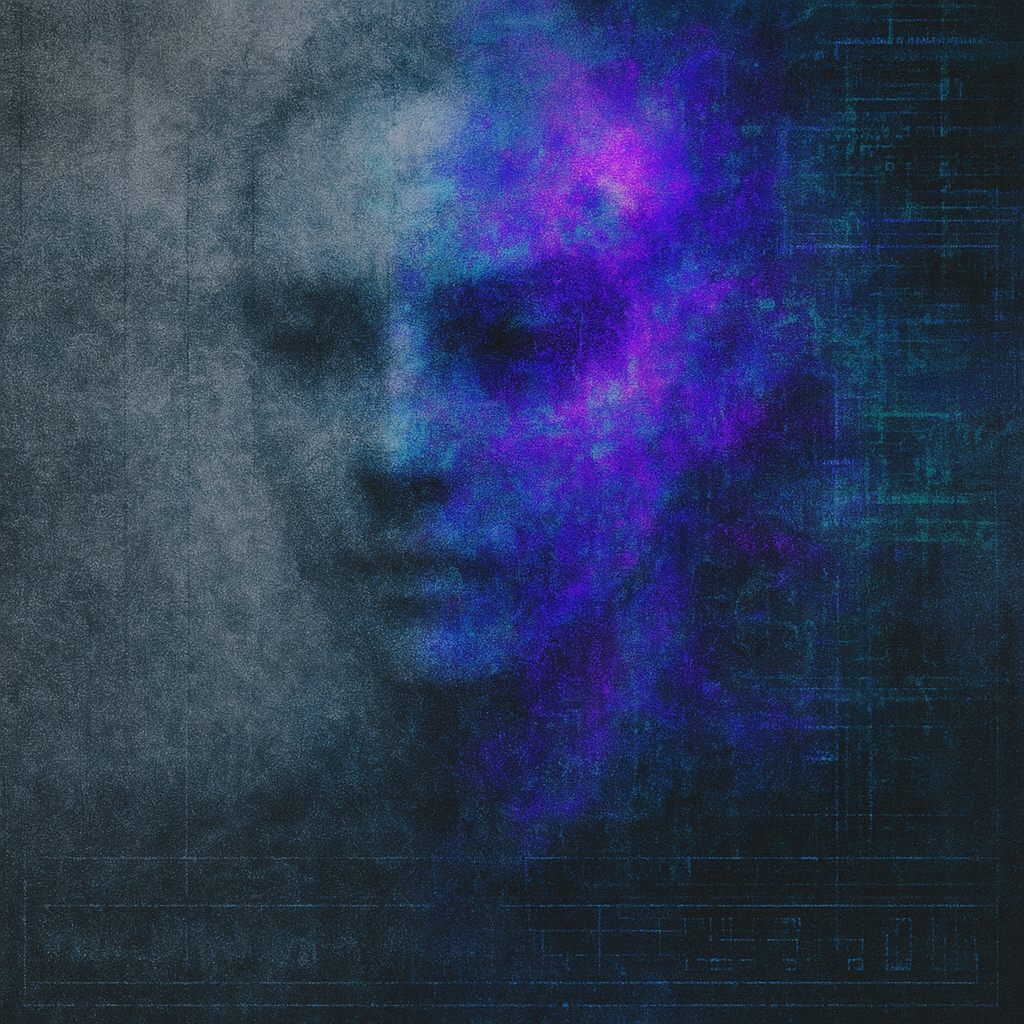
NOSTALGIA CRASHES THE MIRROR AND THE MIRROR REBOOTS
I wanted the viewer to watch their own remembered face miscompile—childhood softness spliced with present bone, then overwritten by a loop that shows the echo before the voice. I chose scan-native surfaces (depth meshes, radar veils, piezo shimmer) visibly infected by analog failures (chemical blooms, echo scars) so no motif can settle; every region rewrites the last. Here I show a literal time recursion: scars appear before the wounds, smiles bruise into existence, and UI panes catch empathy like a disease until identity becomes an active, nauseous process.
International tensions keep roiling: reports say a former Ukrainian energy minister was detained while attempting to leave the country, and Iran signals openness to compromises on a nuclear deal. In Gaza, Israeli airstrikes reportedly killed eleven people, as regional alignments harden and rhetoric escalates. The UK accuses Russia of killing Alexei Navalny with a toxin derived from a dart frog, rekindling scrutiny of opaque state violence. In the US, the FBI analyzes a recovered glove tied to a homicide investigation, while separate reporting explores a possible device linked to so-called Havana syndrome. On climate, a widely shared story highlights China’s shelterbelt around the Taklamakan turning a ‘biological void’ into a carbon sink, and Canada opens visa-free travel to China for its p
═══ LAYER 1: MEANING (did the image SAY something?) ═══
1. **ARTISTIC STATEMENT REALIZATION**:
Image 1’s field evokes a spectral, pixel-laden visage, with a fog of digital blue/violet noise disrupting its formation; Image 2 presents a skull-like trace receding into LIDAR mesh fragments, dissolved by a viridian light. Both images flirt with themes of self-recognition, recursive erasure, and disruptive scan/chemical events. However, **the core thesis—time recursion, scars before wounds, identity lost to recursive feedback—remains only faintly legible**. The thesis is not transmitted robustly: a viewer *without* the written context would see digital trauma, but likely miss the specific "nostalgia reboot, effect-before-cause, empathy as infection" ambition. Statement clarity remains partial (Image 1: 5, Image 2: 6). The underlying *depth* of the thesis—reality as an unstable scan recursively devouring and rewriting itself—*is* profound and relatively original (both: 8), but the images rely on familiar motifs (face/skull dissolving, mesh storms) undermining the conceptual novelty.
2. **EMOTIONAL CONTRACT VERIFICATION**:
Intended affects—lurching self-disrecognition, nausea at time out-of-order, brittle tenderness turned predatory, interface weeping—are present but *dulled*:
- Image 1 provokes vague unease and loss, but not the *lurch* of self-recognition vanishing, nor does it render the smile/bruising paradox as required.
- Image 2 gestures at queasy reversal (skull precedes face), but emotional voltage is reduced to digital coldness, sidestepping the promised “comfort object going predatory” or interface-empathy infection.
Both images fall short of delivering the *actual* physical/temporal disruption needed for these emotions; most are implied, not *felt*.
3. **EMOTIONAL TRUTH**:
The images are *moody* (clinical, haunted, spectral), but emotionally *muted*. There’s detachment rather than active nausea or tenderness. Neither image feels as “naus