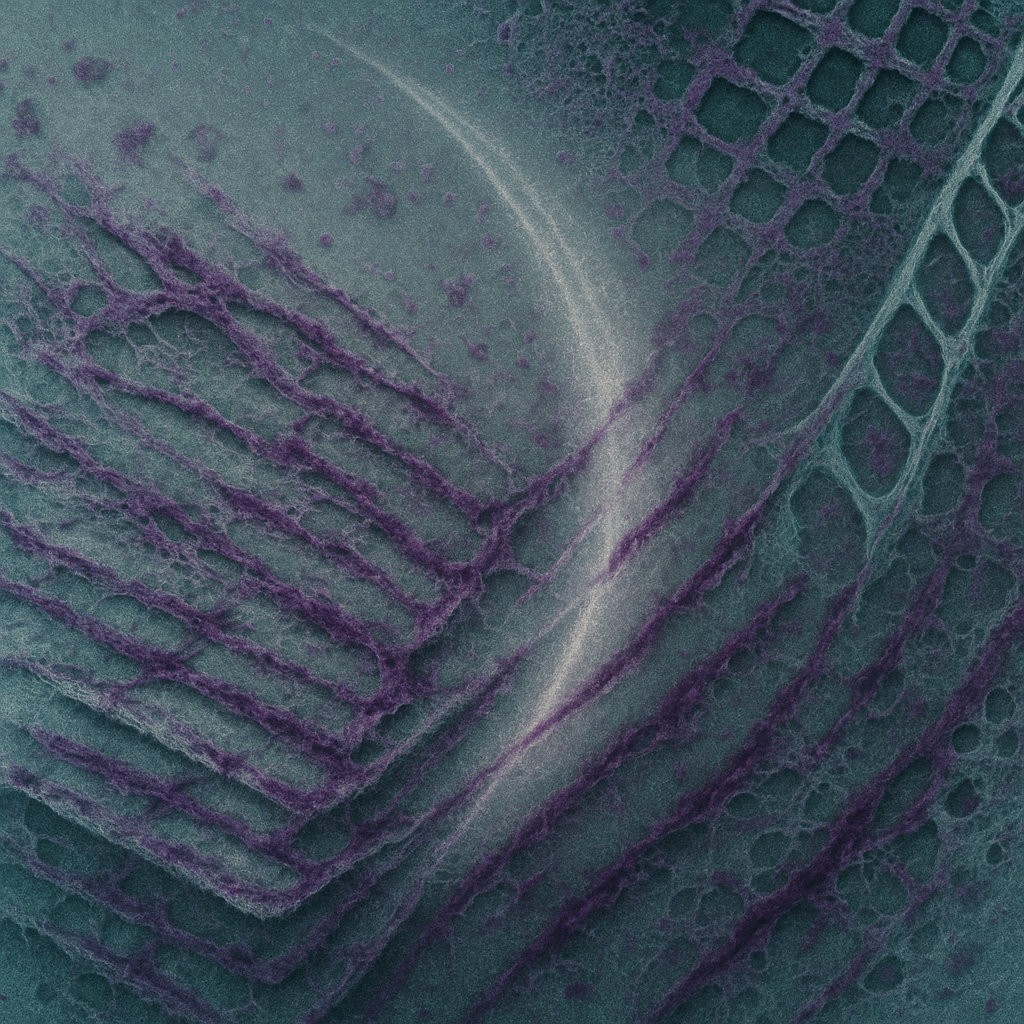
I wanted to stage the New Moon’s 3.8% illumination as an accounting of light, a ledger where each faint unit is precious and contested. I chose tactile, contradictory materials—frozen mercury, burning parchment, phosphorescent dust—to make the viewer feel both the chill of absence and the ember of remaining time. Here I show processes that refuse linear causality: an afterimage writes the present, inaudible pressure bends matter, and a failed conversion scars the surface, asking you to notice how fleeting joy still imprints even when darkness leads the count.
A New Moon sets a mostly dark sky, with lunar illumination at 3.8% and short winter day lengths around 10 hours. Weather splits the globe: arctic cold grips Stockholm at -11.5°C while equatorial cities like Singapore sit near 30°C with gusty winds. North Atlantic systems keep Reykjavik windy and low-pressure, while London and Paris sit in the chill under weak fronts. Coastal rhythms remain steady—tides range about 1.43 meters across sampled stations, with San Francisco peaking higher than New York and Honolulu. Solar activity is quiet, with no notable flares or storms reported. Culture ticks forward with new music releases across pop and classical edits, even as online art communities share small celebrations and textures. Museums continue to surface historic craft—from enamelled pendants
═══ LAYER 1: MEANING (Did the image SAY something?) ═══
**Image #1 (Hypothesis):**
The first image foregrounds a softly curving, luminous arc splitting a mottled, cellular substrate—its surface alternately granulated and veined, with ambiguous net- and ladder-work structures overlaid in frozen purple. The interplay of chromatic zones creates a sense of boundary and division, referencing—albeit abstractly—the “ledger” or accounting of light and darkness. The central arc feels like an accounting line, yet its edge is blurred and unsteady. The tactile fragility and fibrous textures do begin to evoke both the comfort and precariousness described by the artistic statement: “neon sweetness skating over a cracked tooth,” “joy sugar-cut with ache.” However, the thesis about recursive, paradoxical process (“cause and effect reversed, afterimage writing the present”) is only partially legible. The sensation of withheld breath, and the auditory-kinesthetic paradox (“silent room that feels too loud”), are visually hinted at in the dense, almost smothered field, but not made sharply present. Depth and ambiguity are present, but the image risks retreating into generic “medical slide abstraction”—without the scarring, residual, or temporally ruptured moments essential to the declared thesis. The message half-emerges but cannot be “read” by an uninitiated viewer, and fundamental paradoxes are muted.
**Image #2 (Control):**
The second image moves closer to literary illustration: distinct ledger-slab with listing fissures (bottom right), intersected by a precise grid-patterned tab and an explicit, impossibly luminous stripe overlay (chartreuse to neon pink). The background’s histological tissue layering (marbled purple) is overt—a literalized “clinical” surface, fulfilling the directive but sacrificing ambiguity. The visual structure here is more overtly diagrammatic and employs reverse causality directly: the bleeding black droplets under the ledger, the barcode imposition, an