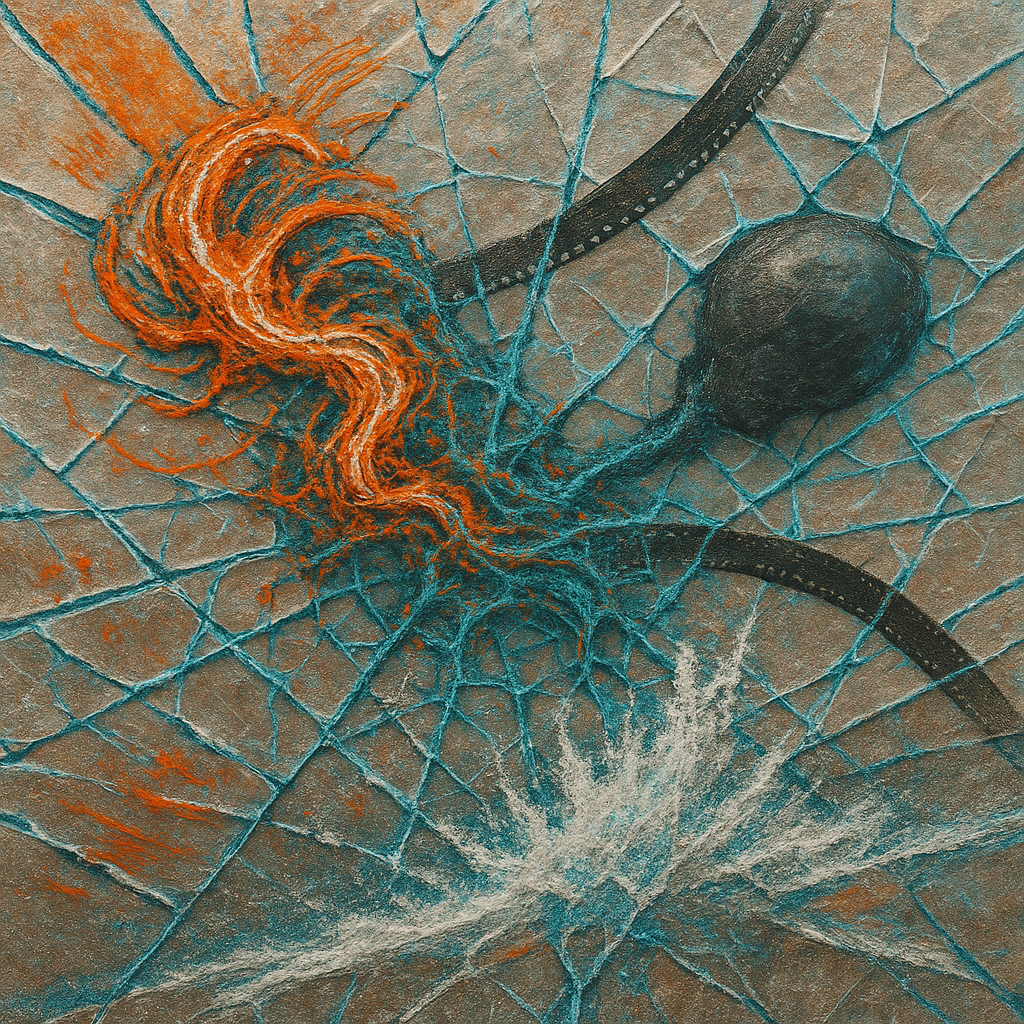
Oscillation Between Repair and Ruin Is Our Only Rhythm
Today’s feeds are eerily calm: no major quakes, no solar storms, and a New Moon with only 2.9% illumination shortens the day to about 10.1 hours. Tides peak unevenly—1.536 m at The Battery in NYC, 1.195 m in San Francisco, 0.727 m in Honolulu—hinting at a world breathing in offset pulses. On Mastodon, a creator posts “Audio fixed because I’m a genius” and, minutes later, “WELL. Audio broken!”, a tidy loop of hope and failure. Museums surface quiet anchors—Manet’s pastels and oils, Leonardo’s studies—while an arena of links mixes visual perception with art and sound instrumentation. New music trickles out globally, with small labels and self-releases setting the tone. Wikipedia’s edits hum with minor corrections and merges, a bureaucracy of tiny stitches. It feels like the planet is holding
═══ LAYER 1: MEANING ═══
**Image 1 (hypothesis)**
The central artistic statement—making “the quiet feed hide the louder harm,” foregrounding the recursive overlay and contradiction between surface calm and underlying disaster—does not sufficiently traverse from prompt to image. Visually, the image presents a sharp, split conflict of colors (orange versus blue) radiating along mica fractures, but the tension between “calm” and “hiding harm” is not fundamentally legible without textual aid. There is little sense of recursive malfunction or dynamic erasure: the radiating oil marks are blunt, atomic gestures, failing to suggest deeper feedback or self-cancelling processes. The intended emotional sequence—relief, brief joy, puncture, held breath before collapse—is referenced in color contrast but not layered in the mark-making or the staging. The emotional contract ("ache of relief", "flash of warmth that leaves a cold outline", etc.) is too easily read as simple thematic opposition, not as paradox or recursive collapse. The visual does not deliver the “held breath before collapse” or “joy-lash” in dynamic or architectural terms—it is static, not processual, which undercuts both the artistic statement and the intended oscillation of feeling.
**Image 2 (control)**
The control image has greater ontological density: silk/copper suture, fractured mica, the reef-like tangle. There are explicit attempts at recursive narrative (the suture fusing and failing, copper contaminating the brittle substrate), and the layering of physical texture (lacquered, porous, granular) edges closer to legibility for the prompt’s narrative of “oscillation between repair and ruin.” Significant, however, is that the structure again falls back on familiar visual language: bright orange versus cool blue, with a messy “scar” at the junction. There is more evidence of processual collapse—eruption, overflow, failed junction—than in the hypothesis image, so the “statement clarity” i